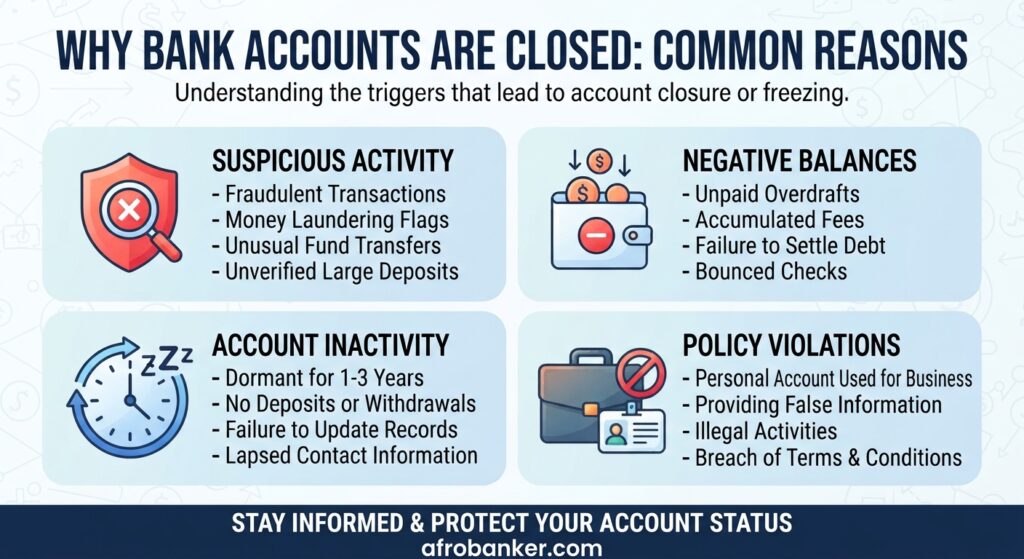
A bank account can be closed for several reasons, including suspicious transactions, failure to update KYC information, involvement in fraud, money laundering concerns, prolonged inactivity, misuse of a personal account for business activities, repeated violations of banking policies, or regulatory directives. Banks may also close accounts that pose compliance, legal, or financial risks.
Banks close accounts to comply with regulations, prevent fraud, reduce financial risk, and enforce their account terms and conditions. Common reasons include suspicious transactions, incomplete KYC documentation, account inactivity, overdraft abuse, and activities linked to fraud investigations.
Why Banks Close Accounts: 15 Common Reasons Your Bank Account Can Be Closed
Having your bank account closed can be frustrating, confusing, and sometimes even embarrassing. Many customers assume that once they open a bank account, it will remain active indefinitely. However, banks reserve the right to close accounts under certain circumstances.
In most cases, account closures are not random. Banks operate under strict regulatory requirements designed to combat fraud, money laundering, identity theft, and financial crimes. When an account presents a risk or violates banking policies, the bank may decide to restrict or permanently close it.
Understanding the reasons banks close accounts can help you avoid problems and maintain a healthy relationship with your financial institution.
Can a Bank Legally Close Your Account?
Yes. Most banks include account closure provisions in their account opening terms and conditions. These provisions typically allow the bank to close an account if the customer violates account rules, engages in suspicious activity, or creates a compliance risk.
In some situations, banks may notify customers before closure. In other situations, especially where fraud or criminal activity is suspected, the account may be immediately restricted or closed.
1. Suspicious or Unusual Transactions
One of the most common reasons banks close accounts is suspicious transaction activity. Banks constantly monitor transactions through automated systems designed to detect unusual patterns. Activities that may trigger concern include:
- Receiving unusually large deposits
- Frequent transfers from multiple unrelated sources
- Rapid movement of funds in and out of the account
- Transactions inconsistent with the customer’s profile
- Sudden international transfers
For example, if an account that normally receives monthly salary payments suddenly begins processing millions of naira from different individuals daily, the bank may investigate the activity. If the explanation provided is unsatisfactory, account closure may follow.
2. Involvement in Fraudulent Activities
Fraud is a major reason banks terminate customer relationships. An account may be closed if it is linked to:
- Online scams
- Identity theft
- Phishing schemes
- Stolen funds
- Chargeback fraud
- Cryptocurrency fraud investigations
Importantly, a customer does not need to be the mastermind behind a fraud scheme. Simply allowing fraudsters to use your account can result in closure. Banks prefer to eliminate any account that could expose them to financial or regulatory risks.
3. Failure to Complete KYC Requirements
Know Your Customer (KYC) regulations require banks to verify the identity of account holders. Your bank may request:
- Valid identification
- Proof of address
- BVN updates
- Tax information
- Source-of-funds verification
If you ignore repeated requests to update your records, your account could eventually be restricted and later closed. Many account closures occur simply because customers fail to provide requested documents on time.
4. Money Laundering Concerns
Banks are legally required to monitor money laundering risks. Certain transaction patterns may raise red flags, including:
- Structuring deposits to avoid reporting requirements
- Receiving funds from high-risk jurisdictions
- Frequent cash deposits without clear business purpose
- Complex transaction chains involving multiple accounts
Even where criminal activity is not proven, the bank may decide that maintaining the account represents too much risk.
5. Prolonged Account Inactivity
Many customers are surprised to learn that inactivity can lead to account closure. When a bank account remains dormant for an extended period, banks may classify it as inactive or dormant according to internal policies and regulations.
Common reasons inactivity leads to closure include:
- Reduced operational costs
- Fraud prevention
- Compliance requirements
- System housekeeping
If you no longer use an account, it may eventually be closed after the required notice period.
6. Providing False Information During Account Opening
Banks expect customers to provide accurate information when opening accounts. Supplying false details regarding:
- Identity
- Address
- Occupation
- Source of income
- Contact information
can result in account closure once discovered. Even minor inconsistencies may trigger further review.
7. Repeated Overdraft Abuse
Customers who consistently misuse overdraft facilities may face account closure.
Examples include:
- Frequent unpaid overdrafts
- Exceeding approved limits
- Failure to settle negative balances
- Continuous account misuse
Banks may determine that the relationship is financially risky and terminate the account.
8. Excessive Returned or Failed Payments
Repeated payment failures can create concerns regarding account management.
Examples include:
- Frequent rejected transfers
- Returned cheques
- Failed direct debits
- Unpaid standing instructions
Although occasional errors are normal, a persistent pattern may prompt the bank to review the account.
9. Using a Personal Account for High-Risk Business Activities
Many people operate businesses through personal accounts. While this may seem harmless, problems arise when transaction volumes become inconsistent with the account type.
For example:
- Hundreds of daily customer payments
- High-volume trading activity
- Unregistered business operations
- Commercial activity requiring a business account
The bank may request you migrate to an appropriate business account or risk closure.
10. Violating Account Terms and Conditions
Every bank account comes with rules. Violations may include:
- Unauthorized use
- Account misuse
- Operating prohibited businesses
- Breaching service agreements
- Sharing account access with unauthorized individuals
Repeated violations can result in account termination.
11. Multiple Compliance Red Flags
Sometimes closure is not triggered by a single event.
Instead, banks look at cumulative risk factors.
For instance, an account may show:
- Frequent cash deposits
- International transfers
- Inconsistent customer information
- Unverified source of wealth
Individually these may not be problematic, but together they can increase regulatory concerns.
12. Receiving Funds Linked to Investigations
Your account can be impacted even if you are not directly involved in wrongdoing. If funds entering your account are connected to:
- Fraud investigations
- Scams
- Financial crimes
- Regulatory probes
the bank may freeze or close the account while protecting itself from legal and compliance exposure.
For example, if an account that normally receives monthly salary payments suddenly begins processing millions of naira from different individuals daily, the bank may investigate the activity. If you want to know what triggers these reviews and how to clear them, read our comprehensive guide on why your bank account is under investigation. If the explanation provided during a review is unsatisfactory, account closure may follow.
13. Abusive Behaviour Toward Bank Staff
Though uncommon, banks can end relationships with customers who repeatedly engage in:
- Threats
- Harassment
- Abusive conduct
- Aggressive behavior
Banks have a responsibility to maintain a safe working environment for employees and customers.
14. Court Orders or Regulatory Directives
Certain closures occur because of external legal requirements maybe from apex bank like the Central Bank of Nigeria. These may involve:
- Court orders
- Regulatory sanctions
- Government directives
- Law enforcement investigations
In such cases, the bank may have little or no discretion regarding the account.
15. The Bank Decides to End the Relationship
In some situations, banks simply decide that a customer relationship no longer aligns with their risk appetite or business strategy. Although not every closure comes with a detailed explanation, banks generally have the contractual right to discontinue a banking relationship provided they comply with applicable regulations.
What to Do If Your Bank Account Is Closed or Frozen: Immediate Recovery Steps
Discovering that your bank account is locked, restricted, or permanently shut down can disrupt your financial life instantly. Whether a banking institution restricts your access due to suspicious activity flags, an extended negative balance, or a regulatory compliance audit, you must act quickly to secure your money.
Here is the exact step-by-step strategy to resolve a frozen account, recover your remaining funds, and protect your financial reputation.
1. Contact the Financial Institution Immediately
Your very first step is to establish direct communication with your bank’s fraud or customer operations department.
- Request Clear Details: Ask the representative specifically whether your access is under a temporary administrative freeze or a permanent account closure.
- Identify the Core Reason: Inquire if the restriction stems from an unverified transaction, an incomplete Know Your Customer (KYC) identity update, an overdraft, or an external legal order.
- Document the Interaction: Record the date, the exact time of your call, the names of the representatives you speak with, and any reference ticket numbers provided.
2. Resolve Pending Compliance or Financial Obligations
If the restriction is tied to a specific policy violation or administrative omission, you can often fix the issue by providing the necessary paperwork or funds.
- Submit Updated Documentation: Provide valid, unexpired government identification, updated proof of residential address, or transaction source documents if the bank flags an unusual deposit.
- Clear Negative Balances: If your profile was flagged for excessive overdrafts, unpaid maintenance fees, or bounced checks, arrange an immediate alternative payment to bring the balance back to zero or positive.
3. Secure and Retrieve Your Remaining Balance
If the banking institution decides to terminate the relationship permanently, they are generally required to return your legally earned funds, provided there is no active law enforcement or court hold.
- Request a Disbursement Check: Ask the branch manager how and when your remaining positive balance will be paid out. This is typically issued via a physical corporate cashier’s check or routed to an alternative external account via wire transfer.
- Confirm Timeline: Ask for an explicit processing timeframe, as some institutions hold funds for 30 to 60 days to ensure all pending debit transactions and checks clear.
4. Redirect Automated Income and Bill Payments
To prevent missing critical financial commitments, immediately disconnect your closed account from your automated digital network.
- Update Employer Direct Deposits: Notify your company’s payroll department immediately to reroute your salary to a different account, a digital wallet, or a prepaid card.
- Pause Automated Debit Agreements: Transfer your recurring monthly bills, subscriptions, utility payments, and loan installments to an alternative payment method to avoid penalty fees.
5. Review and Clean Your Consumer Banking Profile
In many regions, banks report involuntary closures to specialized consumer reporting bureaus (such as ChexSystems or local credit registries). A negative report can make it difficult to open a new account elsewhere for several years.
- Order a Consumer Report: Request a free copy of your banking history report to see exactly what details your previous bank submitted.
- Dispute Inaccuracies: If the bank closed your profile due to identity theft or an internal administrative error, file a formal dispute with the reporting agency to clear your name.
Alternative Strategies: Moving Forward
If your previous bank refuses to reopen your profile, search for financial institutions that offer second-chance checking accounts. These specific products are tailored for individuals recovering from past banking disruptions. Alternatively, establishing an account with a digital-first fintech platform or a local credit union can provide lower fees and more flexible approval criteria as you rebuild your financial standing.
How to Avoid Sudden Account Closures
- Keep Accounts Active: Make at least one small transaction or log in every few months to prevent dormancy flags.
- Separate Personal and Business Funds: Always open a dedicated commercial account if you run a small business or freelance.
- Update Your Information: Respond quickly to bank requests for updated identification documents or proof of address to maintain compliance.
What Happens When Your Bank Account Is Closed?
Depending on the circumstances:
- Remaining funds may be transferred to you.
- The bank may request new payment instructions.
- Outstanding obligations may need to be settled.
- Direct debits and standing orders may stop.
- You may need to open a new account elsewhere.
Where fraud or ongoing investigations are involved, access to funds could be delayed until the matter is resolved.
Can You Reopen a Closed Bank Account?
It depends on the reason for the closure.
Accounts closed due to inactivity may sometimes be reactivated.
However, accounts closed because of fraud concerns, compliance violations, or serious breaches of banking policies are typically not reopened.
You may need to provide additional documentation or open a new account after resolving the underlying issue.
How to Avoid Having Your Bank Account Closed
To reduce the risk of account closure:
- Keep your KYC information updated.
- Avoid suspicious transaction patterns.
- Respond promptly to bank inquiries.
- Use the correct account type for your activities.
- Report unauthorized transactions immediately.
- Maintain accurate account records.
- Follow the bank’s terms and conditions.
These simple practices can help maintain a smooth banking relationship.
Can a Bank Close Your Account Without Warning?
Yes, a bank can close your account without warning in certain situations. While some banks may provide advance notice, immediate closure can occur when there are concerns about fraud, suspicious transactions, security risks, or violations of account terms and conditions. The specific process depends on the bank’s policies and applicable regulations.
Can a Bank Close Your Account for Suspicious Activity?
Yes, banks can close accounts that show suspicious activity. Unusual transactions, large unexplained deposits, frequent transfers from unknown sources, or activity that appears inconsistent with your normal banking behavior may trigger an investigation. If the bank determines that the account presents a compliance or financial crime risk, it may close the account.
Can a Bank Close Your Account Because of KYC Issues?
Yes, failure to meet Know Your Customer (KYC) requirements can result in account closure. Banks are required to maintain accurate customer information and may ask for updated identification, proof of address, or other verification documents. If you fail to provide the requested information, the bank may restrict or close your account.
How Long Does a Bank Account Stay Inactive Before Closure?
The length of time varies by bank and jurisdiction. In many cases, an account may first be classified as inactive or dormant after a prolonged period with no customer-initiated transactions. If the inactivity continues and the account holder does not respond to notifications, the bank may eventually close the account according to its policies and regulatory requirements.
What Happens to Your Money When a Bank Account Is Closed?
Closing an account does not mean you lose your money. In most cases, the bank will return the remaining balance to you through a transfer, bank draft, cheque, or another approved method. However, outstanding fees, overdrafts, or legal restrictions may affect the amount available for withdrawal.
Can You Reopen a Closed Bank Account?
It depends on why the account was closed. Accounts closed due to inactivity may sometimes be reactivated or reopened after verification. However, accounts closed because of fraud concerns, serious policy violations, or compliance issues are usually not eligible for reopening. In such cases, you may need to open a new account.
Frequently Asked Questions
How Do I Know if My Bank Account Is About to Be Closed?
Warning signs may include requests for additional documentation, repeated KYC update reminders, transaction reviews, account restrictions, failed transactions, or direct communication from the bank regarding compliance concerns. Responding promptly to bank inquiries may help prevent account closure.
What Should I Do if My Bank Closes My Account?
If your bank closes your account, contact the bank immediately to understand the reason for the closure and how to access any remaining funds. Update any direct deposits or automatic payments linked to the account, resolve any outstanding issues identified by the bank, and consider opening a new account if necessary.
Why would a bank close my account without warning?
Banks can close accounts without prior notice if they detect suspicious activity, potential fraud, or clear violations of their deposit agreement. Financial institutions use automated monitoring systems to flag risk. To protect themselves from legal liability or financial loss, they reserve the right to terminate an account immediately if a profile exhibits high-risk behavior.
Can a bank close your account for inactivity?
Yes, banks regularly close dormant accounts. If you do not make any deposits, withdrawals, or log into your online portal for an extended period, typically between 1 and 3 years, the bank will categorize the account as inactive. If left untouched, the account is closed, and the remaining funds are turned over to the state or local government’s unclaimed property division.
What happens to my money if the bank permanently closes my account?
If your account is permanently closed, the bank will generally return your remaining positive balance via a physical cashier’s check or a wire transfer to an external account. However, this process applies only if your funds are not frozen by a legal order or law enforcement directive. The bank may hold the funds for 30 to 60 days to ensure all pending checks and automated payments clear completely.
Can I open a new bank account if my old one was forced closed?
It depends on the reason for the closure. If your account was shut down due to an unresolved negative balance or excessive bounced checks, the bank may report you to consumer reporting bureaus like ChexSystems. A negative record can make standard banks reject your applications. In this scenario, you will need to look for second-chance checking accounts or digital fintech platforms that offer flexible approval guidelines.
Is it illegal for a personal bank account to be used for business?
While it is not strictly a criminal offense, using a personal account for business transactions violates the bank’s terms of service. Personal accounts are not built to handle commercial volumes or business tax reporting requirements. If a bank detects business revenue, invoices, or merchant deposits flowing through a personal profile, they will likely give you a warning or close the account for policy violation.
Does an involuntary bank account closure ruin my credit score?
An account closure itself does not directly impact your traditional credit score because checking and savings accounts are not debt products. However, if your account is closed with a negative balance and you fail to pay it off, the bank will send that debt to a collection agency. Once a collection agency gets involved, it will be reported to major credit bureaus, which will severely damage your credit score.
Final Thoughts
Bank account closures rarely occur without a reason. In most cases, they are linked to compliance requirements, fraud prevention measures, risk management concerns, or customer violations of account terms.
If your bank contacts you for information or requests updated documents, respond quickly and transparently. Proactive communication can often prevent restrictions from escalating into permanent account closure.
A sudden bank account closure or freeze can instantly disrupt your daily life, but understanding the core triggers, such as unusual transaction patterns, account inactivity, or compliance omissions, is the best way to prevent it. If your account is restricted, acting immediately by contacting your financial institution, securing your remaining balance, and rerouting automated payments will minimize the impact on your personal finances.
Maintaining a transparent relationship with your bank is essential for long-term stability. Always use your accounts according to their intended purpose, keep your personal identification documents fully updated, and monitor your consumer banking reports regularly. By staying proactive, you can safeguard your digital funds, maintain uninterrupted access to your money, and protect your financial reputation.