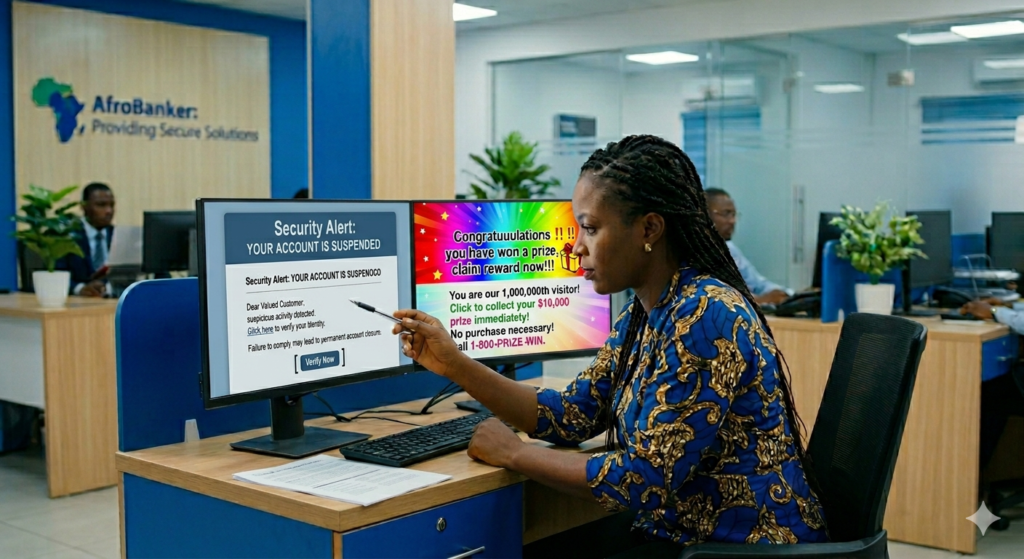
AI voice-cloning bank scams are fraud schemes where criminals use artificial intelligence to replicate a person’s voice and trick victims into revealing banking information or sending money. These scams rely on trust, urgency and social engineering rather than directly hacking bank systems.
AI Voice-Cloning Bank Scams: How Criminals Bypass Bank Security (And How to Stop Them)
Imagine receiving a phone call from your bank’s fraud department. The caller knows your name, account details and recent transactions. They voice sound so professional, confident and urgent. Then they tell you that a suspicious activity has been detected on your account and you have to take action immediately.
You trust the voice because it sounds legitimate like a person calling from the bank. But there is one thing you don’t know, “the person on the phone is not a bank staff.” Most times, the voice does not belong to a real person because it might have been generated by artificial intelligence. A few seconds of your voice on a TikTok video, a LinkedIn video or an outgoing voicemail greeting is now enough for a criminal to call your bank and sound just like you.
This is the frightening and possible reality of AI voice-cloning bank scams, one of the fastest-growing forms of financial fraud worldwide. Criminals are now using advanced AI tools to replicate human voices with shocking accuracy, allowing them to deceive customers, family members and even financial institutions. For banks and their customers, the threat is becoming increasingly difficult to detect. Criminals are using cloned voices in two ways: calling banks to impersonate as account holder and calling customers while posing as senior bank officer.
As someone who has been working in the bank for many years, I have seen many fraud tactics evolve from simple phishing emails to highly sophisticated social engineering attacks. AI voice cloning is taking fraud to a completely new level because it targets the familiar voice with people actually trust. Because we continue with this article, you need to know what phishing emails and social engineering means to banks and its customer by reading our complete guide on Phishing vs Spam Emails: How Bank Customers Can Spot and Avoid Scams.
What Is an AI Voice-Cloning Scam?
An AI voice-cloning scam occurs when fraudsters use artificial intelligence software to copy a person’s voice and use that cloned voice to manipulate victims into revealing their sensitive bank information or transferring money. Modern voice-generation tools can recreate speech patterns, accents, tone, pauses and emotional expressions after analyzing only a small audio sample. In some cases, a scammer may need less than a minute of recorded audio to produce a convincing replica.
The cloned voice may be used to impersonate:
- A bank employee
- A customer
- A company’s executive
- A spouse or relative
- A business partner
- A government official
The reason for this is to gain trust quickly and pressure the victim into making or transferring money to any account they scammer provides.
How Do Criminals Breaks Bank Security with Voice Cloning?
Many banks use multiple layers of security, including passwords, PINs, OTPs, device authentication and fraud monitoring systems. However, fraudsters do not always need to break the bank’s technology direct. instead, they manipulate customers into breaking those controls themselves. For example: A customer receives a call from someone claiming to be a bank official, the caller explains that fraud has been detected and asks the customer to read out an OTP “for verification purposes.” The customer without hesitating, complies because the caller sounds convincing and appears knowledgeable as a bank staff. At that moment, the customer unknowingly authorizes the fraud.
This type of attack is particularly dangerous because the security system itself may not be breached, instead, the victim is tricked into granting access to the scammer. That is why banks repeatedly remind customers never to disclose:
- One-time passwords (OTPs)
- PINs
- Internet banking passwords
- Card CVV numbers
- Mobile banking activation codes
Criminals breaks into banks security using ai-voice cloning using these methods:
1. Impersonating Customers to Bank Call Centers
-
- Voice Data Harvesting: Criminals clones short clips of a targeted customers voice from social media videos, voicemail greetings or public recordings.
- Data Enrichment: They pair the synthetic voice with stolen personal data (Social Security numbers, birth dates, address history) obtained from data breaches.
- Beating Voice Biometrics and IVR: They feed this data into AI tools or interactive voice response (IVR) systems to mimic the customer, attempting to pass “Voice ID” checks, answer security questions, request wire transfers, or alter account settings.
2. Impersonating the Bank or Loved Ones to Customers
-
- Caller ID Spoofing: Scammers spoof a bank’s official number or use a cloned voice of a bank staff or family member.
- Engineered Panic & Urgency: They create artificial crises (e.g., “your account is compromised” or “your family member has an accident”) to pressure victims into acting immediately without thinking because they are panicking.Examples include:
- “Your account is under attack.”
- “Your card has been compromised.”
- “Verify your bank details immediately.”
- “Your son has been arrested and needs money urgently.”
- “A suspicious transfer is being processed right now.”
- Credential Harvesting: They trick victims into sending a One-Time Passwords (OTPs), PINs or online banking credentials or making a direct money movements to crypto/untraceable accounts. The scammer may request:
- OTPs
- Internet banking credentials
- Debit card information
- Account numbers
- Security answers
- Immediate transfers
How Do Criminals Obtain These Voice Samples?
Most people think their voice is private and cannot be cloned or used by anyone anywhere. Unfortunately, that is not true because fraudsters can gather voice recordings from many publicly available sources like:
- Social Media Videos: Videos posted on Facebook, TikTok, Instagram, LinkedIn, YouTube and other platforms often provide enough audio for AI systems to clone a person’s voice.
- Voice Notes: Voice messages shared through WhatsApp, Telegram, Messenger and other apps can become a target if accounts are compromised.
- Recorded Phone Calls: Some scammers deliberately call potential victims and keep them talking for a few moments to collect voice samples.
- Podcasts and Interviews: Public speakers, business owners, content creators and professionals are especially vulnerable because their voices are widely available online.
How to Stop and Prevent AI Voice-Cloning Scams
- Hang Up Call and Call Back: If you receive an urgent call claiming to be from your bank or a relative demanding money, hang up the call immediately. Call your bank customer service hotline immediately and narrate the issue to them. Also, contact that your relative the scammer is claiming to be.
- Never Share Sensitive details over the Phone: Bank staff will never ask you for your OTP, PIN or password over the phone. Do not share any of these with anyone claiming to be a bank staff.
- Establish a Secret Family/Account Code: Create a secret codes with your family members or designate a trusted dual-approval process for high-value business/household transfers.
- Limit Public Audio & Social Media Sharing: Reduce the amount of clear, natural voice samples and personal details (travel plans, job changes, family names) available on your social media platforms.
- Set-up a Multi-Factor Authentication (MFA): Rely on app-based push notifications or hardware security keys rather than SMS-based verification where possible. Therefore, setting up the MFA will really help you.
Ways to Protect Your Bank Account
Customers are becoming more vulnerable to sophisticated scams such as AI voice cloning. While you cannot completely stop fraudsters from accessing recordings of your voice online, you can make it much harder for them to use that information to gain access to your bank account.
1. Disable Voice Authentication and Use a Strong Password Instead
Many banks use voice recognition technology to verify customers during phone calls. While this can be convenient, it may also create a risk if scammers are able to clone your voice. Contact your bank and ask:
- Is voice authentication enabled on my account?
- Can I opt out of voice recognition?
- Can I add a custom security password or PIN for phone banking?
If possible, create a unique password or passphrase that only you know. Avoid using information that can easily be connected to you, such as your pet’s name, hometown, birthday, or favorite sports team. A random phrase known only to you provides an extra layer of protection, even if someone manages to imitate your voice.
2. Restrict Account Changes Made Over the Phone
One common tactic used by fraudsters is to change a customer’s phone number, email address or account details so they can intercept security alerts and verification codes.
Ask your bank to place a security restriction on your profile requiring that:
- Changes to your phone number or email address cannot be completed over the phone.
- Increases to transfer limits require additional verification.
- Sensitive profile updates must be approved through your banking app or at a branch with valid identification.
This extra verification step can prevent criminals from taking control of your account through social engineering.
3. Never Trust Caller ID Alone
Scammers can easily make it appear as though they are calling from your bank’s official phone number. This technique is known as caller ID spoofing.
If you receive a call claiming to be from your bank:
- Do not provide personal information.
- Never share a one-time password (OTP) or verification code.
- Do not approve unexpected requests in your banking app.
- Tell the caller you will contact the bank yourself.
- End the call and contact your bank using the official number printed on the back of your card or listed in your mobile banking app.
Remember: a genuine bank representative will never object to you calling back through official channels.
4. Create a Family Security Code Word
AI voice-cloning scams do not only target bank accounts. Criminals may call family members or business associates pretending to be you and claim they urgently need money. To protect yourself against this:
- Agree on a secret code word or phrase with close family members and trusted colleagues.
- Keep the code private and do not post it online.
- Verify the code whenever someone requests money or sensitive information during an emergency.
If the caller cannot provide the correct code word, treat the request as suspicious, regardless of how convincing the voice sounds.
5. Keep Savings Separate from Everyday Banking
One of the most effective ways to reduce financial loss is to separate your main savings from the account you use for daily transactions.
Consider maintaining:
A Daily Account: Use this account for:
- Debit card purchases
- Mobile banking transfers
- Bill payments
- Everyday spending
A Savings or Reserve Account: Use this account for:
- Emergency funds
- Long-term savings
- Business reserves
Ideally, this account should have limited transfer limits and should not be linked to your debit card. By keeping large balances separate, you reduce the amount of money at risk if your normal account is compromised.
Can Banks Be Fooled by Voice Cloning?
Yes. Some institutions use voice biometrics as part of customer authentication. Voice biometrics can be highly effective, but sophisticated AI cloning technology has raised concerns across the financial industry.
Most banks that use voice recognition now combine it with additional controls such as:
- Device verification
- Behavioral analytics
- Transaction monitoring
- Multifactor authentication
- Risk scoring
- Location analysis
This approach makes fraud significantly harder. However, customers should never assume that voice recognition alone guarantees safety.
What to Do Immediately If You Suspect a Voice Scam
Voice scams can be frightening, especially when you realize that something doesn’t feel right. If you suspect that you’ve spoken to a scammer, shared personal information or authorized a transaction under false pretences, acting immediately can improve the chances of protecting your account and recovering any funds.
1. Secure Your Account Right Immediately
Don’t wait to investigate. Open your banking app immediately and take steps to prevent further activity on your account.
- Lock your debit and credit cards.
- Temporarily disable transfers.
- Freeze your account if the security lock feature is available.
- Review recent transactions to check if there is anything you don’t recognize.
Taking these actions can stop fraudsters from carrying out additional transactions while you report the incident.
2. Contact Your Bank’s Immediately
Call your bank as soon as possible and explain exactly what happened. If your bank has a dedicated fraud hotline, contact that department directly rather than the general customer service line.
When speaking with the bank, clearly state: “I believe I have been targeted by a scam and need my account to be monitored for possible fraudulent activity.” Providing this information early helps the bank treat the case as urgent and begin protective measures on your account.
3. Report Any Suspicious Transfer
If money has already left your account, notify the bank immediately.
Ask whether they can:
- Place a hold on the transaction.
- Attempt to recall the funds.
- Contact the receiving bank.
- Launch a fraudulent investigation.
While recovery is not always guaranteed, the sooner a transfer is reported, the greater chance of stopping or tracing the funds before they are moved elsewhere.
4. Change Your Passwords and Security Settings
If you shared any account details like the login credentials, verification codes or personal details during the call, update your security settings immediately.
Important steps include:
- Change your online banking password.
- Change the password for the email account linked to your bank account.
- Enable two-factor authentication (2FA) if it is not already active.
- Log out of all active sessions where your bank provides that option.
- Update security questions if necessary.
Remember to use a trusted device and secure internet connection when making these changes.
Warning Signs of AI Voice-Cloning Bank Scam
One of the most effective ways to avoid becoming a victim is to recognize the red flags.
Be cautious when:
A Caller Creates Panic
Fraudsters want you to act before you think.
Immediate Action Is Demanded
Scammers often insist that action must be taken within minutes.
Confidential Information Is Requested
Legitimate banks do not ask customers to disclose complete passwords, PINs, or OTP codes over the phone.
Money Must Be Sent Urgently
Urgent transfer requests should always be independently verified.
The Caller Resists Verification
A genuine bank representative should not object if you terminate the call and contact the bank through an official channel.
Why AI Voice Fraud Will Continue to Grow
Artificial intelligence is becoming more advanced, cheaper and easier to access. Tools that previously required technical expertise can now generate realistic voices within minutes. As adoption grows, scammers will continue to refine their methods. Banks are responding with stronger fraud detection systems, but customer awareness remains one of the most effective lines of defense. It is good to understand that at this the age of artificial intelligence, hearing a familiar voice is no longer enough but verification has become more important than trust.
Conclusion
AI voice-cloning scams represent a dangerous new chapter in financial fraud. The technology allows criminals to exploit something that humans naturally trust: the sound of a familiar voice. Whether the voice belongs to a bank employee, a relative or a business colleague, the old rule of “if it sounds genuine, it must be genuine” no longer applies.
Frequently Asked Questions
What is an AI voice-cloning bank scam?
An AI voice-cloning bank scam is a fraud scheme in which criminals use artificial intelligence to replicate a person’s voice and convince victims to reveal banking information, security codes, or send money.
Can scammers really copy someone’s voice?
Yes. Modern AI tools can create highly realistic voice replicas using short audio recordings obtained from social media videos, voice notes, interviews, or phone calls.
Can AI voice cloning defeat bank security?
AI voice cloning may help fraudsters manipulate customers or exploit voice-verification systems, but most banks now use multiple security layers beyond voice recognition alone.
How can I tell if a voice is AI-generated?
It is becoming increasingly difficult. Instead of relying on how a voice sounds, independently verify the caller’s identity using trusted contact information.
What should I do if I receive a suspicious call from someone claiming to be my bank?
End the call immediately and contact your bank using the official phone number listed on its website, mobile app, or debit card.
Are family emergency scams using cloned voices common?
Yes. Criminals increasingly use cloned voices to impersonate children, spouses, or relatives and create fake emergencies that pressure victims into sending money quickly.
Can a bank ask for my OTP over the phone?
No. Legitimate banks generally do not ask customers to reveal OTPs, PINs, passwords, or card security codes over the phone.
The best defense is verification. Never make financial decisions based solely on a phone call, no matter how convincing the voice may sound. In today’s banking environment, trust should always be backed by independent confirmation.