

Cheques remain an important payment instrument for businesses, organizations, schools, government agencies, and individuals who need a secure way to transfer money. While many people are familiar with regular cheques, a manager’s cheque is often viewed as a more trusted and reliable payment method, especially for high-value transactions.
If you have ever wondered why a seller insists on a manager’s cheque instead of a personal cheque, or whether a manager’s cheque is as good as cash, this guide explains everything you need to know.
Key Takeaway
A manager’s cheque offers greater security and credibility than a normal cheque, making it a preferred payment method for businesses and high-value transactions. However, users should understand that it is not completely risk-free. It can still be subject to clearing procedures, verification checks, administrative fees, and, in rare cases, fraud-related issues. Knowing these factors helps businesses use manager’s cheques effectively while minimizing potential risks.
What Is a Manager’s Cheque?
A manager’s cheque is a cheque issued by a bank on behalf of a customer after the customer has provided the funds required for the payment. Unlike a regular cheque, where the money remains in the account of the person writing the cheque until it is presented for payment, the funds for a manager’s cheque are typically set aside by the bank before the cheque is issued.
Because the bank plays a direct role in issuing the cheque, recipients or beneficiaries often consider it a safer payment instrument.
Another Name for a Manager’s Cheque
A manager’s cheque is also known as:
- Banker’s cheque
- Bank cheque
- Certified bank cheque (in some jurisdictions)
- Bank Draft
The exact term may vary from one country to another, but the concept is largely the same: the bank issues the cheque after confirming that funds are available.
What Is a Normal Cheque?
A normal cheque, also called a personal cheque or customer’s cheque, is issued directly by an account holder using a cheque leaf from their cheque book. When the recipient deposits the cheque, the bank verifies whether sufficient funds are available in the drawer’s account before payment is made. If adequate funds are not available, the cheque may be returned unpaid.
What Is the Difference Between a Manager’s Cheque and a Regular Cheque?
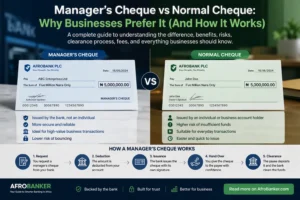
This is one of the most common questions among customers and business owners.
Manager’s Cheque
- Issued by a bank on behalf of a customer.
- Funds are usually confirmed and secured before issuance.
- Generally considered more reliable.
- Frequently used for high-value transactions.
- Offers greater confidence to the recipient.
Regular Cheque
- Written directly by the account holder.
- Payment depends on the availability of funds in the account.
- Carries a higher risk of being returned unpaid.
- Commonly used for everyday payments.
- May not be accepted for major transactions.
The major difference is trust and certainty. A manager’s cheque provides more assurance because the bank has verified the availability of funds before issuing it.
Why Businesses Prefer Manager’s Cheques
Many businesses insist on manager’s cheques when receiving large payments because they reduce payment risk.
1. Greater Payment Assurance
Businesses do not want to deliver goods or services only to discover that a cheque has been dishonoured.
A manager’s cheque offers a higher level of certainty since the bank has already validated the funds.
2. Suitable for Large Transactions
Property purchases, vehicle sales, contract payments, equipment purchases, and school fee payments often involve significant sums.
A manager’s cheque provides a safer alternative than carrying large amounts of cash.
3. Enhanced Credibility
Receiving a manager’s cheque gives the beneficiary confidence that the payer has already arranged the funds.
This is why many organizations request manager’s cheques for tenders, applications, and major payments.
4. Better Security Than Cash
Cash can be lost, stolen, or damaged. A manager’s cheque provides a safer way to move substantial amounts of money.
What Is the Purpose of a Manager’s cheque?
The primary purpose of a manager’s cheque is to provide a secure and trusted method of payment.
It is designed to:
- Reduce the risk of unpaid cheques
- Facilitate large-value transactions
- Increase confidence between buyer and seller
- Provide an alternative to carrying cash
- Support business and corporate payments
For many organizations, a manager’s cheque serves as evidence that payment arrangements have already been made through a bank.
Does a Manager’s Cheque Need Clearing?
Yes, a manager’s cheque generally goes through the cheque clearing process. Although it is issued by a bank, the beneficiary’s bank still needs to process and verify the cheque before funds are made available. The clearing time may vary depending on the banking system and applicable regulations.
In many cases, the clearing process may be faster than that of some regular cheques, but it is still subject to banking procedures.
Can a Manager’s Cheque Be Cashed?
Yes, a manager’s cheque can usually be cashed, subject to the policies of the paying bank and applicable identification requirements. In many instances, beneficiaries prefer depositing the cheque into their bank account rather than cashing it over the counter.
The method available often depends on:
- Bank policies
- Regulatory requirements
- The amount involved
- Customer identification procedures
Is a Manager’s Cheque Good as Cash?
Many people describe a manager’s cheque as “almost as good as cash.” This is because the payment carries a higher degree of reliability than a personal cheque.
However, it is not exactly the same as cash because:
- It may still require clearing.
- Banking procedures must be completed.
- Verification processes may apply.
Nevertheless, businesses often treat it as one of the most secure cheque payment methods available.
Can a Manager’s Cheque Bounce?
A manager’s cheque is far less likely to bounce than a regular cheque because funds are generally secured before issuance.
However, exceptional situations can still arise, such as:
- Fraudulent alterations
- Forgery
- Stop-payment instructions approved under special circumstances
- Procedural issues identified by the bank
While uncommon, a manager’s cheque should never be assumed to be immune from verification requirements.
Can I Deposit a Manager’s Check to Any Bank?
Yes, a manager’s cheque can generally be deposited into a bank account regardless of whether the account is held with the issuing bank. The receiving bank will collect payment through the normal banking channels.
However, the cheque must be:
- Properly endorsed where required
- Valid and unexpired
- Free from material alterations
- Deposited according to bank guidelines
How to Deposit a Manager’s Cheque
Depositing a manager’s cheque is usually straightforward.
Step 1: Verify the Details
Check:
- Beneficiary name
- Amount
- Date
- Signature and bank details
Step 2: Complete a Deposit Slip
Fill out the cheque deposit slip provided by your bank.
Step 3: Submit the Cheque
Present the cheque to the teller or use any approved cheque deposit channel.
Step 4: Wait for Processing
The bank will process the cheque through the clearing system.
Step 5: Confirm Credit
Once processing is completed successfully, the funds will be credited to your account.
How to Use a Manager’s Cheque
Using a manager’s cheque involves several simple steps.
Step 1: Visit Your Bank
Request a manager’s cheque from your bank.
Step 2: Provide the Beneficiary’s Details
Supply the exact name of the individual or organization receiving the payment.
Step 3: Fund the Cheque
The bank will debit your account or receive cash equivalent to the amount.
Step 4: Pay Applicable Charges
Banks typically charge a fee for issuing a manager’s cheque.
Step 5: Collect and Deliver the Cheque
Once issued, deliver the cheque to the beneficiary.
The beneficiary can then deposit or present it for payment according to banking procedures.
Can I Cancel a Manager’s Cheque?
Cancellation may be possible under specific circumstances, but the process is usually more complicated than stopping a regular cheque. If a manager’s cheque is:
- Lost
- Damaged
- Stolen
- Issued with incorrect information
The customer should immediately contact the issuing bank and the bank may requires:
- Written instructions
- Indemnity documentation
- Identity verification
- Additional supporting evidence
Bank policies differ, so cancellation is not always automatic.
What Are the Two Main Types of Cheques?
Although many cheque categories exist, the two most commonly discussed are:
1. Manager’s Cheque
This is issued by a bank after confirming funds from the account holder or customer.
2. Personal or Regular Cheque
This type of cheque is issued directly by an account holder from a cheque book. Other cheque variants may include crossed cheques, bearer cheques, order cheques, certified cheques, and traveller’s cheques depending on the banking system.
Risks of Using a Manager’s Cheque
Although a manager’s cheque is generally considered safer than a regular cheque, it is not entirely risk-free. Understanding these risks can help businesses and individuals make informed decisions.
Delay in Clearing
Many people mistakenly believe that a manager’s cheque provides instant access to funds. In reality, the cheque may still need to pass through the banking clearing process before the beneficiary can use the money. This can create delays, especially when urgent payments are involved.
Possibility of Forgery
Fraudsters sometimes create fake manager’s cheques that appear genuine. Businesses that release goods or services before confirming payment could suffer financial losses if the cheque is later discovered to be fraudulent.
This is why beneficiaries should always verify suspicious or unusually large cheques with the issuing bank.
Loss or Theft
Like any physical financial instrument, a manager’s cheque can be lost, stolen, misplaced, or damaged before it reaches the beneficiary. Recovering or replacing a lost cheque may require additional documentation and time.
Incorrect Beneficiary Details
If the beneficiary’s name is misspelled or incorrect, the cheque may be rejected during processing. Corrections often require returning to the issuing bank for amendments or cancellation and reissuance.
Administrative Charges
Manager’s cheques are not usually issued free of charge. Customers must pay issuance fees, which can increase transaction costs, especially for frequent users.
False Sense of Security
Some recipients treat a manager’s cheque as equivalent to cash and release goods immediately after receiving it. However, prudent businesses still wait for confirmation that the cheque has been successfully processed and credited.
How Long Does a Manager’s Cheque Takes to Clear?
The clearing period for a manager’s cheque varies depending on:
- Banking regulations
- The country involved
- The banks participating in the transaction
- Whether the cheque is deposited locally or in another region
In many banking systems, manager’s cheques may clear within a few business days after deposit. However, factors that can affect processing time include:
Same Bank Deposits
If the cheque is deposited into an account with the issuing bank, processing may be faster because the bank can verify the cheque directly.
Different Bank Deposits
Where the cheque is deposited in another bank, it typically goes through the interbank clearing system, which may take longer.
Public Holidays and Weekends
Cheques deposited shortly before weekends or public holidays may experience additional delays because clearing activities are usually handled on business days.
Verification Requirements
If there are concerns about alterations, signatures, fraud, or errors, the bank may conduct additional checks before releasing funds.
For this reason, businesses should avoid assuming immediate access to funds until the cheque has been fully processed.
What Are the Fees for Issuing a Manager’s Cheque?
Banks typically charge a fee for issuing a manager’s cheque because it involves administrative processing and the bank’s direct participation in the payment arrangement.
The actual fee varies from bank to bank and may depend on:
Bank Pricing Policies
Each bank determines its own charges within applicable regulatory guidelines. As a result, issuance fees can differ across financial institutions.
Transaction Amount
Some banks may apply charges based on the value of the cheque, while others charge a fixed fee regardless of the amount.
Customer Category
Corporate customers, government organizations, and retail customers may have different pricing structures depending on their banking relationship and account package.
Additional Service Charges
Customers may incur extra fees for:
- Cheque reissuance
- Cancellation requests
- Indemnity processing
- Special handling requests
How to Know the Exact Fee
The most reliable way to determine the current cost of a manager’s cheque is to contact your bank directly or review the bank’s latest schedule of charges, as fees may change over time.
Frequently Asked Questions
What is the difference between a manager’s cheque and a regular cheque?
A manager’s cheque is issued by a bank after confirming funds, while a regular cheque is written by an account holder and depends on the availability of funds in that person’s account.
Does manager’s cheque need clearing?
Yes. It normally passes through the banking clearing process before funds become available.
Can a manager’s cheque be cashed?
Yes, subject to the bank’s policies and verification requirements.
What is the purpose of a manager’s cheque?
Its purpose is to provide a secure, trusted, and reliable means of payment, especially for large transactions.
What is another name for a manager’s cheque?
It is often called a banker’s cheque or bank cheque.
What are two types of cheques?
The most common are manager’s cheques and regular personal cheques.
Can I deposit a manager’s cheque to any bank?
Generally yes, provided the receiving bank accepts cheque deposits and the cheque meets all requirements.
Can a manager’s cheque bounce?
It is uncommon, but exceptional situations such as fraud, forgery, or procedural issues may affect payment.
Can I cancel a manager’s cheque?
Cancellation may be possible under specific conditions through the issuing bank.
Is manager’s cheque good as cash?
Many people regard it as nearly as reliable as cash because the funds are typically confirmed before issuance.
How to use a manager’s cheque?
Request it from your bank, provide beneficiary details, fund the payment, collect the cheque, and deliver it to the recipient.
How to deposit a manager’s cheque?
Submit it to your bank with the required deposit documentation and wait for processing.
Conclusion
A manager’s cheque remains one of the most trusted payment instruments in banking. Unlike a regular cheque, it offers greater confidence because the issuing bank has already verified the availability of funds before issuing it. This added security is why businesses, government agencies, schools, contractors, and property sellers often prefer manager’s cheques for important transactions.
While a manager’s cheque may still require clearing and verification, it provides a level of assurance that ordinary cheques often cannot match, making it a preferred choice whenever trust and payment certainty are essential.

Leave a Reply