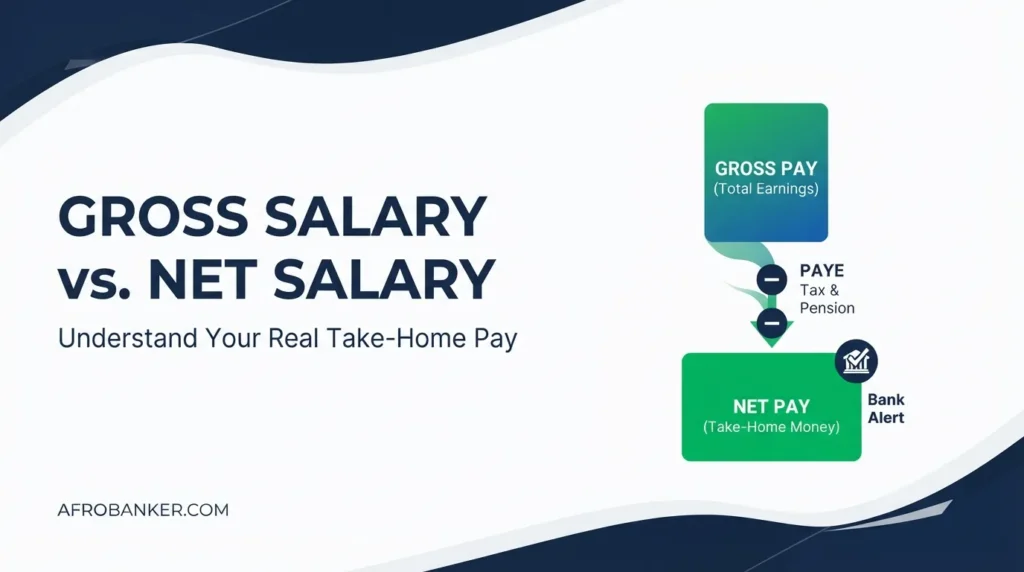
Gross salary is the total amount an employee earns before deductions such as tax, pension, insurance and other statutory charges. Net salary, which is also known as take-home amount deposited into your bank account after taxes and other deductions are subtracted. (Net Salary = Gross Salary − Total Deductions).
How are they Different?
- Gross Salary: Includes your basic pay plus allowances, bonuses, overtime or other agreed earnings before deductions are made.
- Net Salary: This represents what you actually receive on payday after statutory deductions are removed.
When a job offer arrives and employment is secured, most people go straight to their offer letters looking at the salary figure with excitement which is understandable. After months of job searching, interviews and negotiations, seeing a salary of ₦250,000, ₦500,000 or even ₦1 million per month can feel like a great achievement.
However, one mistake employees make is assuming that the figure written in the employment letter is exactly what will be paid into their bank account every month. Having spent years working in the banking sector, I have encountered countless salary earners who were shocked when they received their first salary payment. The amount they expected is different from what they got at payday. In many cases, nothing had gone wrong, just that they did not understand the difference between gross salary and net salary.
This difference may appear very little, but it affects your monthly budget, your ability to save, your eligibility for loans and even your long-term financial planning.
Before accepting any employment offer or negotiating a salary increase, it is important to understand exactly what these terms mean and how they affect your earnings.
What Is Gross Salary?
Gross salary is the total amount of money an employer agrees to pay an employee before any deductions are made. This is the complete salary package applicable to an employee. Gross salary represents what the employer is willing to spend on that employee each month before taxes, pension deductions, health insurance contributions, cooperative deductions, loan repayments and other charges are removed. In simple term, gross salary is that total amount of money that was quoted on your employment letter before any deduction is made.
For example, if your offer letter states that your monthly salary is ₦400,000, that figure is usually your gross salary unless the employer specifically states otherwise. Many people stop at that figure they see at their offer letter and begin making financial plans immediately. Unfortunately, your house, market expenses, school fees and transportation costs will be paid from your net salary rather than your gross salary. That is why understanding the difference is so important.
What Should Be Included in Gross Salary?
Some employees regularly ask; “What should be included in gross salary?” Gross salary is usually made up of several components rather than one single amount. Depending on the organization, it may include:
- Basic salary
- Housing allowance
- Transport allowance
- Utility allowance
- Meal allowance
- Shift allowance
- Hazard allowance
- Leave allowance
- Communication allowance
- Bonuses and incentive payments
- Overtime earnings
- Commission payments
A worker earning ₦500,000 as gross salary might be receiving ₦250,000 as a basic salary or net salary at the end of the month.
Here is a clear breakdown for easy understanding:
| Components of Gross Salary | Amount |
| Basic Salary | ₦250,000 |
| Housing Allowance | ₦100,000 |
| Transport Allowance | ₦50,000 |
| Utility Allowance | ₦30,000 |
| Meal Allowance | ₦20,000 |
| Communication Allowance | ₦50,000 |
| Gross Salary | ₦500,000 |
This is why employees should always ask for a detailed salary structure rather than focusing only on the final figure.
Common Gross Salary Deductions in Nigeria
Under Nigerian payroll rules (including the 2026 changes from the Nigeria Tax Act / NTA 2025), deductions from gross salary typically include:
- PAYE Income Tax: Progressive personal income tax bands, with 0% PAYE tax on annual earnings of ₦800,000 or less and Rent Relief Allowance Under Section 30(2)(a)(vi) of the Nigeria Tax Act 2025 (effective January 2026), Rent Relief is calculated as 20% of actual annual rent paid (capped at ₦500,000), not 20% of gross income. Furthermore, employees must declare/prove their rent paid to qualify, whereas homeowners do not get this relief.
- Pension: At least 8% employee contribution (commonly calculated on basic, housing and transport allowances under the Pension Reform Act).
- National Housing Fund (NHF) & Health: 2.5% NHF contribution (compulsory in the public sector, voluntary in the private sector) and applicable health insurance (NHIS) deductions.
- Other Deductions: Any agreed voluntary deductions, loan repayments, or benefits.
What Is Net Salary?
Net salary is the final amount of money that that your employer or company pays into your bank account after all deductions have been removed. This is called your “take-home pay.” It is the amount available for your rent, feeding, transportation, investments, savings, children’s education and every other financial responsibility you have. When somebody says, “How much do you actually earn every month?” the answer is your net salary rather than your gross salary.
If your gross salary is ₦500,000 but statutory deductions is ₦80,000, then your net salary becomes ₦420,000. The ₦420,000 is what determines your real spending power.
Note: Always confirm and sum up your annual packages, allowances and salary figures into a consistent monthly net figure before comparing and accepting job offers. Ask the Human Resource (HR) for a salary structure and expected deductions before signing the offer letter so that your net salary matches your expectation.
What Is the Difference Between Gross Salary and Net Salary?
This is perhaps the most searched question on the internet today and which requires a clear explanation. The difference between gross salary and net salary is not far-fetched.
Gross salary is what your employer agrees to pay before deductions are made. Net salary is what remains after deductions are made. In a simple formula is, Gross Salary – Deductions = Net Salary.
For example, if your gross salary ₦350,000 and your PAYE tax is ₦20,000, pension is ₦28,000, health insurance ₦2,000. Then the total deductions is ₦50,000. Therefore, your net salary would be ₦300,000. The difference between the two is ₦50,000 which is the total deductions which is statutory or legal.
Gross Salary vs Basic Salary vs CTC (Cost to Company)
Thousands of job seekers search for the “difference between basic salary and gross salary” or “CTC vs gross salary. Basic Salary is your core fixed pay usually called your net pay (used to calculate pension and leave allowances), Gross Salary is Basic + Allowances, and CTC includes the employer’s extra costs (like the employer’s mandatory 10% PenCom pension contribution and NSITF)
How Do I Calculate My Gross Salary?
A lot of company staff knows what enters their account every month but do not know their actual gross salary. If you have access to your payroll, the easiest approach is to add together all salary components before deductions. The calculation is usually Basic Salary + All Allowances + Bonuses = Gross Salary
Suppose your payroll shows:
- Basic Salary: ₦180,000
- Housing Allowance: ₦70,000
- Transport Allowance: ₦30,000
- Meal Allowance: ₦20,000
Then your gross salary is ₦180,000 + ₦70,000 + ₦30,000 + ₦20,000 = ₦300,000
How to Know Gross Salary From Net Salary
This question is particularly common among employees applying for bank loans. Fortunately, this is not difficult. If you have a payment structure, simply look for:
- Gross Earnings
- Total Deductions
- Net Pay
Some employers display all three figures clearly. If you already know your net salary, getting your gross salary requires adding all deductions back to your net pay. For example if your net salary = ₦260,000 and the total deductions = ₦40,000, then your gross salary = ₦300,000.
How Do I Calculate Net Salary?
To calculate your net salary, you have check and identify every deduction first. These may include:
- PAYE tax
- Pension contribution
- National health insurance deductions
- Staff cooperative deductions
- Loan repayments
- Union dues
- Other authorized deductions
The formula is: Gross Salary – Total Deductions = Net Salary.
Whenever customers who are salary earners comes to the bank for salary loans, this is the figure banks pay close attention to because it shows actual repayment capacity of the customer. You may need to read my article on “Loan Recovery and Debt Collection: A Guide on How Banks Recover Unpaid Loans and Manage Loan Defaulters”
How to Calculate PAYE From Gross Salary
PAYE means “Pay As You Earn.” It is an applicable tax to a staff and it is deducted monthly from the staff salary. It is the system through which employers deduct income tax directly from employee salaries and remit it to tax authorities. Most companies or organizations collate these taxes from their employees and pay them directly to the tax authorities with the employees paying individually.
In Nigeria, PAYE calculations follow the provisions of the Personal Income Tax Act Laws and can become quite technical because reliefs and tax laws apply.
A simplified method is:
- Determine annual gross income.
- Apply statutory tax pattern.
- Calculate taxable income.
- Apply the applicable tax rates.
For employees who want exact figures, the most reliable source remains the payroll department or approved PAYE calculators because tax computations can vary based on current regulations
How Do I Calculate My Basic Salary?
Some employees think and mistakenly believe their gross salary and basic salary are the same. This is not true. Your basic salary is simply your core salary before allowances are added. It is also known as your net pay or net salary In many organizations, basic salary may account for 40% to 70% of the total salary package.
For example if your gross salary is ₦500,000, and your housing allowance is ₦100,000, then transport allowance is 50,000 and communication and feeding allowance is ₦100,000. Then your basic salary would be ₦250,000. The structure depends on the employer’s compensation policy.
How to Calculate Daily Basic Salary
Employees often need this calculation for leave payments, resignation settlements, overtime calculations and contract work.
The common formula is: Daily Basic Salary = Monthly Basic Salary ÷ Number of Working Days. If your monthly basic salary is ₦220,000 and your employer uses 22 working days per month, it will now be calculated as ₦220,000 ÷ 22 = ₦10,000 per day. Some organizations use 20, 21, 22, or 26 working days depending on internal policy. and working terms. You should therefore confirm the method your employer uses before calculating.
What Are 5 Factors That Determine the Amount of an Individual’s Salary?
When comparing yourself to your colleagues, you should ask yourself “what are the factors that determines my salary and their own?” With my experience in banking, salary levels are usually influenced by a combination of factors.
Educational Qualifications: Higher qualifications often improve earning potential, especially in specialized fields.
Work Experience: An employee with ten years of experience generally commands higher pay than a fresh graduate.
Industry: Someone working in investment banking, oil and gas or technology firm may earn significantly more than somebody with the same qualifications or certificate in another sector like schools
Location: Workers in Lagos, Abuja, London, New York, or Dubai often receive higher salaries because of living costs and market conditions.
Professional Skills and Certifications: Credentials such as ACCA, ICAN, CFA, PMP, CISSP, and other professional certificates can increase earning potential considerably.
How to Divide Salary for Better Financial Management
Knowing your salary is one thing and managing it wisely is another. One practical approach is the 50-30-20 rule. To understand how the 50-30-20 rule works effectively, read my article on “How To Manage A 100k Monthly Salary in Nigeria.”
This is how it works:
- 50% for necessities
- 30% for everyday expenses
- 20% for savings and investments
Someone whos is earning ₦300,000 net salary could divide income approximately as follows using the 50-30-20 rule:
- Needs: ₦150,000
- Wants: ₦90,000
- Savings/Investments: ₦60,000
The exact percentages can change based on personal circumstances, but every worker should deliberately allocate income rather than spending without a plan.
What Does Not Count as Gross Income?
Certain items and expenses may not be treated as gross employment income depending on local tax regulations and employer’s policies.
Examples include:
- Reimbursed business expenses
- Approved travel reimbursements
- Certain welfare benefits
- Legitimate expense refunds
If your employer gives you money merely to reimburse a business expense you already incurred on behalf of the organization, that amount is generally different from normal salary earnings.
Is It Better to Be Paid Gross or Net?
This is a very difficult question to answer. Most times, I laugh when my colleagues in the bank tells me that they would prefer if all their gross salaries be paid to them as they do not use some of their health insurance allowances monthly. Most workers answer this question emotionally rather than practically. The truth is that non is better as it depends on the individual and lifestyle.
Gross salary is useful because it shows the total value of your compensation package while net salary is useful because it shows the amount you can actually spend. From an employee’s view, net salary often matters more when planning daily life because it reflects real cash flow. However, when negotiating your employment terms, gross salary is usually the starting point because many benefits, pensions, bonuses, and future salary reviews may be tied to it.
My Conclusion
One lesson I have learned from years of dealing with salary earners in the banking industry is that people often pay attention to the huge figure in their gross salary and ignore the most important one which is their net salary.
Before accepting a new job, applying for a mortgage, taking a personal loan or planning your monthly expenses, make sure you understand your salary structure completely. Ask HR for a breakdown and review your payslip carefully. Understand each deduction and know your basic salary, gross salary and net salary.
Once you understand the relationship between those three figures, you will make better financial decisions, negotiate employment offers more confidently and avoid the disappointment that many workers experience when their first salary arrives and it is significantly lower than the amount they saw in their offer letter.
Frequently Asked Questions
Is the salary on an offer letter gross or net in Nigeria?
In Nigeria, the salary stated on an employment offer letter is almost always your gross salary, unless the letter explicitly specifies “Net Pay” or “Take-Home Pay.” Corporate HR departments quote gross figures (often broken down into Basic, Housing, and Transport allowances) because statutory deductions like PAYE tax and pension vary depending on individual reliefs and pension structures. Before signing an offer letter, always request a full remuneration breakdown from HR so you know the exact net amount that will hit your bank account.
Do Nigerian banks use gross or net salary for loans?
Nigerian banks use your net monthly salary and not your gross salary to calculate how much you can borrow. From my experience in banking operations, credit officers look strictly at the actual, verifiable cash inflows hitting your salary account on your 6-month bank statement. To prevent borrowers from defaulting, most Nigerian commercial banks enforce a Debt Service Ratio (DSR) cap of 33.3% (one-third of your net monthly pay). For example, if your gross salary is ₦450,000 but your net pay after deductions is ₦360,000, your total monthly loan repayments across all active loans generally cannot exceed ₦120,000 (33.3% of ₦360,000).
What is the minimum wage tax exemption in Nigeria?
Under Nigeria’s updated tax framework (the Nigeria Tax Act, effective 2026), individuals earning the national minimum wage or an annual chargeable income of ₦800,000 or less (roughly ₦66,667 per month) are 100% exempt from Pay-As-You-Earn (PAYE) personal income tax. If you fall within or below this threshold, your employer should not deduct PAYE income tax from your gross salary, ensuring low-income earners retain their full take-home pay.
How do I negotiate my salary: in gross or net?
You should calculate your target in net salary, but negotiate with HR in gross salary. Decide the exact take-home amount you need each month to cover your rent, bills, and savings, then work backward by adding roughly 15% to 25% to account for PAYE tax, pension, and other deductions. When speaking with recruiters or HR managers, always state your counteroffer as a gross figure standard corporate payroll budgets are approved in gross terms, so negotiating in gross keeps you aligned with HR’s pay bands while guaranteeing you hit your desired net pay.
Is gross salary the same as take-home pay?
No. Gross salary is the amount before deductions, while take-home pay refers to net salary after deductions.
Why is my salary payment lower than my employment letter?
Your employment letter often states gross salary, while your account receives net salary after statutory and voluntary deductions.
Can two employees with the same gross salary have different net salaries?
Yes. Their deductions may differ due to taxes, loans, pensions, cooperative contributions, and other obligations.
Which salary should I use when creating a budget?
Use your net salary because it represents the amount actually available for spending and saving.