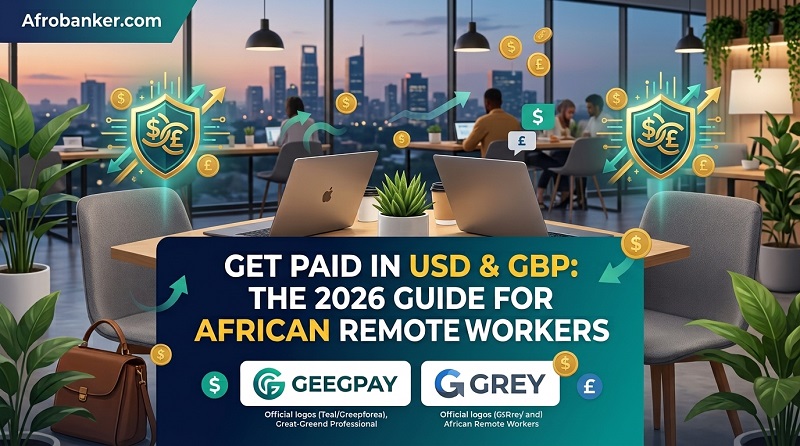
African remote workers use Geegpay (byRaenest) and Grey to receive USD and GBP payments by creating virtual foreign bank accounts that can accept transfers from clients and employers abroad. These platforms provide USD and GBP account details, currency conversion services, and local withdrawals, making it easier to get paid internationally without maintaining traditional foreign bank accounts.
African Remote Workers Use Geegpay and Grey to bypass traditional banking hurdles and receive international payments. Navigating global finance as a digital nomad or freelancer in Africa requires tools that circumvent high wire transfer fees, complex swift codes, and low local currency valuation. Platforms like Geegpay (by Raenest) and Grey (formerly Grey Finance) solve this by issuing virtual foreign bank accounts that allow users to receive USD, GBP, and EUR as if they were local residents of the US, UK, or Europe.
The rise of remote work has opened global opportunities for Africans. Today, a software developer in Lagos can work for a startup in California, a virtual assistant in Accra can support a company in London, and a graphic designer in Nairobi can serve clients across Europe.
One challenge remains constant: how to receive payments from abroad quickly, securely, and affordably.
Traditional banking methods can be slow, expensive, and sometimes difficult to access. That is why many freelancers and remote professionals now rely on platforms such as Geegpay and Grey to receive USD and GBP payments.
In this guide, I will explain how these platforms work based on my years of experience as a bank operation staff member, I will cover who they are suitable for, how payments are received, what fees to expect, and how to choose the best option for your needs.
How Can an African Freelancer Receive Payments from Abroad?
African freelancers receive international payments by using digital fintech wallets like Geegpay and Grey. These platforms create virtual foreign bank accounts (with US routing numbers or UK sort codes) that freelancers can plug into international freelance platforms or hand directly to foreign clients. African freelancers have several options for receiving international payments:
- Foreign domiciliary accounts
- International wire transfers
- Payoneer
- Wise
- Geegpay
- Grey
- Direct employer payment systems
However, many remote workers prefer Geegpay and Grey because they offer a simpler setup process and easier access to virtual foreign bank accounts.
Instead of asking clients to send money through complicated banking channels, freelancers can provide USD or GBP account details generated through these platforms.
What Are Geegpay and Grey?
Geegpay and Grey are fintech platforms built to help users receive, manage, convert, and spend foreign currencies. Both platforms allow eligible users to:
- Receive foreign payments
- Hold multiple currencies
- Convert funds to local currencies
- Withdraw to local bank accounts
- Manage international income digitally
They are especially popular among:
- Freelancers
- Remote employees
- Content creators
- Affiliate marketers
- Consultants
- Software developers
- Virtual assistants
Which Is Better, Geegpay or Grey?
The answer depends on your needs. Both platforms are excellent, but the “better” option depends on your specific use case. Geegpay is highly favored by contractors using platforms like Deel or Upwork due to smooth integrations and strong corporate invoicing tools. Grey is widely praised for its incredibly intuitive user interface, fast personal currency swaps, and highly reliable virtual GBP/EUR accounts.
Geegpay may suit you if:
- You frequently receive international freelance payments.
- You want integrated spending options.
- You value additional financial tools.
Grey may suit you if:
- You primarily need foreign account details.
- You receive multiple international transfers.
- You want a straightforward cross-border payment experience.
The best option depends on fees, supported currencies, user experience, and the countries you transact with.
Head-to-Head Comparison Table Between Geegpay & Grey
Head-to-Head Comparison Table
| Feature | Geegpay (Raenest) | Grey |
| USD Receiving Fee | 0.8% ($1.50 min, $12 max) | 0.8% ($2 min, $10 max) |
| Conversion/Swap Fee | 0% (built into the exchange rate spread) | 1% (capped at $6) |
| Local Withdrawal Fee | ₦12 per transaction | ₦35 per transaction |
| Virtual Card Creation | $3 | $4 – $5 |
| Card Transaction Fee | $0.50 per transaction | $0 (free domestic/standard spend) |
| Best Suited For | Large, infrequent contract payments | Steady automated platforms (e.g., Upwork, Deel) |
Key Cost Takeaways
- The Inbound Edge: While both charge a baseline 0.8% for incoming ACH transfers, Geegpay has a slightly lower minimum cap ($1.50 vs $2.00).
- The Conversion Factor:Grey explicitly adds a 1% currency conversion fee on top of the transfer. Geegpay advertises 0% swap fees, though it integrates its margins directly into the daily exchange rate quote.
Visual Chart Breaking Down Between Grey & Geegpay
Here is the visual chart breaking down the exact estimated fees for both platforms. For this comparison, we look at a $500 USD inbound deposit via ACH being converted into local currency (Naira), which is the standard scenario for most freelancers and remote workers in Africa
Fee Structure Breakdown
While both platforms utilize highly competitive exchange rates, they distribute their pricing across different touchpoints:
| Metric | Grey | Geegpay (Raenest) |
| Inbound ACH Fee | 0.8% ($2 min / $10 max) | 0.8% ($1.50 min / $12 max) |
| Swap/Conversion Fee | 1% (Capped at $6) | 0% (Built directly into the rate) |
| Naira Payout Fee | ₦35 flat | ₦12 flat |
How to Read the Chart
- The Grey Stack: On a $500 transfer, Grey takes a $4 receiving fee (0.8%) plus an out-of-pocket $5 conversion fee (1%). This brings the total explicit transaction cost to $9.
- The Geegpay Stack: Geegpay charges a clean $4 receiving fee (0.8%). Because they charge 0% explicit swap fees, you don’t lose an extra percentage chunk out-of-pocket, though their profit margin is instead subtly factored into the daily exchange rate quote they display before you convert.
Understanding & Using Geegpay
How Does Geegpay Work?
Geegpay allows eligible users to create virtual foreign currency accounts and receive payments from overseas employers or clients. Geegpay acts as a financial bridge. Once you create an account and complete your KYC identity verification, the platform generates virtual international bank accounts in your name. When a client pays into that account, the money appears in your Geegpay digital wallet. You can then exchange it for local currency or hold it. Once your account is approved, you may receive access to foreign account details that can be shared with businesses making international payments.
The typical process is straightforward:
- Create an account.
- Complete identity verification.
- Request foreign account details.
- Share those account details with your employer or client.
- Receive funds.
- Convert and withdraw funds when needed.
Many remote workers use Geegpay because it offers a relatively seamless way to manage earnings from international clients.
Is Geegpay Available in Nigeria?
Yes. Geegpay has become popular among Nigerian freelancers and remote workers who receive payments from international clients. Geegpay is fully operational and widely available in Nigeria for freelancers, remote workers, and corporate entities. Availability and supported services may change over time, so users should always check the platform directly for the latest eligibility requirements and features.
How to Set Up Geegpay in Nigeria
You cannot officially set up a functional, full-featured Google Pay account linked to Nigerian banking systems. Senders abroad can use GPay on their end if they use a remittance service (like Remitly or Wise) that accepts GPay as a funding method to send money straight to your Nigerian bank or fintech wallet.
You cannot officially set up a functional, full-featured Google Pay account linked to Nigerian banking systems. Senders abroad can use GPay on their end if they use a remittance service (like Remitly or Wise) that accepts GPay as a funding method to send money straight to your Nigerian bank or fintech wallet. If your sender is located in Great Britain, they can also check our complete guide on how to send money from the UK to Nigeria using OPay, Moniepoint & Palmpay to transfer funds directly into your wallet.
Setting up Geegpay generally involves:
Create an Account
Register with your personal information.
Complete Identity Verification
You’ll typically be required to verify your identity before gaining access to full services.
Request Foreign Accounts
Once approved, you can access available virtual foreign account details.
Link Your Local Bank Account
Local bank details can be added for withdrawals.
Start Receiving Payments
You can then share your foreign banking details with employers or clients abroad.
Can Geegpay Receive USD?
Yes. One reason many remote workers use Geegpay is the ability to receive USD payments from approved sources. If you work with American clients or companies, receiving payments in USD may simplify your income collection process. Geegpay provides functional virtual US bank accounts complete with routing numbers and account numbers capable of receiving USD via ACH and domestic wire networks.
Does Geegpay Provide a UK Bank Account?
Yes. Geegpay issues virtual UK bank accounts equipped with a Sort Code and Account Number to easily receive British Pounds (GBP) via Faster Payments. Depending on service availability and regulatory requirements, eligible users may receive account details that enable them to receive GBP payments.
These details can be used for international business transactions where supported. Always check the latest information available from Geegpay regarding supported currencies and account types.
Can I Use Geegpay to Receive Money from Abroad?
Yes. Many freelancers use Geegpay specifically to receive international payments from, overseas clients, global marketplaces, foreign employer and international agencies.
This is one of the platform’s primary use cases. But you cannot use Geegpay receive money directly to Nigeria because Google Pay is primarily a digital wallet for making outward purchases rather than an international remittance tool designed to receive foreign remote work salaries directly into Nigeria.
How Long Does It Take to Receive Payments on Geegpay?
Incoming payments typically take 1 to 3 business days depending on the network used (ACH vs. Wire). Once the funds hit your Geegpay dashboard, converting and withdrawing them to your local bank account usually takes anywhere from a few minutes to a couple of hours.
Payment timelines may vary depending on:
- Sender’s bank
- Payment method used
- Compliance checks
- Currency involved
- Banking holidays
Some payments may arrive relatively quickly, while others may take longer depending on processing requirements.
How Much is a Geegpay Dollar to Naira?
Because exchange rates fluctuate continuously based on the parallel and official foreign exchange markets, there is no fixed rate. Geegpay updates its real-time conversion rate constantly inside their mobile app and dashboard, allowing you to review the exact payout before completing a swap.
Understanding & Using Grey
How Does Grey Work?
Grey operates with a similar objective of digital foreign banking service, helping users receive and manage foreign currency payments. By signing up, you get access to foreign bank details. Clients send money to those details, the funds appear in your Grey multi-currency wallet, and you can instantly convert those funds to local currency (like NGN, KES, or GHS) to withdraw to your local bank.
The platform allows users to create foreign account details where available, receive international payments, exchange currencies, and transfer funds to local bank accounts. For many freelancers, Grey serves as a bridge between international income sources and local banking systems.
Can Grey Receive USD and GBP?
Yes. Grey is widely used by African freelancers and remote professionals who receive payments in both USD and GBP. Grey supports multi-currency wallets that easily receive both USD and GBP, alongside Euros (EUR).
This capability makes it suitable for workers serving clients in multiple countries.
Does Grey Provide US and UK Bank Accounts?
Yes. Grey provides users with dedicated virtual US bank accounts (routing and account numbers) and UK bank accounts (sort codes and account numbers). Grey is known for offering foreign account details that can help users receive payments from abroad. Available account types may vary based on location, compliance requirements, and platform updates. Always verify the latest account options directly from Grey.
Can I Use Grey to Receive Money in Nigeria?
Yes. Many Nigerian freelancers use Grey to receive foreign payments and transfer converted funds into local Nigerian bank accounts. This makes it easier to access earnings without waiting for traditional international banking processes.
Is Grey App Legit in Nigeria?
Yes, the Grey app is completely legitimate. It is used by tens of thousands of Nigerian remote workers and freelancers daily to manage global payouts legally. Grey has built a reputation among many African freelancers and remote workers.
As with any financial service provider, users should conduct their own due diligence, read current reviews, review regulatory disclosures, and understand applicable fees before making financial decisions.
Is Grey Safe to Use?
Yes, Grey is safe to use. The platform works alongside licensed global financial infrastructure partners and utilizes strict security protocols, including two-factor authentication (2FA) and biometric logins, to secure user funds.
Security is a major concern for anyone receiving international payments. Grey implements identity verification, account security measures, and transaction monitoring procedures designed to protect users and comply with financial regulations.
Users should also enhance security by:
- Using strong passwords
- Enabling account security features
- Avoiding phishing links
- Protecting login credentials
How Long Do Grey Transfers Take?
Incoming international transfers into Grey usually clear within 1 to 2 business days. Internal currency swaps are instantaneous, and local withdrawals to Nigerian bank accounts typically process within minutes. Receiving money from Grey depends on:
- Payment origin
- Banking systems involved
- Currency type
- Compliance reviews
Transfer times can vary from one transaction to another.
How long does it take Grey to receive money?
Once the sender initiates the transaction, it takes 24 to 48 hours for standard domestic US/UK clearing networks to deposit the funds into your Grey wallet.
How Long Does It Take for Grey to Verify ID?
ID verification on Grey is heavily automated and usually takes anywhere from a few minutes to 48 hours, provided your uploaded government ID documents are clear and your legal name matches your registration details perfectly. Verification timelines differ based on:
- Submitted documents
- Verification workload
- Image quality
- Regulatory reviews
To avoid delays:
- Upload clear documents
- Use accurate personal information
- Ensure names match official records
How Much Does Grey Charge for Receiving Money?
Grey broadly charges a standard 1% fee on incoming deposits across major foreign currencies, though specific promotional rates or caps may apply depending on the transaction channel.
Is Grey still working in Nigeria?
Yes, Grey is actively working and fully functional in Nigeria for receiving, exchanging, and withdrawing global currencies. Financial technology services can update features, supported corridors, and compliance processes over time.
The best approach is to verify current availability directly through Grey’s official channels before opening or funding an account.
Can I Borrow Money From Grey?
No. Grey is built strictly as a multi-currency payment, receiving, and conversion platform. It does not offer loan or credit features at this time.
Grey is generally known as an international banking and payment platform rather than a lending service. Users should check the latest product offerings directly within the platform for current features.
Can I Transfer Naira to My Grey Account?
Yes. You can fund your Grey Naira wallet by using the unique local Nigerian bank account details assigned to you within the app to perform a standard bank transfer from your regular banking app. Available funding methods can evolve over time. Users should confirm the latest supported deposit and transfer methods directly from Grey before initiating transactions.
Navigating Other Payment Methods in Nigeria
Can I use Gpay (Google Pay) in Nigeria?
No, you cannot natively use Google Pay (GPay) for local point-of-sale transactions or standard banking in Nigeria. Many people searching online use “GPay” when they actually mean Geegpay. If you’re referring to Geegpay, Nigerian users can create accounts and access available services subject to the platform’s verification and compliance requirements.
Always verify account eligibility directly through the provider before depending on it for business income. Google Pay does not support Nigerian bank cards for local payments. You cannot officially set up a functional, full-featured Google Pay account linked to Nigerian banking systems.
Senders abroad can use GPay on their end if they use a remittance service (like Remitly or Wise) that accepts GPay as a funding method to send money straight to your Nigerian bank or fintech wallet. If your sender is transferring funds from Great Britain, check our step-by-step guide on how to send money from the UK to Nigeria using PalmPay, OPay, and Moniepoint to ensure your local wallet receives the deposit smoothly.
How Much Does Grey Charge for Receiving Money?
Grey broadly charges a standard 1% fee on incoming deposits across major foreign currencies, though specific promotional rates or caps may apply depending on the transaction channel.
- Geegpay: Generally charges around 1% to receive payments via ACH/Wire (varies by source) and handles conversions using competitive market-driven rates.
- Grey: Typically charges a 1% receiving fee for USD/GBP/EUR deposits (capped depending on the transfer type) and charges a nominal flat fee for local currency withdrawals.
Many freelancers ask: What fees do Geegpay and Grey charge? Fees may vary depending on:
- Currency
- Transfer method
- Conversion service
- Withdrawal destination
Because pricing models can change, always review the latest fee schedule within the respective applications before making transactions.
Can I receive money with Gpay in Nigeria? / Can I use Gpay to receive money from abroad?
No. Google Pay is primarily a digital wallet for making outward purchases rather than an international remittance tool designed to receive foreign remote work salaries directly into Nigeria.
Is GCash available in Nigeria?
No. GCash is a mobile wallet service exclusive to the Philippines and cannot be registered or used for local financial transactions in Nigeria.
How to Receive GBP in Nigeria
To receive GBP, the most straightforward approach is to copy the UK Sort Code and Account Number from your Geegpay or Grey app and provide it to the person paying you. The funds land in your digital wallet, where you can convert them to Naira. Receiving GBP payments typically involves:
- Getting GBP account details from an approved provider.
- Sending the account details to your employer or client.
- Receiving the payment.
- Converting GBP when necessary.
- Withdrawing funds locally.
Both Geegpay and Grey are commonly used by freelancers seeking this capability.
How Can I Receive USD Payments in Nigeria?
You can receive USD payments by using Geegpay, Grey, a traditional bank Domiciliary Account (via SWIFT wire), or digital remittance apps like cross-border payment platforms. The process is similar:
- Obtain USD account details.
- Share them with the sender.
- Receive the transfer.
- Convert funds if needed.
- Withdraw to your bank account.
This model has become increasingly popular among remote workers and independent contractors.
Can I Withdraw Geegpay or Grey Funds Directly to My Nigerian Bank Account?
In many cases, yes. Users generally have the option of converting foreign currency balances and transferring funds to supported local bank accounts.
Both platforms allow you to instantly swap your USD or GBP balances into Nigerian Naira (NGN) inside the app and withdraw the Naira directly to any commercial Nigerian bank account or mobile money wallet. This functionality is one reason these platforms are popular among African remote workers.
Do I Need a Domiciliary Account to Receive Foreign Payments?
Not necessarily. One advantage of platforms like Geegpay and Grey is that they may reduce the need for a traditional domiciliary account for certain payment scenarios. So, you do not need a traditional domiciliary bank account. While you can use one, digital wallets like Geegpay and Grey eliminate this requirement by providing virtual international accounts and allowing you to convert those foreign funds straight into your local African bank account.
However, some users still maintain domiciliary accounts for broader international banking needs.
Can I Receive Salary from a US Company in Nigeria?
Yes. You can receive a salary from a US company by providing them with the ACH or domestic wire routing details generated by your Geegpay or Grey virtual US bank account. The company pays into that account locally, and it reflects in your digital wallet.
Many Nigerians work remotely for international companies and receive salaries through:
- Geegpay
- Grey
- Payoneer
- Wise
- International bank transfers
The preferred method often depends on the employer’s payment system and the employee’s banking preferences.
What Is the Cheapest Way to Receive USD in Africa?
Using multi-currency fintech platforms like Geegpay or Grey is currently the cheapest method. Traditional bank wire transfers (SWIFT) often deduct $20 to $50 per transaction, whereas these platforms generally charge a small flat receiving fee or a low percentage cap, passing the majority of the funds to the worker.
The smartest approach is comparing:
- Exchange rates
- Receiving fees
- Withdrawal costs
- Hidden charges before deciding on a provider.
Earning and Career Opportunities from Nigeria
What are some remote jobs for Nigerians that pay in dollars?
Nigerians successfully earn USD by working remotely in fields like:
- Software Engineering & Web Development
- Technical Writing & Copywriting
- Customer Support & Virtual Assistance
- UI/UX Product Design
- Digital Marketing & SEO Strategy
- Data Analysis
What remote jobs can I find in Canada from Nigeria?
Many Canadian firms hire international independent contractors for roles such as:
- Customer Service Representatives,
- Virtual Assistants,
- Remote Bookkeepers,
- Social Media Managers
- Software Developers.
You can apply via international job boards like LinkedIn, Indeed Canada, and FlexJobs.
How to make 3000 naira daily in Nigeria?
Making ₦3,000 daily can be achieved locally or digitally through tasks like:
- Offering freelance micro-tasks on local gigs sites.
- Writing blog posts or editing content for small businesses.
- Managing social media interactions for local brands.
- Engaging in micro-retail or POS agent banking services.
How to Earn USD From Nigeria
You can earn USD by offering digital services on freelance marketplaces like Upwork, Fiverr, and Contra, applying for global remote jobs via Remote.co or We Work Remotely, or selling digital products (like e-books or templates) on global platforms. Receiving USD starts with securing income opportunities.
Popular dollar-paying opportunities include:
- Software development
- Graphic design
- Virtual assistance
- Content writing
- UI/UX design
- Digital marketing
- Video editing
- Customer support
- Data analysis
- Cybersecurity services
Many Nigerians build long-term careers serving international clients remotely.
What Remote Jobs Can Nigerians Find in Canada and Other Countries?
Common remote opportunities include:
- Customer support roles
- Administrative assistance
- Project coordination
- IT support
- Software engineering
- Marketing
- Sales development
- Accounting support
- Recruitment
- Content creation
Many of these positions pay in USD, GBP, or CAD.
What About GCash in Nigeria?
GCash is primarily associated with another market and is not generally considered a mainstream payment solution for Nigerian freelancers receiving international client payments.
For most Nigerian remote workers, platforms such as Geegpay, Grey, traditional domiciliary accounts, and other international payment services are more commonly used options.
Can You Make ₦3,000 Daily in Nigeria Through Remote Work?
Yes. Many beginners start with freelance services such as:
- Content writing
- Data entry
- Virtual assistance
- Social media management
With consistency and skill development, earnings can exceed this amount over time.
My Conclusion
The global remote work economy has created unprecedented opportunities for Africans to earn in foreign currencies. Platforms such as Geegpay and Grey help bridge the payment gap by providing easier ways to receive USD and GBP payments from clients and employers abroad.
Whether you’re a freelancer, virtual assistant, developer, designer, or full-time remote employee, understanding how these platforms work can help you receive international income more efficiently, convert funds when needed, and access your earnings locally.
As features, fees, and regulations evolve, always review the latest information directly from your chosen provider before relying on any payment platform for critical business transactions.