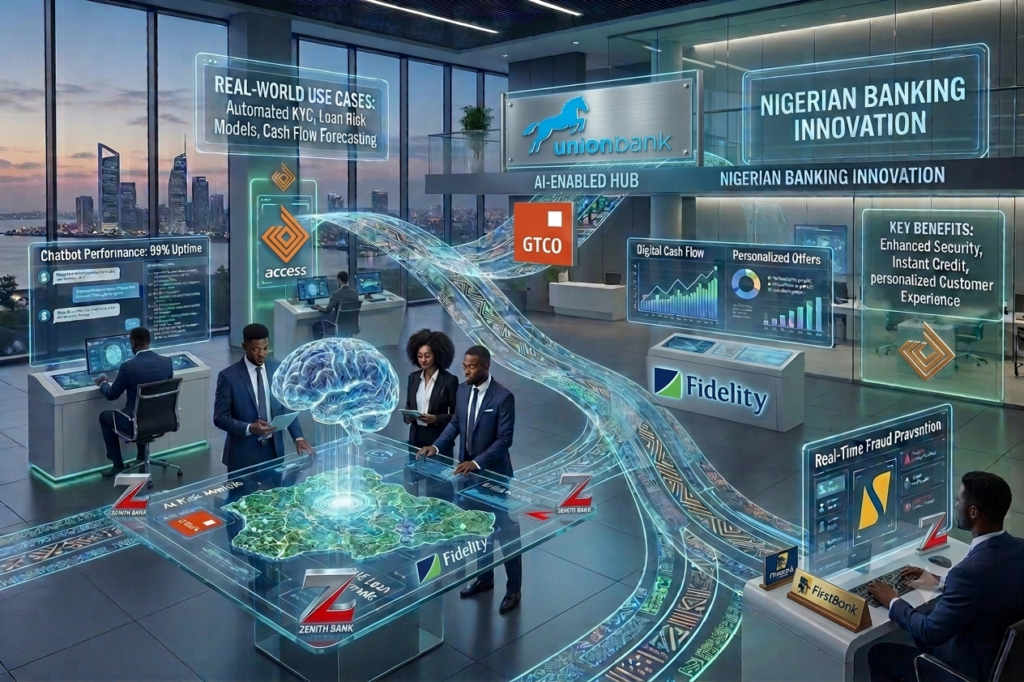
Artificial intelligence is reshaping the Nigerian banking sector by driving real-time digital services, automated risk management, and operational efficiency.
Artificial Intelligence (AI) is rapidly transforming the Nigerian banking sector, changing how banks operate and how customers experience financial services. From smarter fraud detection to faster customer service, AI is helping Nigerian banks deliver more efficient and secure banking solutions. The deployment of AI in Nigerian banking has evolved from speculative piloting to core infrastructure. Spurred by competitive fintech pressures, macroeconomic headwinds, and Central Bank mandates, over 54% of Nigerian financial institutions now run operational AI systems
The deep implementation of AI in Nigerian banking is fundamentally changing risk management, asset quality, and financial inclusion across the country.
As someone working within the banking system, it is clear that this shift is not theoretical, it is already happening in real time. Artificial Intelligence (AI) is no longer a futuristic concept, it is already transforming industries worldwide, and the Nigerian banking sector is no exception. From faster transactions to advanced fraud detection, AI is redefining how banks operate and how customers interact with financial services.
In this article, you will discover how AI is being used in Nigerian banks, real-life applications, key benefits, and what it means for customers today.
What is AI in Banking?
Artificial Intelligence in banking refers to the use of smart computer systems that can analyze data, learn patterns, and make decisions with little or no human involvement.
These systems include the use of chatbots for customer service, machine learning algorithms/systems for fraud detection, automation tools or automated transaction processors for processing transactions and data analytics systems for decision-making
Simply put, AI helps banks operate faster, smarter, and more efficiently.
The rapid rise of AI in Nigerian banking has turned what used to be a futuristic trend into everyday reality. Walk into any banking hall in Lagos or Abuja today, and you will notice fewer queues. That is not because people stopped using banks it is because smart algorithms are quietly handling millions of transactions behind the screen.
For the average Nigerian, this shift means you no longer need to spend a Friday afternoon in a crowded lobby just to resolve a blocked account or apply for a small business loan. Here is a down-to-earth look at how this technology is actually changing things for everyday people.
How AI in Nigerian Banking Keeps Your Money Safe
If you use instant bank transfers in Nigeria, you know how incredibly fast they are. But that speed is a double-edged sword; fraudsters move fast too. Traditional bank security used to rely on stiff rules, like blocking a transaction simply because it was large.
Today, systems powered by AI in Nigerian banking work like a highly alert, digital security guard. Instead of just looking at the amount, the software studies your unique habits. It knows what time you usually spend money, where you typically log in from, and how fast you type. If your account suddenly tries to send a massive payment to an unfamiliar vendor at 3:00 AM from a different device, the system flags it instantly. This behind-the-scenes math stops fraud before the money leaves your account.
How AI is Used in the Nigerian Banking Sector
AI adoption in Nigeria is growing rapidly, especially among major banks. Here are some of the most impactful ways it is being used:
1. Fraud Detection and Security

Fraud is a major issue in banking, and AI is helping to reduce it significantly. GTBank, Fidelity Bank, Zenith & Access Bank, use intelligent monitoring systems to flag unusual transactions. Customers often receive instant alerts when suspicious activity is detected. Working in a banking environment, it is becoming more common to see transactions blocked automatically before staff intervention, something that was not possible years ago.
How does this work? AI monitors transactions in real time, detects unusual patterns (e.g., large withdrawals/deposits or strange locations) and flags suspicious transactions instantly. For example, if someone suddenly tries to withdraw a large amount from a different state, AI systems can block the transaction, send alerts to the customer and also notify the bank immediately. This results in an improved security and reduces financial fraud.
2. Customer Service (Chatbots & Virtual Assistants)

Many Nigerian banks now use AI-powered assistants to handle customer inquiries quickly. UBA’s “Leo” & Fidelity Bank’s “IVY” chatbot on WhatsApp allows customers to check balances, transfer money and resolve basic account issues. Banks digital assistant also handles customer queries online, and customers increasingly prefer resolving issues via chat instead of visiting the branch, reducing long queues and saving time for both staff and customers resulting in 24/7 support and faster service delivery.
Now what does this Chatbots and Virtual Assistants do? These AI mechanisms answers common questions instantly, helps with account issues, provides transaction updates and guides users through services. They are beneficial because they are available 24/7, faster in response time and reduces waiting queues.
Customers no longer need to visit branches for simple issues
3. Loan and Credit Decisions
AI is changing how banks evaluate loan applications. Digital lending platforms and banks now use automated scoring systems to determine loan eligibility within minutes.
Loan approvals that used to take days or weeks in the Bank where I work can now be processed within hours, especially for salary-based customers. With AI, loan approvals are now quicker with risk assessment.
Traditional loan application system uses manual checks, which has a slow approval process and is human biased. But the AI-powered system analyzes customer data (income, spending habits, credit history) and makes faster and more accurate decisions.
4. Personalized Banking Experience

AI helps banks understand customers better and offer tailored financial services to them. Customers are beginning to receive more relevant offers instead of generic promotions, making banking feel more personalized.
Mobile apps from banks like Zenith Bank and GTBank, Fidelity Bank etc suggests:
This leads to more tailored and relevant financial services, and better customer engagement and satisfaction. For example, a customer while navigating through his mobile app might receive suggestions for Investment plans, Loan offers and Budgeting tools. This is cool and engaging especially to curious customers.
Benefits of AI in Nigerian Banking
AI is creating major advantages for both banks and customers. These benefits includes
1. Faster Transactions – AI has reduced delays in payments and processing and increase real-time banking experiences
2. Better Fraud Prevention – There is an early detection of suspicious activities with the help of AI with an increased safe digital banking experience
3. Improved Customer Experience – Customers now enjoys 24/7 support through chatbots, faster issue resolution, personalized services and reduced waiting time in branches.
4. Reduced Operational Costs – Transactions has been automated, which reduces manual work and Banks save money on staffing and processes.
5. Increased Financial Inclusion – AI helps banks reach underserved populations & mobile banking becomes more accessible
Challenges of AI in Nigerian Banking
Despite its benefits, AI adoption comes with multiple challenges and they are discussed as follows:
1. High Implementation Cost – AI systems are expensive to develop and maintain
2. Data Privacy Concerns -Banks handle sensitive customer data and this is a major concern as suffer risk of misuse or breaches
3. Job Displacement – While some roles may reduce, new opportunities are emerging in Tech support, Data analysis and Digital banking operations. So, job Transformation (Not Just Loss) happens with AI as automation may reduce certain banking roles, for example, fewer bank teller work.
4. Infrastructure Limitations – Poor internet connectivity in some areas are some of the challenges of AI in the Banking setting. Limited internet access in some areas slows full adoption of AI-driven services. also, limited technological support poses a challenge too.
Overcoming Credit Hurdles with AI in Nigerian Banking
For a long time, getting a loan from a Nigerian bank required an exhausting mountain of paperwork, collateral, and corporate guarantors. This system locked out millions of traders, freelancers, and small shop owners who operate primarily with cash or digital transfers.
By introducing AI in Nigerian banking platforms, lenders have changed the rules of credit scoring:
- Smart History Checks: Instead of demanding a formal corporate payslip, machine learning models look at your data footprint—like your monthly data top-ups, utility bills, and regular POS deposits.
- Loans in Minutes: By analyzing these patterns, banks can judge if you are reliable within seconds, allowing them to drop emergency funds or business capital right into your app without a single physical document.
Impact of AI on Banking Jobs in Nigeria/Future of AI in the Nigerian Banking Sector
From a practical standpoint, AI is not removing jobs completely, it is changing them, or simply put “AI is not just changing banking services, it is also transforming jobs”.
Now, what is changing, traditional roles (like tellers) are evolving or routine tasks like cash handling and basic inquiries are decreasing, There is more demand for Data analysts, IT specialists and AI engineers. This means that workers need to upgrade their skills as digital knowledge is becoming essential.
Therefore, AI is not eliminating jobs, it is reshaping them.
The future of AI in Nigeria’s banking industry looks promising as the expected trends include:
Nigeria is gradually moving toward a cashless and technology-driven financial system, with AI at the center of this transformation.
Chatbots that Actually Understand Nigerian Needs
We have all dealt with frustrating, robotic automated systems that fail to give a straight answer. Thankfully, customer service tools are getting a major upgrade. The evolution of AI in Nigerian banking means virtual assistants like UBA’s Leo or Zenith’s Ziva are learning to think and converse more like real humans.
These chatbots are widely available on WhatsApp and Telegram, making them incredibly accessible. They are increasingly tuned to recognize local nuances, context, and Nigerian English expressions.
Whether you need to block a misplaced debit card on a Sunday night or quickly check your balance without using a slow banking app, these assistants handle it immediately. Even the smartest AI cannot overcome baseline infrastructure limits. Frequent app downtimes, network glitches, and failed transactions create a severe trust deficit, which explains
why many African youths still avoid fintech and digital banking despite being highly active online.
The Real-World Challenges Behind the Technology
Transitioning to a tech-driven banking system is not without its friction. Nigerian financial institutions face unique hurdles behind the scenes:
| The Challenge |
What It Means in Practice |
| Aging Core Systems |
Many banks built their foundations on software from a decade ago. Getting these older systems to smoothly connect with modern, fast-thinking AI tools is incredibly expensive and complex. |
| Protecting Your Privacy |
Under the Nigeria Data Protection Act (NDPA), banks have to be extremely careful with customer data. They must ensure that automated systems do not misuse personal details or show unfair bias when approving loans. |
| The Cost of Tech Talent |
Building these systems requires highly skilled engineers. Nigerian banks are constantly competing with international tech firms to attract and keep local software talent.
|
Ultimately, the goal of AI in Nigerian banking is not to replace the human touch, but to take over the boring, slow administrative work. This allows human bankers to focus on complex financial problems, while you get your banking done seamlessly and securely right from your phone.
Can AI replace the banking sector?
No, AI cannot replace the banking sector, but it is fundamentally re-engineering it. Banking at its core relies on trust, systemic risk management, and regulatory compliance areas where human oversight is legally and structurally mandatory. AI acts as an exponential layer of efficiency, replacing legacy infrastructure rather than the sector itself. In emerging markets across Africa and the global south, AI is actually expanding the banking sector by lowering underwriting costs and enabling the financial inclusion of millions of unbanked citizens.
How is AI changing the banking industry?
AI is shifting banking from reactive processing to predictive intelligence. The transformation is occurring across three distinct layers:
- Front Office: Hyper-personalized conversational AI assistants handle routine customer service inquiries instantly.
- Middle Office: Machine learning algorithms detect complex fraud patterns and run real-time anti-money laundering (AML) checks.
- Back Office: Automated document processing handles credit scoring, optical character recognition (OCR) for KYC documentation, and compliance reporting, cutting operational timelines from days to seconds.
What banking jobs will be replaced by AI?
High-volume, repetitive data entry and basic administrative roles are facing immediate displacement. The specific banking positions facing structural decline include:
- Data Entry Clerks: Manual input of customer forms, loan applications, and transaction records is entirely automated.
- Basic Credit Evaluators: Standard retail loan and credit card approvals are now handled by automated underwriting engines.
- Compliance Processors: First-line document verification and routine regulatory reporting are being absorbed by algorithmic compliance tools.
Which AI is used in the banking sector?
Banks deploy a hybrid mix of specialized AI architectures to handle distinct financial operations.
- Machine Learning (ML): Used for credit scoring models and predictive analytics to forecast market trends.
- Natural Language Processing (NLP): Powers intelligent chatbots and parses unstructured data from financial contracts.
- Computer Vision: Enables biometric authentication, secure facial recognition, and mobile check deposits.
- Generative AI (GenAI): Utilized to synthesize financial reports, write internal code for legacy system migrations, and simulate market stress-test scenarios.
Is banking at risk from AI?
The banking sector faces operational and cybersecurity risks from AI, rather than existential risk. The rapid adoption of AI introduces fresh vulnerabilities:
- Algorithmic Bias: Machine learning models trained on historical data can perpetuate systemic biases in loan approvals.
- Systemic Cyber Threats: Highly sophisticated, AI-driven phishing and deepfake attacks target financial institutions.
- Regulatory Penalties: Lack of model explainability (“black box” AI) can result in severe compliance failures under strict global banking laws.
Which 5 jobs will survive AI?
Roles that require deep empathy, complex ethical judgment, and strategic relationship management are highly resilient. The top 5 surviving banking roles are:
- Corporate Relationship Managers: High-net-worth clients and large corporations demand human trust and bespoke negotiation for complex deals.
- M&A Advisors & Investment Bankers: Structuring cross-border mergers requires nuanced cultural, political, and strategic human judgment.
- Chief Risk Officers (CROs): Navigating systemic financial crises and ethical governance cannot be outsourced to an algorithm.
- AI Compliance & Ethics Auditors: Human experts must validate, audit, and take legal responsibility for AI model outputs.
- Wealth Managers & Financial Planners: Clients require human empathy and emotional reassurance when managing life savings and generational wealth.
What Jobs will be gone by 2030 due to AI?
By 2030, purely transactional and manual administrative roles will virtually cease to exist.
- Traditional Bank Tellers: Cash handling and routine account updates will move entirely to digital-first, AI-driven self-service kiosks.
- Loan Clerks: The manual processing, sorting, and verification of standard retail loan paperwork will be fully obsolete.
- Routine Fraud Analysts: Basic, rule-based fraud detection will be completely replaced by real-time neural networks.
Which career can’t AI replace?
Careers rooted in complex human behavior, high-stakes negotiation, and systemic leadership cannot be replaced by AI. Financial engineering roles that require creative problem-solving under highly volatile, unprecedented market conditions remain safe. AI excels at analyzing the past to predict the future, but it cannot navigate unpredictable black swan events or build deep, trust-based institutional partnerships.
What Jobs will no longer exist in 5 years?
Within the next 5 years, entry-level back-office processing roles will see rapid consolidation.
- Junior Document Verifiers: Roles dedicated strictly to checking IDs against loan applications will be eliminated by advanced KYC automation.
- Basic Customer Support Agents: Level-1 call center support will be entirely managed by human-like generative AI voice and text assistants.
Which Banks are leading in AI banking?
Global tier-1 institutions and agile digital giants are currently setting the benchmark for AI adoption.
- JPMorgan Chase: Leading with proprietary platforms like IndexGPT for investment analysis and massive investments in cloud-AI infrastructure.
- Capital One: Utilizing advanced machine learning across its entire credit decisioning and fraud detection pipeline.
- Ping An Bank: Pioneering AI-driven retail banking, biometrics, and automated credit risk assessment at massive scale.
- Standard Bank Group & Access Bank: Leading the African continent by deploying AI conversational layers and algorithmic micro-lending models to scale financial services across emerging markets.
Which Jobs in finance will not be replaced by AI?
Finance jobs that blend technical data oversight with high-level stakeholder management are secure.
- Quantitative Researchers (Quant Leaders): Designing the proprietary algorithms that drive market strategies.
- Strategic CFOs: Directing corporate capital allocation, corporate governance, and high-level board strategies.
- Turnaround & Restructuring Experts: Managing distressed assets, which requires intense human negotiation and legal creativity.
Which Jobs are most at risk of being replaced by AI?
Any finance role involving predictable, rule-based data manipulation is at high risk.
- Bookkeepers and Accounts Payable Clerks: Automated invoice matching and ledger balancing software require minimal human intervention.
- Junior Financial Analysts: Basic tasks like spreadsheet aggregation, data scraping, and standard financial model formatting are highly vulnerable to generative AI tools.
Frequently Asked Questions
Can AI in Nigerian banking completely replace human bank branch staff?
No. While automated systems are taking over repetitive tasks like processing data, resetting pins, and answering basic questions, human expertise is still essential. Human bankers are moving into specialized roles that require empathy and complex decision-making, such as corporate lending, wealth management, and handling complicated customer disputes.
Are AI-powered WhatsApp chatbots like Leo and Ziva safe to use?
Yes, they are highly secure. Transactions made through these chatbots use end-to-end encryption and require authentication, such as a secure PIN or a one-time password (OTP) sent to your registered phone number. A bank will never ask for your full online password or BVN via a chat application.
How does AI in Nigerian banking help me get a loan if I don’t have a salary job?
Instead of asking for formal corporate payslips or landed property as collateral, banks use machine learning to look at alternative data. They analyze your daily business cash flows, airtime recharges, utility bill payments, and consistent POS deposits to instantly calculate your creditworthiness.
Does the use of AI in Nigerian banking mean my personal data is shared with everyone?
No. All Nigerian financial institutions must strictly comply with the Nigeria Data Protection Act (NDPA). This means banks are legally required to safeguard your data, use it only for approved services (like verifying your identity or scoring a loan), and prevent unauthorized third parties from accessing it.
Why do some AI systems and bank apps still fail during peak hours?
While the AI algorithms themselves are fast, they still rely on underlying infrastructure. Network downtime, issues with telecommunications providers, or legacy core banking systems that are slow to process real-time data from AI pipelines can still cause occasional transaction delays during periods of high traffic.
Conclusion
AI is revolutionizing the Nigerian banking sector by making services faster, safer, and more customer-focused. From fraud detection to personalized banking experiences, its impact is already visible and this is just the beginning. For customers, this means more convenience, better security and smarter and faster financial decisions.
AI is not replacing banking, it is transforming it into something faster, smarter, and more accessible.