What Is a DSCR Loan?
A DSCR Loan (Debt Service Coverage Ratio Loan) is a type of investment property mortgage that allows real estate investors to qualify based primarily on a property’s rental income rather than their personal income. Instead of reviewing tax returns, pay slips, or employment history, lenders assess whether the rental income generated by the property is sufficient to cover the mortgage payment and related expenses. DSCR Loans are commonly used by rental property investors, self-employed individuals, and people with complex income structures.
Real estate investing has always required two things: capital and access to financing. While many investors have excellent property opportunities, qualifying for traditional mortgages is often the biggest obstacle standing between them and their next investment.
For years, conventional lenders have focused heavily on personal income, tax returns, debt-to-income ratios, and employment verification. While that approach may work for salaried employees with predictable earnings, it creates significant challenges for entrepreneurs, business owners, freelancers, landlords, and experienced investors whose finances do not fit neatly into traditional lending boxes. This is where the DSCR Loan has gained popularity.
Over the past few years, investors across the United States have increasingly turned to DSCR Loans as a practical way to finance income-producing properties without the documentation burden associated with conventional lending.
As someone working in bank operations, I have seen many customers struggle to secure financing despite owning profitable businesses, receiving substantial rental income, or maintaining healthy cash flow. Their challenge was not necessarily a lack of money. The challenge was proving income according to strict conventional underwriting requirements.
A DSCR Loan approaches the issue differently. Instead of focusing on the borrower first, it focuses on the property. But does that mean every investor should get one? Not necessarily. Understanding when a DSCR Loan makes sense and when it doesn’t is essential before making a borrowing decision.
This guide explains everything investors need to know about DSCR Loans in 2026.
Understanding the Meaning of a DSCR Loan
DSCR stands for Debt Service Coverage Ratio. The term may sound technical, but the underlying concept is straightforward. The debt service coverage ratio measures a property’s ability to generate enough rental income to cover its debt obligations.
In simple terms, lenders want to know: Can this property generate enough money to pay for itself? If the answer is yes, financing approval becomes much easier. Unlike traditional mortgages that rely heavily on the borrower’s employment income, a DSCR Loan evaluates the cash flow of the investment property itself.
This makes the mortgage particularly attractive to:
- Real estate investors
- Property flippers building rental portfolios
- Self-employed professionals
- Business owners
- Freelancers
- High-net-worth individuals
- Investors with multiple properties
This idea becomes simple because if the property earns enough rental income to comfortably pay the mortgage, lenders may be willing to lend regardless of whether the borrower has conventional employment documentation.
How Does a DSCR Loan Work?
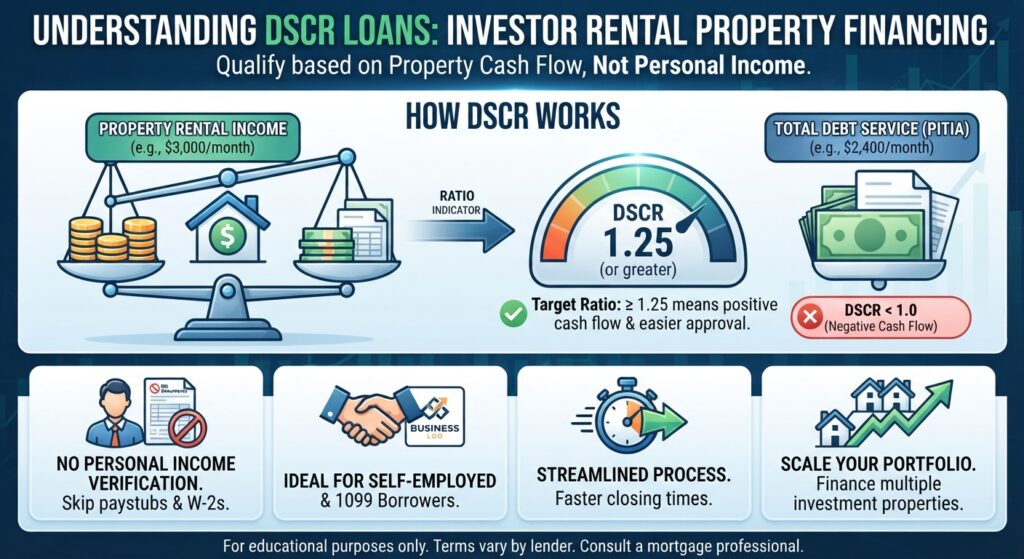
The foundation of every DSCR Loan is a mathematical ratio. The formula is: DSCR = Property Rental Income ÷ Property Debt Payment.
Suppose a rental property generates $3,000 per month in rent, the mortgage payment, taxes, insurance, and other qualifying expenses total $2,000 per month. The ratio becomes: 3,000 ÷ 2,000 = 1.50. Therefore, the property’s DSCR is 1.50. This means the property generates 50% more income than is required to cover the loan payment. From a lender’s perspective, that provides a comfortable margin of safety.
The higher the ratio, the stronger the application usually appears.
You can also use this formula lenders divide the property’s income (such as monthly or annual rent) by the total debt service (mortgage principal, interest, taxes, insurance, and HOA dues, often called PITIA)
- DSCR = 1.0: The property’s rental income exactly covers the mortgage debt.
- DSCR < 1.0: The property loses money; rental income is lower than the debt payments.
- DSCR ≥ 1.25: The standard target for most lenders, meaning income comfortably exceeds debt obligations. Some programs allow down to 0.75x or no-DSCR options
What Is Considered a Good DSCR Ratio?
According to Investopedia lender requirements vary and the general guidelines include:
DSCR Below 1.0
The property does not generate enough income to cover debt obligations. Many lenders view this as high risk. Approval may become difficult or require a larger down payment.
DSCR of 1.0
The property generates exactly enough income to cover expenses. This is typically considered the minimum threshold. There is little room for unexpected costs or vacancy periods.
DSCR of 1.20 to 1.25
Many lenders prefer this range. The property produces enough income to cover debt obligations comfortably.
DSCR Above 1.25
This is often viewed as a strong ratio. Borrowers may receive more favorable loan terms because the property demonstrates healthy cash flow.
DSCR of 1.50 or Higher
This generally indicates a highly attractive investment property. Properties with stronger cash flow typically create less risk for lenders.
Why Do Investors Prefer a DSCR Loan?
The popularity of the DSCR Loan is not accidental. It solves several problems that traditional financing often creates.
No Need for Employment Verification
Traditional lenders frequently require years of employment records, salary verification, tax returns, and proof of stable income. For entrepreneurs and self-employed individuals, compiling this information can be frustrating. A DSCR Loan significantly reduces that burden. The property’s income becomes the primary focus.
Easier Portfolio Expansion
Many investors own multiple rental properties. As portfolios grow, qualifying for additional conventional mortgages can become difficult. Lenders may view multiple mortgages as increased personal risk. With a DSCR Loan, the emphasis shifts from the borrower’s income to the performance of the investment property. This allows investors to continue scaling their portfolios.
Faster Approval Process
Gathering tax returns, business records, payroll documents, and financial statements often delays traditional mortgage approval. DSCR Loans generally require less documentation. This can shorten approval timelines and help investors move quickly when opportunities arise.
Suitable for Self-Employed Borrowers
Business owners frequently face a paradox. Their businesses generate substantial revenue, but tax deductions may reduce reported taxable income. As a result, traditional lenders may underestimate their repayment ability. A DSCR Loan can help bridge that gap.
Who Should Actually Use a DSCR Loan?
One of the biggest misconceptions is that every investor should pursue this financing option. That is not always true. The ideal borrower typically falls into one of several categories.
Real Estate Investors Growing Rental Portfolios
Investors purchasing multiple rental properties often benefit the most. Instead of relying on personal income documentation every time they seek financing, they can use property cash flow to support borrowing decisions.
Self-Employed Professionals
Doctors, consultants, accountants, lawyers, digital entrepreneurs, and agency owners frequently benefit from this financing structure. Many have significant income but difficult-to-document earnings patterns. A DSCR Loan offers flexibility.
Retirees Investing in Property
Retirees sometimes earn income from pensions, dividends, investments, and savings rather than employment. Traditional mortgage underwriting may not always accommodate these income structures as efficiently. A DSCR Loan may offer an alternative path.
Foreign Investors
International buyers seeking U.S. investment properties often struggle with traditional mortgage requirements. A DSCR Loan can provide a more flexible financing option.
Investors With Complex Tax Returns
Many successful property investors strategically reduce taxable income through depreciation and business deductions. While this may lower taxes, it can also limit borrowing capacity through conventional channels. DSCR-based underwriting may provide a solution.
Who Should Avoid a DSCR Loan?
Not everyone will benefit from the DSCR loan. In some situations, traditional financing may be more appropriate. Below are the category of people to avoid the loan.
1. First-Time Homebuyers
DSCR Loans are designed primarily for investment properties. Individuals purchasing a primary residence often find more affordable financing options elsewhere.
2. Borrowers With Excellent W-2 Income
If you have strong employment income, low debt, and excellent credit, a conventional mortgage may provide better interest rates.
3. Investors Buying Weak Cash-Flow Properties
The entire concept behind a DSCR Loan depends on property income. If rental income is insufficient, obtaining favorable financing becomes difficult.
Advantages of a DSCR Loan
The growing popularity of the DSCR Loan stems from several practical benefits.
Simplified Documentation
Less paperwork often means fewer delays. Many investors find this refreshing after experiencing traditional underwriting.
Portfolio Growth Potential
Investors can potentially acquire additional properties without repeatedly proving personal income.
Flexible Qualification Standards
Borrowers with unconventional financial profiles may find approval easier.
Attractive for Experienced Investors
Seasoned investors often prefer financing structures focused on asset performance rather than employment history.
Time Savings
Quicker approvals can create opportunities to secure deals before competitors.
Disadvantages of a DSCR Loan
While the benefits are significant, there are trade-offs investors should understand.
Higher Interest Rates
DSCR Loans often carry higher rates than conventional mortgages. Lenders are assuming more risk because traditional income documentation may be limited.
Larger Down Payments
Many lenders require larger down payments compared to primary residence loans. Investors should be prepared to contribute substantial capital upfront.
Strong Property Performance Required
Properties with weak rental income may not meet lender requirements. The property itself must justify the financing.
Potentially Higher Fees
Origination fees and lender charges may sometimes exceed those associated with conventional loans.
How Credit Scores Affect a DSCR Loan
Although rental income plays a major role, credit scores still matter. A strong credit profile can improve:
- Interest rates
- Loan terms
- Down payment options
- Approval chances
Investors with higher credit scores often enjoy more financing flexibility. For that reason, maintaining healthy credit remains important even when pursuing a DSCR Loan.
Can You Use a DSCR Loan for Airbnb Properties?
Yes, in many cases. Some lenders accept projected short-term rental income when evaluating eligibility. This has become increasingly relevant as investors expand into:
- Airbnb properties
- Vacation rentals
- Short-term rental homes
- Holiday accommodation investments
However, lender policies differ significantly. Investors should always verify requirements before applying.
DSCR Loan vs Conventional Mortgage
Income Assessment
A DSCR Loan evaluates rental income. A conventional mortgage evaluates personal income.
Documentation
DSCR financing generally requires less income documentation. Conventional loans require extensive verification.
Flexibility
DSCR underwriting is often more accommodating for investors.
Interest Rates
Conventional mortgages frequently offer lower interest rates.
Property Focus
The DSCR Loan prioritizes property performance rather than borrower employment history.
Common Mistakes Investors Make With DSCR Loans
Assuming Approval Is Automatic
A profitable-looking property still requires proper valuation and underwriting review.
Ignoring Vacancy Risk
Rental income projections should be realistic. Unexpected vacancies can affect cash flow.
Overleveraging
Taking on too much debt can strain finances even when rental income appears strong.
Forgetting Property Expenses
Maintenance, repairs, insurance, taxes, and management fees reduce actual profitability. Investors should account for all expenses when evaluating a property.
My Objective/Perception on DSCR Loans As a Bank Operation Staff
Working in bank operations provides a unique perspective on lending decisions. Many customers assume loan approval depends entirely on how much money they make. Risk assessment has many layers.
Some borrowers earn impressive incomes but carry significant obligations that increase risk. Others own profitable assets but struggle to document their income in ways traditional underwriting requires.
The strength of the DSCR Loan is that it recognizes property performance as a meaningful indicator of repayment capacity.
I have seen cases where investors possessed valuable rental properties with consistent cash flow yet encountered challenges with conventional financing due to tax structures, business deductions, or complex income arrangements.
For these investors, a DSCR Loan can be a practical financing tool. However, experienced bankers also understand that no loan product eliminates risk. Successful investors focus on property fundamentals, location quality, rental demand, vacancy trends, maintenance costs, and long-term cash flow sustainability rather than simply pursuing easier approval.
The property should make financial sense whether financing is obtained through a DSCR Loan or a conventional mortgage. That mindset separates professional investors from speculative buyers.
Is a DSCR Loan Worth It in 2026?
For many real estate investors, the answer is yes. The financing structure offers flexibility, scalability, and easier qualification for borrowers whose financial situations fall outside traditional lending models. However, the best candidates are investors purchasing properties with strong rental income potential. The stronger the property’s cash flow, the stronger the financing opportunity.
A DSCR Loan should be viewed as a tool rather than a shortcut. Used correctly, it can help investors expand portfolios, improve cash flow, and access opportunities that may otherwise remain out of reach. Used incorrectly, it can increase borrowing costs and reduce investment returns. As with any financing decision, success depends on selecting the right property, understanding the numbers, and maintaining a long-term investment strategy.
Who Is Eligible For A DSCR Loan?
Any real estate investor who wants to buy or refinance a rental property can qualify. Lenders look at the property more than they look at you. You are eligible if you meet these basic checks:
- Rental Income: The property must make enough money from rent to cover the monthly loan payments.
- Down Payment: You need to pay at least 20% to 25% of the property price upfront.
- Credit Score: You generally need a fair to good credit score, usually 620 or higher.
- Business Intent: You must use the property strictly as a rental investment, not as your personal home.
If you are planning to invest in real estate while transitioning to another country, you can also go through my guide on Loans for Moving Abroad: Guide to Relocation Loans & Expat Financing to manage your moving costs alongside your property investments.
What Is A Good DSCR Ratio For A Loan?
A good ratio is 1.25 or higher. This number means the property makes 25% more money from rent than it costs to pay the monthly housing bills.
- 1.00 Ratio: The rent covers the exact cost of the mortgage, taxes, and insurance.
- Below 1.00: The rent is too low, and you would have to pay the difference out of your own pocket.
Is It Hard To Qualify For A DSCR Loan?
No, it is often easier than a normal home loan. It is easier because the lender does not check your personal job history. They do not look at your paychecks, W-2 forms, or personal tax returns. If the rental property makes good money and you have a solid down payment, qualifying is usually very straightforward.
How Long Does It Take To Get Approved For A DSCR Loan?
It typically takes 30 to 45 days to finish the whole process. Because the lender skips checking your personal income paperwork, the setup can move fast. However, it still takes a few weeks because the lender must hire a professional appraiser. The appraiser needs time to visit the property and confirm how much rent it can realistically bring in.
What Disqualifies You From Getting A Loan?
You can be turned down for a few specific reasons. The most common deal-breakers include:
- Low Rent: The property does not make enough rental income to satisfy the lender.
- Living In The House: You plan to live in the property yourself instead of renting it out.
- Bad Background: You have a recent bankruptcy or foreclosure on your record.
- Poor Property Condition: The house is severely damaged and unsafe to rent out.
What Is The Minimum Loan Amount For A DSCR Loan?
Most lenders set the smallest loan amount at $100,000 to $150,000. Lenders rarely offer these loans for very cheap properties because the paperwork and setup costs are high. If you want to buy a house that costs less than this minimum, you might need to find a different type of financing.
What Are The Risks Of A DSCR Loan?
The biggest risk is losing the property if it sits empty. If you cannot find a tenant to rent the home, you still have to pay the mortgage. Other risks include:
- Higher Rates: You will pay a higher interest rate than a normal homebuyer.
- More Cash Needed: You have to risk a larger amount of your own savings for the down payment.
- Exit Fees: Many of these loans charge a penalty fee if you try to pay the loan off early.
How Do I Apply For A DSCR Loan?
The process follows a few simple steps. Here is how you get started:
- Find A Lender: Look for a mortgage broker or company that specializes in “Non-QM” or investor loans.
- Share Property Info: Give the lender the address and the current or expected rental income of the property.
- Fill Out The Form: Complete the lender’s application with your personal details and credit history.
- Get An Appraisal: Wait for the lender to order a property review to confirm its value and rental market rate.
Which Bank Is The Best For A DSCR Loan?
Independent mortgage companies and specialized investor brokers are usually better than big traditional banks. Major nationwide banks prefer standard loans where they can look at your job paystubs. Specialized online lenders and local mortgage brokers have dedicated programs built just for real estate investors and cash-flowing properties.
Can I Get A DSCR Loan As A First-Time Investor?
Yes, many lenders allow it, but it can be slightly harder. Some lenders want you to have experience managing rental properties first. If you are brand new, a lender might ask you to have a higher credit score or keep more emergency cash in your bank account just to be safe.
What Documents Are Required To Apply For A DSCR Loan?
You do not need tax returns, but you will need paperwork for the property. Be ready to hand over:
- Lease Agreement: A copy of the current rental contract if tenants already live there.
- Appraisal Report: The formal document showing the property value and local rent averages.
- Bank Statements: Proof that you have enough cash for the down payment and a few months of emergency savings.
- Identification: Your driver’s license or passport, along with corporate documents if you buy the house under an LLC.
How Much Is A DSCR Loan?
A DSCR loan usually costs more than a standard home loan. Expect to face these specific costs:
- Interest Rates: The interest rate is typically 1% to 2% higher than a regular mortgage.
- Down Payment: You must pay 20% to 25% of the home’s purchase price upfront.
- Closing Fees: You will pay standard lender fees, title fees, and appraisal costs at the very end.
What’s Better Than A DSCR Loan?
A conventional investor loan is better if you have a traditional job and great tax returns. Standard traditional loans offer lower interest rates and cheaper closing fees. A DSCR loan is only the better choice if you are self-employed, write off a lot of expenses on your taxes, or want to buy multiple properties quickly without your personal debt getting in the way.
Can I Get A DSCR Loan If I Have Bad Credit?
Yes, but it requires a much larger down payment. If your credit score is low (under 620), lenders see you as a higher risk. To balance that risk, they might demand that you pay 30% to 40% of the property price upfront instead of the usual 20%.
Frequently Asked Questions (FAQs)
What is a DSCR Loan?
A DSCR Loan is a mortgage designed for investment properties where qualification is based primarily on rental income rather than the borrower’s personal income.
What does DSCR stand for?
DSCR stands for Debt Service Coverage Ratio.
How is a DSCR Loan calculated?
The ratio is calculated by dividing a property’s rental income by its total debt obligations.
Is a DSCR Loan easier to get than a conventional mortgage?
For many investors and self-employed individuals, a DSCR Loan can be easier because it relies less on traditional income documentation.
What credit score do you need for a DSCR Loan?
Requirements vary by lender, but higher credit scores generally improve approval chances and loan terms.
Can first-time investors get a DSCR Loan?
Yes. Some lenders allow first-time investors to apply, provided property cash flow requirements are met.
Can a DSCR Loan be used for Airbnb properties?
Many lenders permit short-term rental properties, although underwriting standards differ.
Is a DSCR Loan only for investment properties?
Yes. DSCR Loans are generally designed for income-producing real estate rather than owner-occupied primary residences.
Do DSCR Loans require tax returns?
Many DSCR Loan programs do not require traditional income verification through tax returns.
Are DSCR Loans worth it?
They can be highly valuable for investors who have strong rental properties but do not qualify easily under conventional mortgage requirements.
Conclusion
The DSCR Loan has transformed the way many investors finance rental properties. By focusing on property income rather than personal employment income, it offers an alternative path for self-employed professionals, real estate investors, retirees, and borrowers with complex financial profiles.
While it may not be suitable for every borrower, it has become one of the most important investment financing tools available in today’s real estate market. If your goal is to build a rental portfolio, acquire cash-flowing properties, or qualify outside traditional lending standards, a DSCR Loan may be worth serious consideration.
The key is understanding when it works, when it doesn’t, and how to use it strategically to support long-term wealth creation.