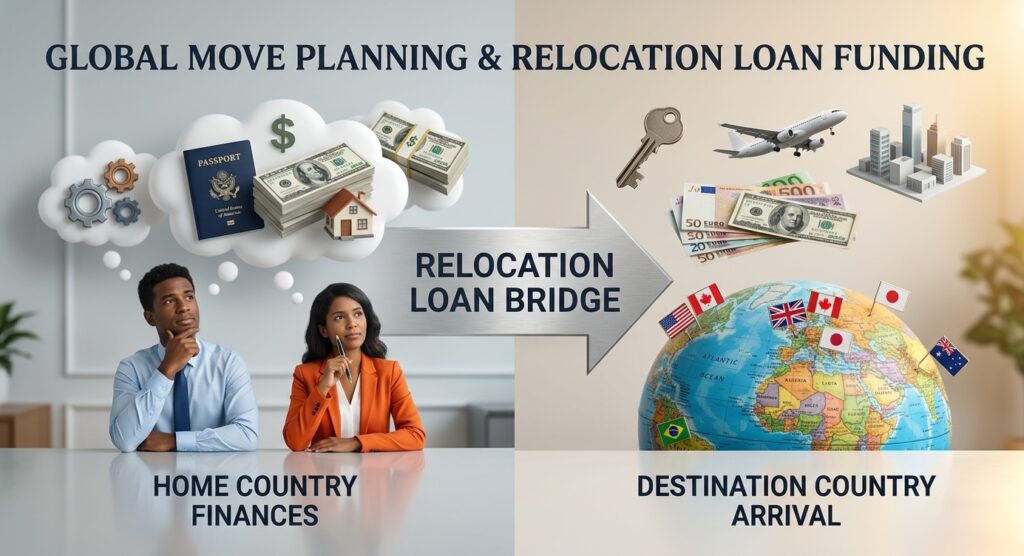
What is a relocation loan for moving abroad?
A relocation loan is a specialized personal loan used to cover the upfront costs of moving to a new country, such as flights, visa fees, shipping, and rental deposits. Because traditional banks rarely lend across international borders, expatriates typically secure these funds through specialized international fintech platforms, domestic personal loans before departure, or employer-sponsored relocation packages.
For expatriates moving across borders, financing a relocation can be challenging since traditional lenders often reject applicants who lack a local credit history. Relocation loans for expatriates are specialized personal or property loans designed to cover international moving costs, visa fees, temporary housing, or property investments back home without requiring established domestic credit.
Lenders serving expats typically bypass standard local credit scores by instead verifying foreign income streams, international credit histories, or verified employment contracts in the destination country.
Moving Abroad? The Ultimate Guide to Relocation Loan and Expat Financing
Moving to a new country is easily one of the most thrilling chapters of a person’s life. The thought of exploring new streets, experiencing different cultures, and starting a fresh career is incredibly energizing. However, during my ten years working as a bank operations staff member, I saw a completely different side to this excitement: the sheer financial shock that hits people right before they board their flight.
Time and again, customers would walk up to my desk or call our branch with the same urgent dilemma. They had been accepted into a dream university abroad or landed an incredible job contract in a new country. But when they sat down to calculate the actual costs of packing up their lives and crossing an ocean, reality hit them like a brick wall.
Between airline tickets, visa application fees, international shipping containers, and the massive upfront deposits required for foreign apartments, the price tag of relocation scales up very quickly. For most people, paying these costs completely out of pocket is simply not possible. That is where a relocation loan comes into play.
Unfortunately, getting a bank loan to move out of the country is not as straightforward as borrowing money to buy a car or renovate a kitchen. In fact, cross-border moving creates a unique financial paradox that catches most people completely off guard. When planning on how to get a relocation loan, you can still learn how to move from Nigeria to Canada and still use your bank account.
As a former banker who spent a decade managing loan documentation, regulatory compliance, and account operations, I want to lift the veil on how the banking system views international movers. In this comprehensive guide, we will break down how to secure a relocation loan, navigate the hidden traps of international financing, and explore the best alternatives to fund your journey safely without ruining your financial future.
Why Getting a Relocation Loan Is Complicated
To understand how to get a relocation loan, you first need to understand how a bank’s brain works. During my ten years in bank operations, our primary goal when issuing any loan was simple: risk management. We needed to be certain that the borrower had a stable income and, more importantly, that we could find them if they stopped making payments.
When you tell a traditional domestic bank that you need a relocation loan because you are moving to the other side of the world, a red flag immediately goes up in the credit department. Here is why:
- Jurisdictional Risk
If a bank in your home country lends you money today, and you fly to a different continent next week, the bank loses its primary leverage. If you decide to stop paying the loan, it is incredibly difficult and expensive for a domestic bank to pursue legal collections across international borders. To them, you are essentially disappearing out of their legal reach.
- The Credit History Void
You might have a flawless credit score in your home country. You paid your credit cards on time, cleared your student debt, and maintained a great relationship with your local branch. However, the moment you land in a new country, that credit score usually drops to zero.
Credit reporting systems are highly localized. The major credit bureaus in your home country do not automatically share your financial history with bureaus in the United Kingdom, Canada, the United States, or Australia. To a bank in your destination country, you look exactly like a teenager who has never held a job or owned a credit card. They have no data to prove you are a responsible borrower.
- Employment Verification Gaps
Traditional banks rely on local income verification. If your new job is with a foreign company paying you in a foreign currency, a local bank’s automated compliance systems cannot easily verify your pay stubs or tax records.
This creates a frustrating “Catch-22” situation: your home country banks do not want to lend to you because you are leaving, and your destination country banks do not want to lend to you because you have just arrived.
Types of Expatriate Relocation Loans
Depending on your relocation objective, financial products are structured into three main categories:
- Expat Personal Loans: Unsecured funds ranging from $1,000 to $100,000 to bridge short-term cash flow gaps. They cover moving logistics, flight tickets, visa fees, and initial apartment security deposits.
- Study Abroad Relocation Loans: Tailored for international students or postgraduates moving to countries like the US, UK, or Canada. These options often require no collateral or co-signer and look at future earning potential.
- Cross-Border & Diaspora Mortgages: High-value property financing structured for expats. For example, the Federal Mortgage Bank of Nigeria (FMBN) offers a dedicated NHF Diaspora Mortgage Loan allowing documented citizens abroad to access up to ₦100 million at a 9% fixed annual interest rate to secure a home remotely.
Top Relocation Loan Providers for Expats
- MPOWER Financing: Focus: Relocation and tuition funding for expats moving to the US or Canada.
Collateral: No collateral or co-signer required. - Prodigy Finance: Focus: International postgraduates relocating for Business, STEM, or Health programs.
Coverage: Up to 100% of cost of attendance and living fees. - LendKoi: Focus: Working expats, freelancers, and visa holders in the US.
Credit Rule: Evaluates global financial profiles rather than native credit scores. - Enness Global: Focus: High-net-worth expats moving across jurisdictions requiring complex international mortgages.
Terms: Structures cross-border multi-currency loans against global asset portfolios. - Federal Mortgage Bank of Nigeria: Focus: Structured real estate financing for Nigerian expats residing overseas.
Terms: Up to ₦100 million maximum facility at a 9% fixed annual interest rate with a 10-year tenor.
Standard Eligibility Requirements
To qualify for an international relocation loan, you will typically need to present comprehensive documentation to satisfy cross-border risk assessments:
- Proof of Income: A minimum of 6 to 12 months of certified bank statements verifying your current cash flow.
- Employment Contract: A formal employment offer letter or confirmation from your destination country proving ongoing financial stability.
- Legal Status: Valid international passport data pages, visas, or approved immigration documentation.
- Alternative Credit Profile: If local credit is unavailable, international credit reports or a 12-month consecutive history of utilities, housing, and insurance payments are used to establish trustworthiness.
Compare Moving Loan Costs Before You Apply
If you are using a standard personal loan to move, use this interactive calculator to estimate your ongoing interest costs and monthly payments based on typical unsecured market rates.
5 Practical Types of Relocation Loans for International Movers
Despite these hurdles, you can still secure a relocation loan if you target the right financial structures. Because of the digital transformation in banking over the last decade, alternative lending platforms have stepped in to fill the gaps that traditional brick-and-mortar banks left behind.
Let’s look at the five most reliable avenues for securing a relocation loan when moving across borders.
1. Pre-Departure Domestic Personal Loans
The easiest way to secure a relocation loan is to apply for a standard, unsecured personal loan in your home country before you give your bank any indication that you are leaving.
From an operations standpoint, if you currently have a stable local job, a strong domestic credit history, and a valid local address, you meet the standard lending criteria.
- How it works: You apply for a fixed-rate personal loan to cover “moving expenses” or “personal use.” The funds are deposited into your local account, and you use them to pay for your flights, shipping, and initial transition costs.
My Candid Advice As a Bank Staff
Make sure you maintain an active bank account in your home country with automated digital transfers set up. You will need to funnel money from your new foreign salary back into this home account every month to keep making your loan payments on time. Defaulting on a loan in your home country will destroy your ability to ever return or utilize financial services there in the future.
2. Specialized Expat FinTech Lenders
In recent years, innovative financial technology (FinTech) companies have emerged specifically to solve the migrant credit crisis. These platforms do not rely solely on local credit scores. Instead, they use global data underwriting to assess your risk.
- How it works: These lenders evaluate your upcoming employment contract, your educational background, and your financial history in your home country to grant you a relocation loan that bridges the gap between your two lives.
- Why they are different: They understand cross-border logistics. They can issue funds that you can access either right before you leave or immediately upon arrival in your new destination, giving you instant liquidity to sign a lease on an apartment.
3. Borderless International Student Loans
If your reason for moving abroad is higher education, your path to a relocation loan is much clearer. Standard personal loans are notoriously difficult for students to get, but international student lending platforms look at your future earning potential rather than your past credit history.
- How it works: Companies look at the university you have been accepted into and the degree you are pursuing. If you are entering a high-demand field like engineering, data science, or business management, they will grant you a relocation loan to cover both your tuition and living/moving expenses.
- The Advantage: Most of these specialized student loans do not require a co-signer in your destination country, which removes one of the biggest roadblocks international students face.
4. Credit Union Relocation Programs
If you prefer dealing with human beings rather than algorithms, credit unions are an incredible alternative to major commercial banks. Because credit unions are member-owned cooperatives, their lending criteria are often far more flexible than standard banks.
- How it works: If you have been a member of a local credit union for several years, schedule a face-to-face meeting with a loan officer. Show them your official visa paperwork and your signed job contract abroad.
- The Operational Advantage: Credit unions often look at the “character” of the borrower, not just a rigid automated credit score. If they can see that your move is a verified step forward in your career, they may approve a specialized relocation loan with highly competitive interest rates.
5. Employer-Sponsored Relocation Advances
While not technically a bank product, this is the safest and cheapest relocation loan option available on the market today. Many multinational companies that hire talent from abroad offer corporate relocation assistance.
- How it works: If a company wants you badly enough to sponsor your visa, they know that moving is expensive. Many employers will offer a relocation loan in the form of a salary advance. They will give you a lump sum upfront to cover your flights and moving trucks, and then automatically deduct a small, interest-free portion from your monthly paycheque over your first year of employment.
- Why it’s the best option: There are no credit checks, no foreign currency conversion traps, and zero interest charges. Always ask your new HR department if this option is available before looking at outside lenders.
Essential Costs a Relocation Loan Should and Shouldn’t Cover
During my years reviewing loan applications, I watched many borrowers make the critical mistake of over-borrowing. They would estimate their moving costs off the top of their head, add a massive safety margin, and take out a massive loan that took them years to pay off.
When you apply for a relocation loan, every single dollar you borrow needs to be tied to a specific, non-negotiable expense.
Expenses to Keep Out of Your Loan
Do not use a relocation loan to finance an extravagant lifestyle upgrade the moment you arrive. Avoid using borrowed money for high-end electronics, luxury apartment rentals that stretch your budget, or sightseeing tours. Remember, your first goal when moving abroad is survival and stability. Every dollar of debt you accumulate is a weight tying you down in your new country.
3 Hidden Bank Risks of Borrowing to Move Abroad
When you read standard marketing brochures for a relocation loan, everything sounds perfectly simple. Lenders promise fast approvals and easy monthly payments. But as someone who has spent ten years auditing loan portfolios, I know exactly where the traps are hidden.
Before you sign any loan agreement, you must understand these three critical risks:
1. The Exchange Rate Trap (Currency Mismatch)
This is the single most common financial mistake international movers make. If you take out a relocation loan in your home country, your debt is denominated in your home currency. However, your new job will be paying you in your destination country’s currency.
Imagine you take out a loan where the monthly payment is 500 dollars. When you first move, the exchange rate means that 500 dollars equals exactly 400 units of your new foreign currency. You budget your life around that number.
Two months later, the global economy shifts, and your home currency strengthens significantly. Suddenly, making that exact same 500-dollar loan payment requires you to spend 480 units of your foreign currency. Your loan has effectively become 20% more expensive simply because of currency fluctuations.
2. Double Taxation on Salary Transfers
To pay off a domestic relocation loan using foreign earnings, you will have to send money across borders every month. Many people completely forget to calculate the transaction costs.
Between international wire transfer fees, poor retail exchange rates offered by major banks, and potential tax reporting triggers for moving large sums of money back into your home country, you can easily lose 3% to 5% of every payment just to the mechanics of transferring the money.
3. Career Probation Risks
Almost every employment contract in a new country includes a probationary period, usually lasting between three to six months. During this window, the employer can terminate your contract with very little notice if things do not work out.
If you have taken out a massive relocation loan based on the assumption that you have a secure, high-paying job, and that job disappears during month two, you are left in a truly terrifying financial position. You have no local income, a mountain of international debt, and the potential cost of a flight back home to handle.
Step-by-Step Guide to Applying for a Relocation Loan
If you have weighed the risks and decided that a relocation loan is necessary to make your move happen, you must treat the application process with extreme precision.
As a former bank operations officer who reviewed thousands of loan files, I can tell you that a sloppy application is an instant rejection. Loan underwriters hate uncertainty. If your paperwork looks messy, they will assume your financial life is messy too. Follow this exact checklist to make your application look incredibly polished and professional:
Step 1: Gather Your Professional Proof
Do not just tell the bank you are moving for a good job; prove it to them with unassailable documentation. You will need:
- A clean, signed copy of your official employment contract or university acceptance letter.
- An official letter from your new employer’s HR department stating your exact start date, your guaranteed annual salary, and any relocation allowances they are providing.
- Your valid passport along with your approved residency or work visa stamped inside it.
Step 2: Prepare a Clear Moving Budget
Create a simple, transparent spreadsheet that details exactly where every single unit of currency from your relocation loan will go. Underwriters love seeing this because it proves you are a rational planner, not an emotional spender. Show them the written quote from the moving company, the exact cost of the flight options, and real estate listings showing average rental deposits in your destination city.
Step 3: Clean Up Your Current Bank Accounts
Three months before you apply for your loan, look at your bank statements through the eyes of an auditor.
- Eliminate any late fees or overdrafts completely.
- Stop making irregular, large cash deposits that look suspicious.
- Pay off as many small, lingering debts (like retail store cards or small credit card balances) as possible.
When the loan underwriter pulls your statement and sees a clean, organized history of responsible cash management, approving your relocation loan becomes an incredibly easy decision for them to make.
How to Reduce Your Financial Burden
As a former banker, my ultimate advice to you is always the same: The cheapest money is the money you do not have to borrow. Before you sign your life away to a high-interest relocation loan, explore every alternative to lower your upfront costs.
Embrace Digital Minimalism
Do you truly need to pay thousands of dollars for a shipping container to move your old furniture across the ocean? In almost every single case, it is significantly cheaper to sell your heavy furniture, appliances, and non-essential belongings in your home country. Use that influx of quick cash to fund your plane tickets and then buy second-hand furniture when you arrive at your destination.
Negotiate Your Sign-On Package
When a foreign company offers you a job, you are at the peak of your negotiating leverage. Do not be afraid to ask for a relocation stipend. Explain to the hiring manager that the upfront costs of moving across borders are a significant barrier for you. Many companies have hidden budgets specifically to help top talent cover their moving costs, and they will gladly give you an advance or a lump-sum relocation grant if you simply ask for it.
Utilize Borderless Digital Banks
Before you even step onto the airplane, set up an account with an international digital multi-currency bank. These platforms allow you to open local bank accounts in various countries (like the US, UK, Eurozone, and Australia) online.
By setting these up early, you can convert your savings into your destination currency gradually when the exchange rates are favourable, completely avoiding the terrible fees and rates that traditional brick-and-mortar banks charge you at the airport terminal.
Can you get a loan to relocate?
Yes, lenders offer personal loans or specific relocation/travel loans to cover expenses like moving companies, deposits, flights, and setup costs.
Which loan app gives $20,000 instantly?
No standard mobile app gives a $20,000 (approx. ₦30+ million) loan instantly without strict credit checks, formal banking history, or collateral. Most common mobile apps (like FairMoney, QuickCheck, or Branch) cap instant cash loans at much lower local limits (such as ₦20,000 to ₦500,000). Larger lump sums require traditional banks or digital lenders with formal underwriting (such as Credit Direct offering up to ₦5,000,000 locally depending on net pay).
Can I get a personal loan for relocation?
Yes, personal loans are unsecured (no collateral needed) and can be used for moving expenses. You pay them back in fixed monthly installments over a set term (usually 2 to 7 years).
Can you take out a loan to move to another country?
Yes, specialized international or education/relocation financing companies exist (such as MPower Finance, Stilt, Lendwise, or platform options like Travelloan), though availability depends on your destination, visa status, and proof of future income.
Who will give me a loan if no one else will?
If traditional banks and major lenders turn you down, your options are very limited. “No-refusal” or instant lenders do not exist legally. If you have bad credit or no history, you might look at local microfinance banks, credit unions, or borrowing from family, because predatory “no credit check” online lenders charge extreme, illegal, or trap-like interest rates.
How much would a $20,000 loan cost per month?
Monthly payments depend on your interest rate and repayment length (term):
At 10% annual interest over 3 years (36 months): about $645 per month.
At 10% annual interest over 5 years (60 months): about $425 per month.
Higher interest rates (like 20% to 35%) will make these monthly payments significantly higher.
How much are payments on a $32,000 loan?
Monthly payments depend on your rate and term:
At 10% annual interest over 3 years (36 months): about $1,033 per month.
At 10% annual interest over 5 years (60 months): about $680 per month.
What is the cheapest way to borrow $20,000?
The cheapest ways generally include:
A low-rate personal loan from a credit union or traditional bank with a strong credit score.
A home equity line of credit (HELOC) or home equity loan if you own property.
A 0% intro APR credit card (if you can pay it off before the promotional period ends, though getting a $20k limit requires high credit).
Can I get a personal loan for $150,000?
Rarely as a standard unsecured personal loan. Most unsecured personal lenders cap out at $35,000 to $50,000 (such as Upgrade’s $50,000 limit). To borrow $150,000, lenders usually require secured collateral like home equity, a large commercial loan, or high-net-worth backing.
Where can I borrow $100,000 instantly?
Nowhere. No legitimate lender offers $100,000 “instantly” with no documentation. Large sums require multi-day underwriting, income verification, asset appraisal, and formal credit approval through major commercial banks or specialized private lenders.
What is the cheapest way to borrow $15,000?
Like $20,000, the cheapest options are a credit union personal loan, a bank personal loan with a low APR, or borrowing against an asset (like a home equity loan) rather than using high-interest payday or mobile loan apps.
Can I get a personal loan if my salary is $50,000?
Yes, you can get a personal loan with a $50,000 annual salary, provided your debt-to-income (DTI) ratio is low and your credit score is acceptable. Lenders care more about how much of that $50,000 goes toward existing debts and living expenses than the raw salary number alone.
Frequently Asked Questions
Can I get a relocation loan if I don’t have a job lined up yet?
Securing a traditional relocation loan without a verified job offer or institutional acceptance letter is incredibly difficult. Banks view an international move without guaranteed income as an extreme risk. If you are moving to look for work, your best option is to save up an emergency fund in advance or look for a domestic personal loan based entirely on your current local employment before you resign.
How long does it usually take to get a relocation loan approved?
If you are applying for a traditional personal loan through a domestic bank or a credit union, the approval process typically takes between 3 to 7 business days, provided you have all your documentation ready. Digital fintech platforms that specialize in expat financing can often process applications faster, sometimes giving an approval decision within 24 to 48 hours.
Will my domestic credit score help me get a loan in my new country?
Generally, no. Most traditional countries use completely isolated credit networks. However, some international credit card companies and specialized fintech platforms allow you to “transfer” or use your home country’s credit history to open an account abroad. Always check if your current credit card provider has an international transfer program before you cancel your card.
What happens if I default on my relocation loan after moving abroad?
Defaulting on a loan is a massive financial mistake, regardless of where you live. If you abandon a relocation loan in your home country, the bank will hand your debt over to collection agencies, your local credit score will be ruined for up to seven years, and they can legally seize any assets you left behind. Furthermore, as international financial tracking improves, debt records can occasionally follow you across borders, impacting your future visas or background checks.
Should I choose a fixed or variable interest rate for my moving loan?
As a conservative former bank operations staff member, I almost always recommend a fixed interest rate for any relocation loan. Moving to a new country introduces a massive amount of volatility into your life. You will be dealing with new tax systems, different grocery prices, and unfamiliar utility bills. Having a fixed monthly loan payment gives you a predictable anchor in your budget that will not change, regardless of what global interest rates or central banks decide to do.
Final Thoughts from the Vault
An international relocation is an incredible investment in your future self. It expands your horizons, boosts your career potential, and builds immense personal resilience. But please, do not let financial stress ruin the magic of your first few months abroad.
If you must take out a relocation loan, do so with clear vision and absolute discipline. Treat it as a temporary financial bridge to get you safely across the water, not as a permanent safety net to fund a lifestyle you cannot afford. Keep your budget lean, document every single expense, protect your credit score at all costs, and welcome the adventure of your new global life with confidence.
Are you planning a move to a specific country, or are you currently trying to figure out how to transfer your existing credit history? If you share your destination and your home country, I can give you explicit details on the top cross-border platforms operating in that specific corridor.