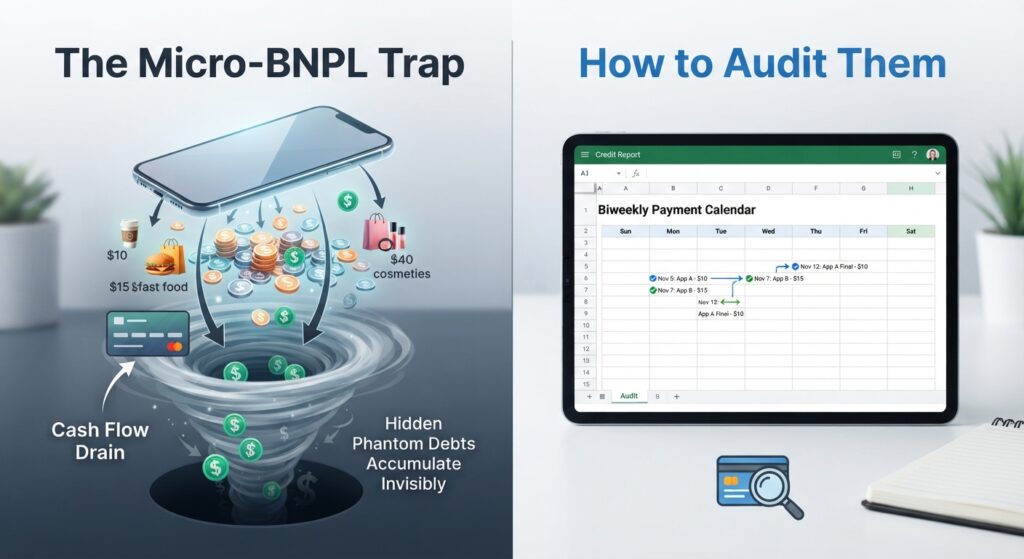
Small Buy Now Pay Later payments affect cash flow by creating multiple recurring deductions that consumers often overlook. While each payment may seem insignificant, several active BNPL plans can add up to hundreds of dollars per month, reducing disposable income, disrupting budgets, increasing overdraft risk, and making it harder to save money.
Micro-BNPL phantom debts are small Buy Now Pay Later obligations, often under $10 or $20 per instalment, that consumers forget about after making purchases. Although each repayment appears minor, multiple active instalments can combine to reduce monthly cash flow, create budgeting problems, trigger overdrafts, and increase financial stress.
You receive your salary, pay a few bills, and expect to have enough money left for savings and daily expenses. Yet within a week or two, your account balance looks much lower than expected.
You check your banking app and notice a series of small deductions:
- $8 here
- $12 there
- $10 somewhere else
- Another $15 scheduled next week
None of these payments seem large enough to cause concern. In fact, most people barely notice them.
However, when dozens of these small deductions operate simultaneously, they can quietly consume a significant portion of your monthly income. These are the hidden effects of multiple Buy Now Pay Later (BNPL) obligations, a growing financial issue that many consumers fail to recognize until their cash flow becomes strained.
This is what we call the Micro-BNPL Trap. The trap isn’t created by one large debt. It is created by numerous small instalment payments that individually seem harmless but collectively weaken financial stability.
Understanding how these tiny obligations impact your finances can help you regain control of your spending, improve your cash flow, and avoid unnecessary financial stress.
The micro-BNPL (Buy Now, Pay Later) trap is a hidden cash flow killer. By splitting tiny purchases like a $10 coffee and sandwich into biweekly instalments, you create “phantom debts” that slip under your budgeting radar but collectively drain your bank account.
Here is your comprehensive, original guide to understanding, auditing, and breaking free from this micro-installment cycle.
What is BNPL phantom debt?
BNPL phantom debt refers to low-cost, short-term Buy Now, Pay Later micro-loans (often between $10 and $50) that accumulate silently across multiple apps. Because these biweekly payments slip past traditional monthly budgeting tools and auto-draft from checking accounts, they create a compounding drain on daily cash flow and increase the risk of bank overdraft fees and credit score damage.
According to the Consumer Financial Protection Bureau, Buy Now Pay Later services have become an increasingly popular payment option, particularly among younger consumers.
Your salary arrives. Your bills are paid. Yet within days, your account balance looks lower than expected.
Nothing major was purchased. No emergency occurred. No large loan repayment was deducted.
Instead, your money disappears through a series of small transactions:
- $8 for a gadget bought last month
- $12 for a pair of earbuds
- $10 for a streaming device
- $15 for a fashion purchase
- $20 for an online course
Each deduction seems harmless in isolation.
The problem is that modern consumers rarely carry just one instalment payment. Many carry several, spread across different merchants, providers, marketplaces, subscriptions, and financing platforms.
Over time, these tiny obligations accumulate into what we call the Micro-BNPL Trap.
The danger isn’t one large debt. The danger is a collection of miniature debts hiding in plain sight, quietly eroding your cash flow month after month.
In this guide, you’ll learn how phantom debts develop, why they are difficult to spot, how they impact your financial health, and how to audit every hidden BNPL obligation before it damages your budget.
What Is the Micro-BNPL Trap?
The Micro-BNPL Trap occurs when consumers accumulate multiple small Buy Now Pay Later obligations that individually appear manageable but collectively create significant financial pressure.
Instead of borrowing $500 through one obvious loan, consumers may unknowingly spread that same amount across:
- Electronics
- Accessories
- Fashion purchases
- Digital subscriptions
- Online services
- Home gadgets
Because the repayments are fragmented, they rarely attract attention.
For example:
| Purchase | Repayment |
| Phone Case | $8 |
| Earbuds | $12 |
| Smart Watch | $15 |
| Online Course | $20 |
| Fitness Equipment | $18 |
The individual payments seem insignificant.
Combined, they create recurring deductions that slowly weaken disposable income.
Why Buy Now Pay Later Feels Less Like Debt
One reason BNPL has grown rapidly is that it changes how consumers think about borrowing. Traditional loans encourage people to consider:
- Interest
- Repayment schedules
- Debt obligations
- Future affordability
BNPL often shifts attention toward one question: “Can I afford the first payment?” Instead of: “Can I afford the full purchase?”
This psychological shift makes spending feel easier and borrowing feel less serious, increasing the likelihood of accumulating multiple repayment obligations simultaneously.
What Are Phantom Debts?
Phantom debts are financial obligations that continue affecting your finances long after you’ve mentally forgotten about them. You remember buying the product. You no longer remember making the repayments. Yet the deductions continue.
Examples include:
- A gadget purchased six weeks ago
- A financed phone accessory
- A digital service paid through instalments
- A subscription linked to financing arrangements
The item fades into the background, the debt remains active.
This is why phantom debts are so dangerous. They continue draining resources even when they’ve disappeared from your financial awareness.
Why Your Money Disappears After Payday
Many people assume income is the problem. Visibility is often the bigger issue.
Consider this example:
| Purchase | Monthly Cost |
| Device Financing | $45 |
| Fashion Purchase | $35 |
| Smart Gadget | $50 |
| Subscription Repayment | $30 |
| Earbuds | $25 |
| Home Appliance | $35 |
Total Monthly BNPL Commitments:
$220 per month
Annual Total:
$2,640 per year
That’s enough money to:
- Build an emergency fund
- Pay down high-interest debt
- Start investing
- Cover unexpected expenses
Yet many consumers never view these obligations as one combined figure.
Why Am I Losing Money to Buy Now Pay Later?
You are likely losing money because BNPL alters your brain’s perception of cost. This is driven by two main factors:
- The Decoupling Effect: When you split a $40 purchase into four $10 payments, your brain evaluates the transaction as a $10 decision. This lowers your natural resistance to spending, leading you to buy things you otherwise would pass up.
- Frictionless Overspending: Because these services are integrated directly into checkout screens, buying becomes too easy. You aren’t losing money to a single massive purchase; you are losing it to a dozen tiny, simultaneous commitments that quietly erode your disposable income.
Hidden Dangers of Micro-Instalment Financing
While large loans demand careful thought, micro-instalments slip through without scrutiny. Their hidden dangers include:
- Cash Flow Fragmentation: Instead of your income going toward major bills and savings, it is chopped up into random $5, $12, and $15 deductions throughout the month.
- The “Subscription” Illusion: You begin to view physical goods as ongoing monthly or biweekly subscriptions. Unlike a streaming service you can cancel, you cannot easily switch off a BNPL obligation without facing penalties.
- Overdraft Dominoes: Because micro-payments are small, users rarely log them. When multiple $10 payments hit your account on the same day, they can trigger a cascade of bank overdraft fees far exceeding the original cost of the items.
Does Paying Biweekly with Klarna Affect Credit Score?
Generally, standard biweekly BNPL payments do not affect your credit score, but there are critical nuances:
- Approval: Most biweekly services use a “soft credit check,” which does not impact your credit score or appear on your credit report.
- Good Behaviour: Making your biweekly payments on time usually will not help build your credit score, as most BNPL providers do not report positive payment history to the major credit bureaus.
- The Risk: If you miss payments and your account faces severe delinquency, the provider may sell your debt to a collection agency. Once a collection agency reports that debt, your credit score will take a major hit.
How Afterpay Payment Stacking Affects Your Checking Account
Payment stacking occurs when you have multiple active Afterpay orders running at the same time. This creates a volatile environment for your checking account:
- Unsynchronized Cycles: Afterpay operates on a strict 14-day cycle from the date of each individual purchase. If you buy items on three different days, you now have three separate biweekly schedules hitting your account at different times.
- The Mid-Month Squeeze: If these staggered dates align right before payday when your account balance is at its lowest, they can instantly drain your remaining cash, causing subsequent essential checks or scheduled bills to bounce.
Step-by-Step Buy Now Pay Later Audit Guide
To regain control, you must conduct a manual audit to expose your true level of debt.
- Gather the Data: Download the apps for every BNPL service you have ever used (e.g., Klarna, Afterpay, Affirm, Zip).
- Isolate Active Schedules: Navigate to the “Orders” or “Payments” tab in each app. List every single item with a remaining balance.
- Map the Dates: Create a master calendar. Plot the exact days and dollar amounts of every upcoming deduction for the next 60 days.
- Calculate the Aggregate Total: Add up all the remaining balances. Seeing that your $10 and $15 purchases total $350 in total debt provides a necessary reality check.
- Reconcile with Your Bank: Match the app schedules against your actual bank statements from the last 30 days to ensure no hidden fees or automated renewals were missed.
How to Track Hidden Phantom Debts on Your Phone
Phones make it easy to hide these debts, but you can use them to bring transparency back to your finances:
- Centralize Notifications: Turn on push notifications and email alerts for every BNPL app. Force yourself to see the alert every time money moves.
- Use a Dedicated Calendar: Set up a separate color-coded calendar layer on your phone (e.g., Google Calendar or Apple Calendar) exclusively for BNPL due dates. Treat them as rigid appointments.
- The “Notes App” Gatekeeper: Keep a simple running list in your phone’s Notes app. Before clicking “Pay with BNPL,” you must type the item name, total cost, and the four payment dates. If the list is too long, deny the purchase.
Best Way to Budget for Biweekly BNPL Payments
Standard monthly budgeting fails for biweekly BNPL because months don’t divide cleanly into two-week blocks. Use this system instead:
- The Income-Matching Method: Align your BNPL dues directly with your paychecks. If you get paid every other Friday, adjust your BNPL payment dates inside the apps to fall on the Monday after payday.
- Create a BNPL Buffer: Open a separate, free checking account dedicated solely to digital payments. At the start of the month, transfer the aggregate total of your budgeted BNPL expenses into that account and link your apps to it. This protects your primary account from surprise drafts.
How to Stop Automatic Deductions from Affirm
Stopping an automatic deduction requires addressing both Affirm and your financial institution:
- Inside the Affirm App: Navigate to your active loan, select “Payment Options,” and look for the toggle to disable AutoPay. Note that Affirm typically requires you to do this at least 24 to 48 hours before the scheduled payment date.
- Change the Payment Method: Update your profile to link a manual payment option (like a different debit card) so the system stops pinging your primary account.
- The Bank Stop-Payment: If Affirm refuses to halt a disputed or erroneous automatic draft, contact your bank directly. Request a formal “Stop Payment Order” on ACH transfers from Affirm. Banks may charge a fee for this, but it legally blocks the merchant from pulling funds.
Why Small Payments Feel Invisible
Human psychology is designed to notice large expenses. Most people can immediately tell you:
- Their rent
- Their mortgage
- Their car payment
- Their utility costs
But many struggle to list every active BNPL arrangement. A $700 loan is memorable. Seven separate $10 obligations are not. This is precisely what makes micro-BNPL debt dangerous.
How Phantom Debts Create Financial Leakage
Financial leakage occurs when money leaves your account without active attention or monitoring.
Micro-BNPL repayments create leakage because they:
- Operate automatically
- Blend into everyday transactions
- Require little customer interaction
- Continue long after purchase excitement fades
- Are often attached to debit cards
Over time, these obligations become invisible background expenses.
Signs You May Be Trapped by Hidden BNPL Payments
Your Account Balance Is Always Lower Than Expected
Salary enters your account. A week later, the balance feels unusually low. Small deductions may be accumulating behind the scenes.
You Cannot List All Active Instalment Plans
If you need to check statements before remembering all your BNPL obligations, visibility has already declined.
You Frequently See Small Recurring Transactions
Repeated payments between $5 and $20 deserve attention.
You Experience Unexpected Account Shortages
Declined transactions and failed payments can indicate excessive hidden commitments.
You’re Still Paying for Things You No Longer Use
This is one of the strongest indicators of phantom debt.
How Multiple BNPL Plans Damage Your Budget
Sound budgeting principles require tracking every recurring financial obligation, including instalment payments and subscription charges.
Most budgets account for:
- Housing
- Utilities
- Transportation
- Food
- Savings
Many consumers fail to include instalment-based obligations.
As a result:
- Spending power is overstated
- Savings targets are missed
- Financial stress increases
- Overdraft risk rises
A budget can only be accurate when every commitment is visible.
Can Buy Now Pay Later Cause Overdrafts?
Yes. Suppose you have:
- $12 deducted on Monday
- $18 deducted on Wednesday
- $20 deducted on Friday
- $15 deducted over the weekend
None of these payments appears threatening alone. Together, they may create insufficient funds for more important obligations.
This increases the risk of:
- Failed payments
- Overdraft charges
- Borrowing to cover shortfalls
How the BNPL Trap Affects Nigerian and African Consumers
The BNPL model is increasingly common across Africa through:
- EasyBuy
- CredPal
- CDCare
- Device financing programs
- Retail instalment plans
- Fintech-powered consumer financing
The issue is not the financing product itself. The issue arises when consumers lose track of multiple commitments spread across different providers. The result is the same: tiny repayments accumulate and silently reduce monthly cash flow.
The Hidden Link Between BNPL and Lifestyle Inflation
As income increases, spending often rises too. Instead of using additional earnings to save, invest, or build emergency reserves, many consumers begin financing more purchases through Buy Now Pay Later services. This behaviour is closely related to modern money habits such as emotional spending and lifestyle-driven consumption. If you’re unsure whether your spending decisions are helping or hurting your financial goals, read our guide on Doom Spending vs Revenge Saving: How to Escape 2026’s Extreme Money Mindsets Without Feeling Deprived. Understanding these spending patterns can help you recognize why small BNPL obligations often accumulate unnoticed.
The 7-Step Micro-BNPL Audit
Step 1: Download Three Months of Statements
Gather:
- Bank statements
- Credit card records
- Debit card records
- Mobile wallet histories
Step 2: Search for Small Recurring Deductions
Look for payments between:
- $5–$10
- $10–$20
- $20–$50
Step 3: Create a Phantom Debt Inventory
Track:
- Purchase
- Remaining balance
- Payment amount
- Repayment frequency
- Completion date
Step 4: Calculate Your Real BNPL Burden
Add every active repayment together.
The total often surprises people.
Step 5: Identify Forgotten Purchases
Ask:
- Do I still use this?
- Was this necessary?
- Would I buy it again today?
Step 6: Rank Debts by Completion Date
Prioritize obligations that can be eliminated soonest.
Step 7: Build a Tracking System
Visibility is the ultimate goal.
The One-Page BNPL Dashboard You Need
Create a simple dashboard containing:
Active Accounts
List every BNPL provider.
Outstanding Balance
Track total obligations.
Monthly Payment Total
Know exactly what leaves your account.
Completion Dates
Monitor repayment endpoints.
Purchase Purpose
Label purchases as:
- Essential
- Useful
- Impulsive
This creates accountability before future purchases.
How Many BNPL Plans Are Too Many?
There is no universal number. A practical rule is this:
If you can’t remember all active plans without checking records, you probably have too many.
How to Prevent the Micro-BNPL Trap
Use a 48-Hour Waiting Rule
Pause before creating a new instalment plan.
Set a Personal BNPL Limit
For example:
- Maximum of three active plans
- No more than 5% of income devoted to BNPL repayments
Review Transactions Weekly
Five minutes a week can prevent months of financial leakage.
Pay Off Small Balances Quickly
Reducing financial complexity improves visibility.
The Future of Personal Finance Is Financial Visibility
Modern financial life includes:
- Bank accounts
- Digital wallets
- Mobile banking apps
- Subscriptions
- BNPL services
- Investment platforms
The challenge is no longer access to financial products. The challenge is managing dozens of small financial commitments simultaneously. People who develop strong visibility habits will enjoy:
- Better cash flow
- Improved savings
- Lower financial stress
- Greater financial control
The Micro-BNPL Trap: How $10 ‘Phantom Debts’ Are Secretly Tanking Your Cash Flow (And How to Audit Them)
We’ve all been there. You’re at the digital checkout, looking at a modest $40 shopping cart. Maybe it’s a couple of specialized skincare items, a new book, or a quick food delivery order. Just as you’re about to click “Buy,” a sleek, brightly coloured widget pops up underneath the total.
“Or pay 4 interest-free instalments of $10.00.”
It sounds completely harmless. Ten dollars is practically pocket change. It’s less than the price of a streaming subscription or a casual lunch. By choosing this option, you get the instant gratification of your purchase without feeling the immediate sting of a $40 withdrawal from your checking account.
But this frictionless experience hides a structural shift in how we spend money. This is the world of Micro-BNPL (Buy Now, Pay Later), a rapidly growing segment of financial technology designed to turn everyday, low-cost purchases into multi-week instalment plans.
What begins as a single $10 payment can quickly evolve into an interconnected web of recurring obligations. Economists and consumer advocates have a specific name for this hidden financial burden: Phantom Debt. These are real, legally binding micro-loans that slip entirely beneath the radar of traditional budgeting software, aggregate quietly in the background, and can quietly drain your monthly liquidity.
Let’s pull back the curtain on the micro-BNPL ecosystem, explore the exact mechanics of payment stacking, analyse how major changes to credit reporting affect you, and provide a step-by-step audit to help you reclaim your cash flow.
What is “Phantom Debt” and why is it Multiplying?
For years, Buy Now, Pay Later was marketed as a modern alternative to traditional financing for large, big-ticket expenses. Consumers used platforms like Affirm, Klarna, Afterpay, and Zip to break up the cost of a $1,000 mattress, a new laptop, or an exercise bike. It functioned essentially like a digital instalment plan or a more transparent version of old-school store layaway.
Today, the BNPL landscape looks fundamentally different. Fintech providers have aggressively expanded their integration into point-of-sale systems, moving down the price ladder from luxury items to basic, low-margin retail and daily essentials. You can now use a Pay-in-4 plan to finance a $35 grocery run, a $20 pair of socks, or even a fast-food order.
e.g., $1,200 Laptop e.g., $40 Groceries, $25 Apparel, $15 Fast Food
Visible, calculated risk Invisible, compounding “Phantom Debt”
This shift down-market creates Phantom Debt. It is called “phantom” because it is designed to be structurally invisible:
- Invisible to Budgeting Apps: Traditional personal finance platforms are built to monitor stable, predictable monthly cycles (like rent, utilities, and insurance) or categorized lump-sum transactions (like a one-time debit card charge at a clothing store). They struggle to parse a chaotic stream of overlapping, biweekly micro-deductions originating from different fintech merchants.
- Invisible to the Consumer Mind: Because human psychology is optimized to evaluate prices as single, upfront totals, breaking a tiny cost into even tinier fractions removes the mental barrier to spending. Your brain registers the $10 instalment rather than the true cumulative price of the underlying items.
- Invisible to Traditional Underwriting: Because micro-BNPL platforms rely heavily on proprietary data and soft credit checks during the initial transaction, users can easily open multiple accounts across competing platforms without one company knowing what the other has extended.
When you turn small, short-term retail purchases into multi-week liabilities, you aren’t saving money. You are simply shifting today’s expenses onto your future cash flow.
The Math of Payment Stacking: How $10 Becomes a Cash Flow Crisis
The primary danger of micro-BNPL is not a single, isolated transaction. The danger lies in a compounding behaviour known as payment stacking.
Because these micro-payments feel so inconsequential at checkout, it becomes incredibly easy to use them repeatedly across different stores and platforms over a short period. The frictionless nature of modern digital wallets means a consumer can comfortably open several distinct Pay-in-4 plans in a single afternoon.
Let’s look at how the math compounds over a standard calendar month when multiple small obligations run simultaneously:
The Compounding Micro-Loan Scenario
Imagine a typical consumer who uses various BNPL apps for everyday retail purchases over a two-week period:
- Plan 1 (Apparel Store A): A $40 purchase split into four biweekly payments of $10.
- Plan 2 (Cosmetics Brand B): A $60 purchase split into four biweekly payments of $15.
- Plan 3 (Home Decor Store C): An $80 purchase split into four biweekly payments of $20.
- Plan 4 (Online Grocery Order D): A $100 purchase split into four biweekly payments of $25.
- Plan 5 (Footwear Store E): A $120 purchase split into four biweekly payments of $30.
Individually, every single one of these transactions feels completely manageable. None of them require an upfront layout of more than $30.
However, because these plans are completely independent, they run concurrently. When these five minor plans overlap, your financial reality shifts dramatically:
Total Biweekly Obligation= $10 + $15 + $20 + $25 + $30 = $100
Every two weeks, a total of $100 is automatically pulled from your checking account. Over the course of a standard month, that translates to $200 in recurring, fragmented debt obligations.
The Frictionless Drain and the Overdraft Trap
This $200 monthly drain doesn’t hit your account in a single, predictable block on the first of the month like a rent check. Instead, because BNPL payments operate on a strict 14-day cycle relative to the specific purchase date, these deductions hit your bank account randomly throughout the month.
This variable timing creates a high-friction environment for your checking account liquidity:
- The Mid-Week Automated Withdrawal: A $25 deduction triggers on a random Tuesday, three days before your primary paycheck hits.
- The Account Drop: If your balance is running low, that unexpected auto-draft can push your checking account balance below zero.
- The Overdraft Cascade: A single missed or forced transaction can trigger a bank overdraft fee (often ranging from $30 to $35). Suddenly, a $10 micro-payment has cost you an extra $35 in bank penalties, completely erasing any perceived financial flexibility the app originally offered.
- The Credit Card Pivot: To prevent an overdraft, consumers frequently link their BNPL profiles directly to a traditional credit card. If you cannot pay off the credit card statement balance in full at the end of the month, those original “interest-free” micro-loans are transformed into high-interest credit card debt, compounding at standard revolving interest rates.
The Shift in Credit Reporting: Hidden Liabilities Enter the Light
For years, the conventional wisdom surrounding Buy Now, Pay Later was that it occupied a safe regulatory gray zone. Consumers believed that even if they mismanaged their micro-instalments or forgot about an active account, it would remain isolated from their broader financial record. Unless an account deteriorated so severely that it was sold to a third-party debt collection agency, it simply didn’t show up on a standard credit report.
That era of structural invisibility has formally ended. Major credit reporting bureaus and financial regulatory frameworks have systematically adapted to integrate short-term consumer instalment data directly into standard credit histories.
The Integration of Bureau Reporting
The big three credit bureaus Experian, TransUnion, and Equifax have built specialized data infrastructure specifically designed to receive and process short-term consumer loan information from major BNPL companies.
Prominent fintech infrastructure providers and platforms like Affirm and Klarna have moved toward reporting point-of-sale loans, including short-term biweekly and Pay-in-4 structures.
The Impact on Credit Scores and Future Borrowing
This reporting integration transforms micro-BNPL usage from a private convenience into a core component of your formal credit profile. The implications of this data transparency are widespread:
- Missed Payments Carrying Full Weight: If an autopay fails because of insufficient bank funds and a $10 installment remains unresolved beyond the grace period, that delinquency can be reported directly to the bureaus as a late payment. On a standard FICO or VantageScore model, a single recent 30-day delinquency can cause a severe drop in a previously pristine credit score.
- Artificial Credit File Inflation and Deflation: The regular opening and rapid closing of multiple short-term point-of-sale micro-loans can create volatility in your credit report. It alters the average age of your accounts, which is a key metric used to evaluate your overall creditworthiness.
- Underwriting Scrubbing for Major Loans: When you apply for a primary mortgage, an auto loan, or a major line of credit, modern mortgage underwriters scan your bank statements and credit reports for recurring tech-driven deductions. A pattern of constant, overlapping micro-payments signals to mainstream lenders that your daily cash flow is highly extended, potentially leading to higher interest rate offers or outright loan rejections.
The Step-by-Step Micro-BNPL Cash Flow Audit
If you suspect that your daily liquidity is being slowly eroded by unmonitored digital installments, it is time to run a comprehensive financial audit. Use this systematic framework to find, track, and clear out your phantom liabilities.
Step 1: Centralize and map the “Ghost Profiles”
Because the checkout experience is designed to be as frictionless as possible, many consumers create accounts across multiple platforms without even realizing it. You might use one app for an apparel order, another for tech gadgets, and a third for delivery services.
- Action: Open your smartphone and search your app library for common BNPL providers (including Klarna, Affirm, Afterpay, Zip, Sezzle, PayPal, and Apple Pay Later).
- The Digital Clean: Log into every identified profile. Go directly to the “Orders,” “Loans,” or “Active Purchases” dashboard. Do not rely on your memory; write down every single open balance, no matter how small it seems.
Step 2: Build a Specialized Biweekly Cash Flow Calendar
Standard monthly budgets are fundamentally mismatched with the two-week processing schedule of point-of-sale instalment apps. To fix this, you must map your obligations using a timeline that matches your income cycle.
- Action: Grab a calendar or open a blank spreadsheet. Create two distinct columns representing the two halves of your month (or match them directly to your biweekly paychecks).
- The Plot: For every single active instalment plan you uncovered in Step 1, plot the exact upcoming payment dates and the precise dollar amounts due over the next 30 days. Sum the columns to find your true cumulative biweekly liabilities.
| Date | BNPL App / Provider | Underlying Purchase | Instalment Due |
| Oct 16 | App A | Apparel Order | $10.00 |
| Oct 20 | App B | Home Goods | $15.00 |
| Oct 23 | App C | Online Grocery | $25.00 |
| Oct 30 | App A | Apparel Order (Final) | $10.00 |
| Total | $60.00 |
Step 3: Eliminate the Auto-Pay Blindspot
Automated debit features are highly effective tools for fintech platforms because they remove the conscious awareness of money leaving your possession. When a payment occurs silently in the background, you miss the vital psychological feedback loop that naturally regulates your spending.
- Action: Go into the settings of your active instalment apps and enable immediate push notifications for upcoming drafts.
- The Manual Transition: Whenever your cash flow permits, manually log into the app and pay off your remaining micro-instalments ahead of schedule. Clearing out these small, open accounts early immediately reduces the complexity of your upcoming bank activity and restores stability to your checking account balance.
Establishing Your Personal Guardrails
The goal of auditing your phantom debt is not to categorize point-of-sale fintech as inherently bad. When used intentionally, instalment choices can serve as valuable tools for managing short-term cash flow for necessary, well-planned expenses. The danger comes entirely from utilizing an institutional credit framework to finance impulsive, low-cost consumable purchases.
To ensure your cash flow remains insulated from the micro-BNPL trap moving forward, implement two strict operational rules for your personal checking account:
1. Enforce an Absolute $100 Floor
Never use a multi-week financing option for any transaction totalling under $100. If an item costs $25, $40, or $75 and you cannot or do not want to pay for it entirely out-of-pocket using cash or a standard debit card at checkout, treat that as a clear signal that the item does not fit into your current discretionary spending budget.
2. Implement the “One-Active-Plan” Constraint
Limit your household to a maximum of one single active instalment plan at any given time across all digital platforms. Never open a new instalment contract until the previous one has been completely paid off, settled, and closed. This simple rule prevents payment stacking entirely, keeps your monthly cash flow completely transparent, and ensures you always remain in full control of your money.
Frequently Asked Questions (FAQs)
What is micro-BNPL phantom debts?
Micro-BNPL phantom debts are small Buy Now Pay Later obligations that consumers forget about but continue repaying through automated deductions.
Can multiple small BNPL payments hurt my finances?
Yes. Several small payments can add up to hundreds of dollars each month and significantly reduce disposable income.
How do I know if I have phantom debts?
Review your bank statements for recurring instalment payments, especially low-value deductions you no longer consciously track.
How often should I audit BNPL payments?
A monthly audit is recommended, while weekly transaction reviews provide even better visibility.
Can BNPL payments affect saving goals?
Yes. Hidden repayments reduce the amount of money available for saving, investing, and building emergency funds.
Conclusion
The greatest threat to your finances may not be a large loan or credit card balance. It may be a collection of forgotten $5, $10, and $15 obligations quietly draining your account every month. This is the Micro-BNPL Trap. Individually, these payments seem harmless. Collectively, they can distort budgets, delay savings goals, increase overdraft risk, and create persistent cash-flow problems. The good news is that the solution isn’t complicated.
Audit your payments. Review your statements. Track your obligations. Build a simple dashboard. Because when you can see every debt clearly, phantom debts lose their power.