

Cybersecurity in banking refers to the practice of protecting financial institutions, their internal networks, and customer data from cyberattacks, theft, and unauthorized access.
Cybersecurity is the foundation of modern banking trust. As financial threats evolve from simple malware to sophisticated, AI-driven social engineering, institutions must protect billions of dollars using a combination of cutting-edge technology and human vigilance.
Here is a comprehensive breakdown answering your key questions on cybersecurity principles, banking defense mechanisms, careers, and the crucial role of human awareness.
In the modern banking landscape, cybersecurity is no longer just a technical responsibility, it is a human responsibility. While financial institutions continue to invest heavily in advanced technologies such as artificial intelligence, encryption systems, and fraud monitoring tools, one critical vulnerability remains consistently overlooked: human behavior.
The truth is clear and increasingly undeniable that “human error in bank cyber attacks remains the biggest entry point for cybercriminals”. No matter how strong a system is, a single careless action can expose an entire network. This is why cybersecurity in banking is gradually shifting from a purely technical framework to a people-driven defense model, where awareness, training, and vigilance play a central role.
Core Concepts & Fundamentals Cybersecurity in Banking
What is the purpose of cybersecurity awareness?
The primary purpose is to minimize human error, which accounts for over 80% of data breaches. Awareness training transforms employees and customers from security liabilities into active defenders by teaching them to recognize phishing, handle data securely, and report suspicious activities immediately.
What are the 7 types of cybersecurity?
- Network Security: Securing network traffic from unauthorized access.
- Cloud Security: Protecting data, applications, and infrastructure hosted in cloud environments.
- Endpoint Security: Securing devices like laptops, smartphones, and servers.
- Application Security: Coding software securely to prevent flaws and vulnerabilities.
- Data Security: Protecting database stores and information in transit using encryption.
- Identity & Access Management (IAM): Ensuring only authorized people have access to specific systems.
- Mobile Security: Defending mobile devices and applications from cellular exploits.
What are the two types of cybersecurity?
When simplified to its core operational pillars, cybersecurity is split into:
- Infrastructure Security: Protecting physical hardware, networks, data centers, and cloud spaces.
- Behavioral (Human) Security: Managing user access, policies, training, and mitigating social engineering.
What are the three key elements of cybersecurity?
Cybersecurity relies on the CIA Triad:
- Confidentiality: Ensuring only authorized users access sensitive data.
- Integrity: Guaranteeing data is accurate and has not been altered or tampered with.
- Availability: Ensuring systems and data are accessible to authorized users when needed.
Careers, Industry Retention, and Education
What are 5 careers in cybersecurity?
- Security Analyst: Monitors networks for suspicious activity and responds to alerts.
- Penetration Tester (Ethical Hacker): Legally hacks systems to find and patch vulnerabilities.
- Incident Responder: Acts as a digital firefighter to contain and mitigate active cyberattacks.
- Security Architect: Designs complex, secure network and computer systems.
- Chief Information Security Officer (CISO): Executive leader responsible for the entire cybersecurity strategy.
Why do people quit cybersecurity?
Severe burnout and high stress are the leading causes. Cybersecurity professionals operate in a high-stakes, 24/7 environment where a single mistake can result in millions of dollars in losses. Additionally, corporate underfunding and “alert fatigue” lead many to exit the industry.
How many subjects are in cybersecurity?
While university curricula vary, a comprehensive cybersecurity education typically spans 8 core domains based on industry-standard frameworks like CISSP:
- Security and Risk Management
- Asset Security
- Security Architecture and Engineering
- Communication and Network Security
- Identity and Access Management (IAM)
- Security Assessment and Testing
- Security Operations
- Software Development Security
How to make money with cybersecurity?
- Corporate Employment: Securing high-paying roles as an analyst, engineer, or consultant.
- Bug Bounty Hunting: Finding vulnerabilities for companies via platforms like HackerOne.
- Freelance Consulting: Offering security audits and compliance mapping to small businesses.
- Content & Training: Creating technical tutorials, courses, or writing security blogs.
Cybersecurity in the Banking Sector
Can cybersecurity work in a bank?
Yes, cybersecurity is mandatory for a bank’s survival. Without it, financial institutions would face immediate collapse due to theft, regulatory penalties, and a total loss of public trust.
Do banks have cybersecurity departments?
Yes, every modern bank houses a dedicated Cybersecurity Department. These are often structured around a Security Operations Center (SOC) that monitors global financial transactions, system logs, and threat intelligence around the clock.
What cybersecurity do banks use?
Banks use a layered, multi-billion-dollar defense framework including:
- Multi-Factor Authentication (MFA): Biometrics, hard tokens, and one-time passwords (OTPs).
- End-to-End Encryption: Advanced algorithms (AES-256) that scramble data during transactions.
- AI Fraud Detection: Machine learning algorithms that analyze transaction anomalies in real-time.
- Firewalls & EDR: Network perimeters and Endpoint Detection and Response software to stop malware.
The Growing Threat: Understanding Modern Banking Security Risks
Modern financial threats have evolved past traditional bank robberies into highly digital, invisible operations. Today, institutions must defend against a broader spectrum of hybrid warfare in banking and cyber attacks that target network vulnerabilities and infrastructure.
The banking sector is the primary target for global cybercriminals. Modern risks have evolved past traditional bank robberies into highly digital, invisible operations:
- Deepfake Fraud: Attackers use generative AI to mimic the voices or faces of company executives or customers to authorize massive wire transfers.
- Ransomware-as-a-Service (RaaS): Syndicate groups launch sophisticated attacks that lock banks out of operational systems, demanding millions to restore services.
- Supply Chain Vulnerabilities: Hackers target third-party software vendors used by banks, gaining a backdoor entry into core banking networks.
Building a Human Firewall: Why Cyber Security Awareness Training is Vital
Even the most expensive, military-grade firewall can be bypassed if an employee clicks a malicious link. Building a “Human Firewall” bridges this gap:
                  ┌───────────────────────────────┐
                  │      MILITARY-GRADE TECH      │
                  │   Firewalls, AI, Encryption   │
                  └───────────────┬───────────────┘
                                  │  Stopped by Tech
                                  ▼
                  ┌───────────────────────────────┐
                  │       HUMAN VOLNERABILITY     │
                  │  Phishing / Social Eng. Links │
                  └───────────────┬───────────────┘
                                  │  Requires
                                  ▼
                  ┌───────────────────────────────┐
                  │        HUMAN FIREWALL         │
                  │  Awareness, Reporting, Culture│
                  └───────────────────────────────┘
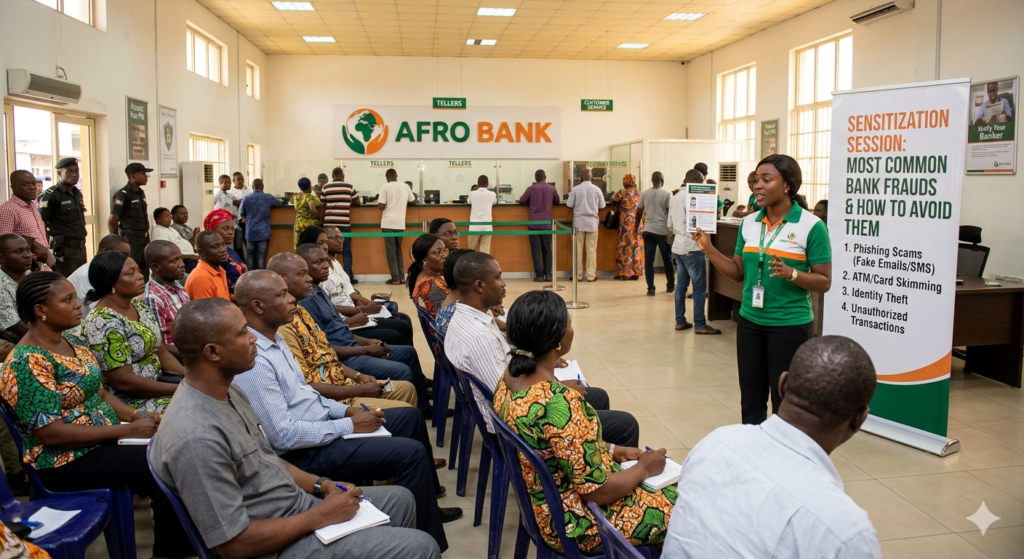
- Educating the Workforce: Employees are trained through simulated phishing tests. They learn to spot subtle signs of corporate email compromise (BEC), enforce strict data sharing rules, and flag suspicious external vendors.
- Protecting the Customer: Banks must actively educate their users. Customers are reminded never to share PINs, tokens, or OTPs with anyone, even individuals claiming to be bank employees.
How Banks Protect Customer Data
Banks employ a data protection strategy known as Defense-in-Depth. If one layer fails, several others stand behind it to secure your assets:
| Protection Layer | Defensive Mechanism | Financial Purpose |
|---|---|---|
| Data At Rest | AES-256 Bit Encryption | Renders stolen data unreadable if servers are physically breached. |
| Data In Transit | TLS/SSL Secure Channels | Prevents hackers from intercepting account data during mobile banking sessions. |
| Access Control | Zero Trust Architecture | Assumes everyone is a threat; requires continuous identity verification. |
| Compliance | PCI-DSS & NDPR/GDPR Audits | Guarantees strict regulatory oversight and heavy fines for security gaps. |
What Is the Biggest Cyber Threat to Banks Today?
When many people think about cyber threats, they imagine sophisticated hackers breaking into systems using complex code. While that does happen, the reality is more subtle and more dangerous. The biggest cyber threat to banks today is not technology, it is human error.
Cybercriminals have realized that manipulating employees is often easier than attacking systems directly. Instead of forcing their way through firewalls, they trick staff into opening the door for them. These attacks rely on:
- Trust
- Urgency
- Authority
- Carelessness
A single click on a malicious link, a shared password, or failure to verify instructions can initiate a major breach. In practical banking terms an employee may unknowingly approve a fraudulent transaction, download infected files, or respond to a phishing email disguised as internal communication. This makes human awareness the most powerful and most neglected cybersecurity control in the banking sector.
Understanding Human Error in Bank Cyber Attacks
Human error is not about incompetence, it is about normal human behavior being exploited under pressure. Bank employees operate in fast-paced environments where customers demand quick service, transactions must be processed rapidly, emails and messages are constant and internal communication flows continuously. In such an environment, mistakes are inevitable. Cybercriminals take advantage of these moments.
Common forms of human error include:
- Clicking on suspicious links without verification
- Using weak or repetitive passwords
- Sharing sensitive information over unsecured channels
- Ignoring unusual system behavior
- Failing to report suspicious activity on time
Here is an example from banking operation & experience
One of our staff received an urgent email appearing to come from head office requesting immediate processing of a transaction or password update. Because this message creates a sense of urgency, the staff member responds without verifying, which leads to unauthorized access. This clearly shows that attackers do not need advanced hacking tools when human psychology can be used as an entry point.
One of our staff received an urgent email appearing to come from head office requesting immediate processing of a transaction or password update. Because this message creates a sense of urgency, the staff member responds without verifying, which leads to unauthorized access. This clearly shows that attackers do not need advanced hacking tools when human psychology can be used as an entry point.
Why Human Error Is the Biggest Vulnerability in Financial Institutions
Financial institutions are built on trust. Employees are trusted with sensitive customer data, financial systems, and internal processes. However, this trust can become a weakness when not backed by awareness. Human error becomes the biggest vulnerability for several reasons:
1. High Access Levels Within Banking Systems
Bank employees often have access to sensitive information and transaction systems. If attackers gain access through an employee, the damage can be immediate and widespread.
2. Repetitive Work Habits
Routine tasks can lead to complacency. When employees perform the same actions daily, they may overlook unusual signs that indicate a threat.
3. Pressure and Urgency
The banking environment demands speed and efficiency. Under pressure, employees are more likely to make mistakes or skip verification steps.
4. Overreliance on Technology
Some employees assume that security systems will catch all threats. This false sense of security reduces personal vigilance.
5. Lack of Continuous Training
Cybersecurity is constantly evolving. Without regular training, employees may not recognize new attack techniques. In essence, cybersecurity fails not because systems are weak, but because human behavior is predictable and exploitable.
Cybersecurity Awareness Training for Bank Staff: A Critical Necessity

To address this challenge, banks must prioritize cybersecurity awareness training for bank staff. Training is no longer optional, it is a core requirement for modern banking operations. Effective training goes beyond basic instructions. It should reshape how employees think, act, and respond to potential threats.
Key Objectives of Cybersecurity Training
Cybersecurity training should help employees to:
- Recognize suspicious emails and links
- Understand different types of cyber threats
- Follow secure communication practices
- Protect sensitive customer information
- Respond quickly to security incidents
Training should not be treated as a one-time event. It must be continuous, practical, and engaging.
How Do Banks Train Employees on Cybersecurity?
Modern banks are adopting structured approaches to cybersecurity training that focus on both knowledge and behavior.
Here are some of the most effective methods:
1. Simulated Phishing Exercises
Banks conduct simulated phishing attacks to test employee awareness. Staff receive fake phishing emails designed to mimic real attacks. When an employee interacts with the email, it becomes a learning opportunity.
Yes, this has happened to me severally without notice and the bank have to send me for training online for clicking a phishing mail unnoticed. Why this works? It transforms theoretical knowledge into real-life experience, helping staff recognize threats in actual situations.
2. Interactive Training Sessions
Instead of long lectures, banks now use, workshops, scenario-based learning and real-life case studies. These sessions help employees understand how attacks happen and how to respond correctly.
3. Role-Based Training
Different employees face different risks. For example, customer-facing staff like the Customer Service Units, the Fund Transfer Officer and Tellers deal with social engineering. The IT staff manage technical vulnerabilities while the operations teams handle transaction-related risks.
Training is tailored to match each role’s exposure to cyber threats.
4. Regular Security Updates
Cyber threats evolve rapidly. Banks provide regular updates on new fraud trends, emerging phishing techniques and industry-specific risks. This keeps employees informed and prepared.
5. Clear Reporting Channels
Employees are trained on how and where to report suspicious activity. This ensures that threats are addressed quickly.
Best Practices for Bank Cybersecurity Awareness Training
To truly reduce human error, banks must adopt strategic training practices that drive long-term behavioral change.
Below are essential best practices:
Make Training Continuous, Not Occasional
Cybersecurity awareness must become part of daily operations. Regular refreshers ensure that knowledge remains current.
Focus on Real-Life Scenarios
Training should reflect actual banking situations, such as: suspicious customer requests, fraudulent transaction approvals and fake internal emails. This makes training practical and relatable.
Encourage a Zero-Blame Reporting Culture
Employees should feel safe reporting mistakes or suspicious activity without fear of punishment. Early reporting can prevent major incidents.
Simplify Security Policies
Complex rules often lead to non-compliance. Policies should be clear, easy to follow and practical
Measure Training Effectiveness
Banks should track how employees respond to simulations and adjust training accordingly.
The Role of Leadership in Cybersecurity Awareness
Cybersecurity culture starts from the top. When leadership prioritizes security, employees are more likely to take it seriously. Management must lead by example by participating in training, reinforce security policies and support awareness initiatives. Cybersecurity should be seen as a business priority and not just an IT function.
From Awareness to Action: Building a Security-Conscious Workforce
Awareness alone is not enough it must translate into action. Employees should consistently practice:
- Verifying before clicking
- Questioning unusual requests
- Protecting sensitive information
- Reporting suspicious activities immediately
When these habits become routine, cybersecurity becomes part of the organization’s DNA.
The Cost of Ignoring Human Risk
Failing to address human error in cybersecurity can lead to serious consequences like financial losses from fraud, regulatory penalties, data breaches, loss of customer trust and operational disruptions. In the banking sector, trust is everything. One breach can damage a bank’s reputation for years.
Frequently Asked Questions (FAQ)
1. What is the main purpose of cybersecurity awareness training?
The primary purpose is to minimize human error, which accounts for more than 80% of corporate data breaches. It transforms employees and customers into an active “human firewall” capable of recognizing, resisting, and reporting digital threats like phishing and social engineering.
2. What are the 7 primary types of cybersecurity?
The seven fundamental types of cybersecurity are:
- Network Security: Protecting network traffic from unauthorized access.
- Cloud Security: Securing data, applications, and infrastructure hosted in cloud spaces.
- Endpoint Security: Defending devices like laptops, smartphones, and servers.
- Application Security: Securing software code from flaws and vulnerabilities.
- Data Security: Protecting database stores and information using encryption.
- Identity & Access Management (IAM): Restricting system access to authorized personnel.
- Mobile Security: Protecting mobile applications and devices from cellular exploits.
3. What are the three key elements of cybersecurity?
Cybersecurity is anchored by the CIA Triad, which stands for Confidentiality (ensuring only authorized users access data), Integrity (guaranteeing data is accurate and untampered with), and Availability (ensuring authorized users have reliable access to systems when needed).
4. What are the two core divisions of cybersecurity?
When simplified to its operational pillars, cybersecurity is divided into Infrastructure Security (protecting physical networks, hardware, and cloud data repositories) and Behavioral (Human) Security (managing user access, policies, and mitigating social engineering tactics).
5. Why do banks need dedicated cybersecurity departments?
Banks require dedicated cybersecurity departments and Security Operations Centers (SOCs) to monitor multi-billion-dollar transaction networks 24/7. Without continuous automated defense, financial institutions face immediate operational collapse, massive regulatory fines, and a total loss of public trust.
6. What specific cybersecurity technologies do modern banks use?
Banks implement a layered defense strategy including Multi-Factor Authentication (MFA) for identity verification, AES-256 Bit Encryption for scrambling data, AI-powered Fraud Detection to monitor transaction anomalies in real-time, and Endpoint Detection and Response (EDR) to stop malware.
7. What is hybrid warfare in banking?
Hybrid warfare in banking is the coordinated use of cyberattacks, systemic fraud, and trust manipulation to disrupt financial systems without using physical weapons. Attackers leverage technology gaps and human errors simultaneously to trigger liquidity pressures and erode public confidence in digital banking.
8. How do banks protect sensitive customer data at rest and in transit?
Banks protect data at rest (stored on servers) using advanced AES-256 encryption algorithms that render stolen data completely unreadable. Data in transit (moving during a transaction) is shielded using Transport Layer Security (TLS) and Secure Sockets Layer (SSL) channels to prevent interception.
9. Can someone hack my bank account using only my account number or BVN?
No. An account number is simply a public-facing destination address for deposits. Similarly, a Bank Verification Number (BVN) is an encrypted identity tracking tool. Neither item grants access to withdraw or move funds on its own, as transactions strictly require cryptographic transaction PINs, passwords, or One-Time Passwords (OTPs).
10. What are 5 high-paying careers available in cybersecurity?
- Security Analyst: Monitors networks for active threats and security alerts.
- Penetration Tester (Ethical Hacker): Authoritatively hacks internal networks to find security gaps.
- Incident Responder: Acts as a digital first responder to contain active data breaches.
- Security Architect: Designs complex, secure network infrastructures from scratch.
- Chief Information Security Officer (CISO): Executive leader handling the entire security strategy.
11. Why is there a high turnover and burnout rate in cybersecurity?
Professionals often quit cybersecurity due to extreme, chronic stress. Operating in a 24/7, high-stakes environment where a single oversight can cost an organization millions of dollars leads to severe mental exhaustion, alert fatigue, and corporate underfunding pressures.
12. How can individuals monetize their cybersecurity skills?
There are several lucrative avenues, including corporate employment as an engineer or consultant, bug bounty hunting on platforms like HackerOne to legally find flaws for cash rewards, freelance security auditing for small businesses, and creating online technical training courses.
13. How many academic subjects or domains are in a standard cybersecurity curriculum?
A comprehensive cybersecurity education generally spans 8 core domains mapped out by industry frameworks like CISSP. These include Security and Risk Management, Asset Security, Security Architecture, Communication/Network Security, Identity and Access Management, Security Assessment, Security Operations, and Software Development Security.
Conclusion: The True Power of Human Awareness
Technology will continue to evolve, and cybercriminals will continue to adapt. But one fact remains constant, the strongest defense in banking cybersecurity is not technology, it is the people. When employees are aware, trained, and vigilant, they become the first and most effective line of defense against cyber threats.
The power of human awareness lies in its simplicity which are
- A paused click
- A questioned request
- A reported suspicion
These small actions can prevent massive breaches. For banks aiming to stay secure in an increasingly digital world, the path forward is clear, invest in people, strengthen awareness, and build a culture where every employee understands that cybersecurity is their responsibility. Because in today’s banking environment, human awareness is not just part of cybersecurity, it is the foundation of it.
I will like to learn more.
What an insightful teaching!