
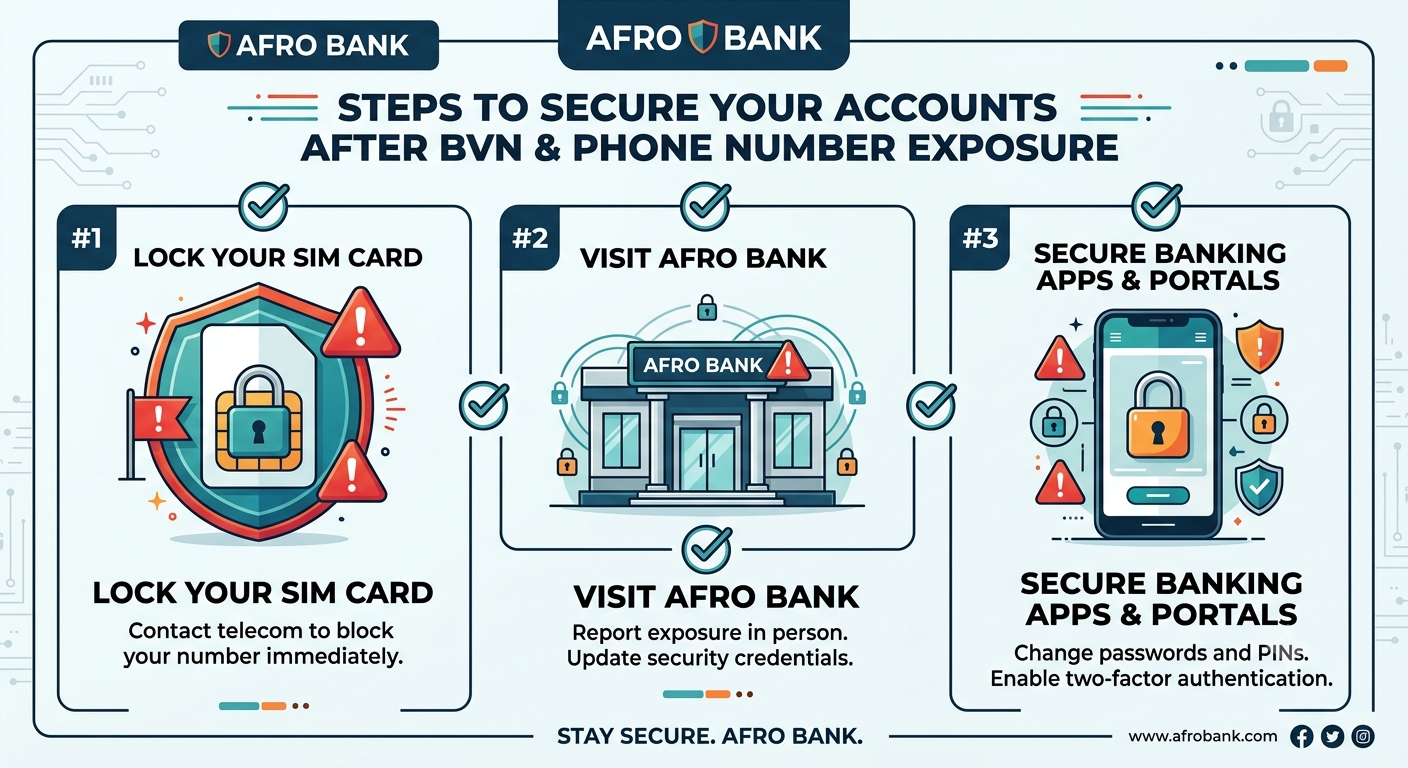
If you’ve mistakenly shared your BVN and phone number, don’t panic, but don’t relax either. While scammers can’t just walk into your account with those two details alone, they can use them to trick you or hijack your phone line. That’s why you need to act fast and lock things down.
Let me clear the air immediately, a cybercriminal cannot directly log into your bank account and empty your funds using only your BVN and phone number. However, they can use these two critical data points as a powerful launchpad to orchestrate complex, multi-layered social engineering and SIM-swap scams that can ultimately lead to your account being compromised.
As bank staff, we deal with the aftermath of these security breaches daily. To permanently secure your hard-earned money, you must understand exactly how backend banking security interfaces with your personal identity.
What Is BVN and What It Is Not?
To understand why a fraudster cannot magically withdraw your money with just a BVN, you must understand what a Bank Verification Number actually represents in the central banking ecosystem.
Launched by the Central Bank of Nigeria (CBN) in collaboration with the Nigeria Inter-Bank Settlement System (NIBSS), the BVN is a centralized biometric identification system. It was designed to curb identity theft, reduce non-performing loans across multiple banks, and uniquely identify every banking customer across the nation.
Think of your BVN as your financial National Identity Number or a digital fingerprint. It is an **identity marker**, not an **authentication credential**.
What a Scammer Can See with Your BVN
If a criminal gains access to your 11-digit BVN and possesses basic tools to query backend databases (often via compromised third-party fintech portals or rogue internal agents), they can extract the following metadata:
- Your full legal name (First, Middle, and Surname)
- Your registered date of birth
- Your primary phone number and email address
- The biometric photographs tied to your profile
- A list of bank accounts linked to that specific identity
What a Scammer Cannot Do with Your BVN Alone
A BVN database does not store, broadcast, or grant access to the details of your bank account. A criminal possessing your BVN does not have:
- Your 4-digit ATM PIN
- Your Mobile Banking Application Login Password
- Your Internet Banking Username or Password
- Your active Hardware Token generation algorithms
- Your live One-Time Passwords (OTPs)
Because banking operations & processes requires multi-factor authentication (MFA) to authorize any outbound movement of cash (debit transactions), simply knowing your BVN is functionally useless for generating a direct withdrawal request.
How Scammers Uses Your BVN & Registered Phone Number?
If a BVN alone cannot extract funds, why do security experts constantly warn against exposing it? The dangers escalates exponentially when a cybercriminal pairs your BVN with your registered phone number.
When a fraudster has both pieces of information, they stop trying to hack the bank’s unyielding central servers. Instead, they try to hacking the weakest link in any security chain, the human user and the telecommunications network.
Here are the techniques and what criminals do when they hold both your phone number and your BVN:
The “Fake Bank Staff” Social Engineering Attack
This is the most widespread financial scam format. Armed with your BVN data, the fraudster already knows your full name, date of birth, and exactly where you open your accounts.
1. The Call: You receive a telephone call from a professional, calm voice claiming to be from your bank’s compliance or data regularization unit.
2. The Psychological Hook: To bypass your natural suspicion, the caller calls your real name, saying “I am calling from the headquarters to ensure your account is not blocked due to an uncompleted BVN update.” To confirm I am looking at your file, they call your phone number and BVN.
3. The Trap: Because they know intimate details that only a banker should know, your psychological defenses drop. You trust them.
4. The Ultimate Request: Once trust is established, the scammer initiates a password reset or a transaction authorization from their end, triggering a real OTP to hit your phone. They then say: *”An authentication code has been sent to your phone to finalize the update. Please read it out to me to complete the process.”*
If you read that OTP, you have willingly given them the final authorization key to drain your accounts. The BVN was merely the bait used to make the fake phone call sound authentic.
The SIM-Swap Fraud (Network Level Hijacking)
Your registered phone number is the primary pipeline for transactional notifications and security OTPs. If a fraudster can get control of your SIM card, they bypass the need to call you entirely.
Using your exposed BVN details (Full name, Date of Birth, and Phone number), the criminal can approach an unsuspecting customer care agent at a telecommunications service center. They present forged identity cards matching the BVN records and claim that their phone was stolen, demanding a SIM replacement (SIM Swap).
The moment the telecommunications provider activates the new SIM card in the fraudster’s device, your physical phone loses network signals completely. The fraudster now routes all your incoming SMS messages, bank alerts, and most importantly your USSD transfer OTPs directly to their own handset. They can then utilize your phone number to reset your mobile app pin via USSD channels (*737#, *901#, *770# etc.) and systematically empty your accounts while you sleep, wondering why your phone has “no network.”
The Automated USSD Profile Regimes
Many retail banks allow customers to set up and configure their mobile banking profiles via short codes directly from their mobile phones. To link a mobile banking profile to a phone number via USSD for the first time, the banking system typically requests two primary validation points:
1. The phone number must match the account information
2. The user must input the account number or the BVN tied to the profile.
If a fraudster gets hold of your phone via physical theft or brief borrowing (e.g., “Please let me make a quick call with your phone”), and they already have your BVN written down, they can quickly dial your bank’s USSD code, initiate a pin reset using your BVN, and set up a new transactional pin within minutes without your consent.
How to Lock Down Your SIM & Phone Against Scammers
If you have already exposed your BVN and phone number, sitting back and hoping for the best is a dangerous strategy. You must proactively disable of block your mobile app & USSD codes, so that even if a hacker has your identity details, they remain locked out of your money
Implement these four ironclad security steps immediately:
Step 1: Secure Your Mobile Operator Access (Set up a SIM PIN)
A SIM PIN ensures that even if a criminal physically steals your phone or attempts to clone your SIM card, the card cannot register on any network tower without a specialized 4-digit code.
On Android:** Go to Settings > Security & Privacy > More Security Settings > SIM Card Lock. Toggle “Lock SIM Card” and enter a unique 4-digit pin.
On iOS:** Go to Settings > Cellular > SIM PIN. Toggle it on and establish your secret access code.
Note: Never use obvious combinations like 0000, 1234, or your birth year.
Step 2: Move from SMS Authentication to Digital Tokens
SMS-based One-Time Passwords are fundamentally vulnerable to network attacks and SIM swaps. Most progressive retail banks now allow you to deactivate SMS OTPs for large transactions, requiring you to generate authorization codes using a hard token or an in-app software token (like Google Authenticator or your bank’s custom authenticator app). Software tokens are made strictly to your physical smartphone device hardware and cannot be hijacked via a standard network SIM swap.
Step 3: Deactivate Visible Mobile App Push Notifications
If your phone is sitting on a desk or table, and a banking OTP arrives via SMS, standard phone settings often broadcast the code directly on the lock screen for anyone to read. Go into your smartphone notification settings and configure your device to “Hide sensitive content on lock screen.” This simply blocks casual visual theft of login tokens.
Step 4: Report To Your Bank Immediately
Walk into your bank branch and demand to speak directly with the Compliance or Information Security Officer. Inform them that your credentials (BVN and phone number) have been compromised through phishing. Request that your account be frozen immediately. This alert mandates that any request for an online password reset, change of primary phone number, or unusually large funds transfer must done manually, physical biometric verification inside a branch before processing.
Frequently Asked Questions
Can a fraudster withdraw money from my account using only my phone number?
Absolutely not. Your phone number is a communication pipeline, not a key. Without a corresponding transaction PIN, card details, or internet banking password, merely knowing a phone number yields zero extraction capabilities for an external actor.
Is it legal for apps or fintech platforms to ask for my BVN?
Yes, it is completely legal and mandatory under Know Your Customer (KYC) regulatory compliance frame frameworks set by central banks. Legitimate platforms use your BVN solely to verify that the person creating the digital wallet matches the official name registered with the government identity database. It protects the ecosystem against money laundering.
Can I change my BVN if it gets leaked or compromised?
No. Your BVN is a permanent biometric identifier tied to your physical body (fingerprints and facial mapping). It cannot be deleted, reset, or reissued. If your BVN leaks, your identity parameters remain the same, meaning your focus must shift entirely toward securing your changeable authentication pins, app access codes, and telecommunications infrastructure.
Conclusion
As a bank staff, my final piece of advice is simple, treat your financial identity like your home. Your BVN and phone number are the physical address of your house, anyone can look up where you live if they search hard enough. But knowing your address does not open your front door unless you willingly hand over the physical door keys.
Your BVN is like your ID card, it shows who you are but doesn’t open your bank vault. The real danger comes when scammers combine it with your phone number to trick you or steal your SIM. By locking your SIM, updating your bank details, and staying alert, you make it almost impossible for them to touch your money.
Your ATM PINs, mobile banking passwords, security tokens, and transaction OTPs are those precise door keys. Keep them protected, never repeat numbers across different banking interfaces, and ignore any phone call demanding validation codes.

Leave a Reply