
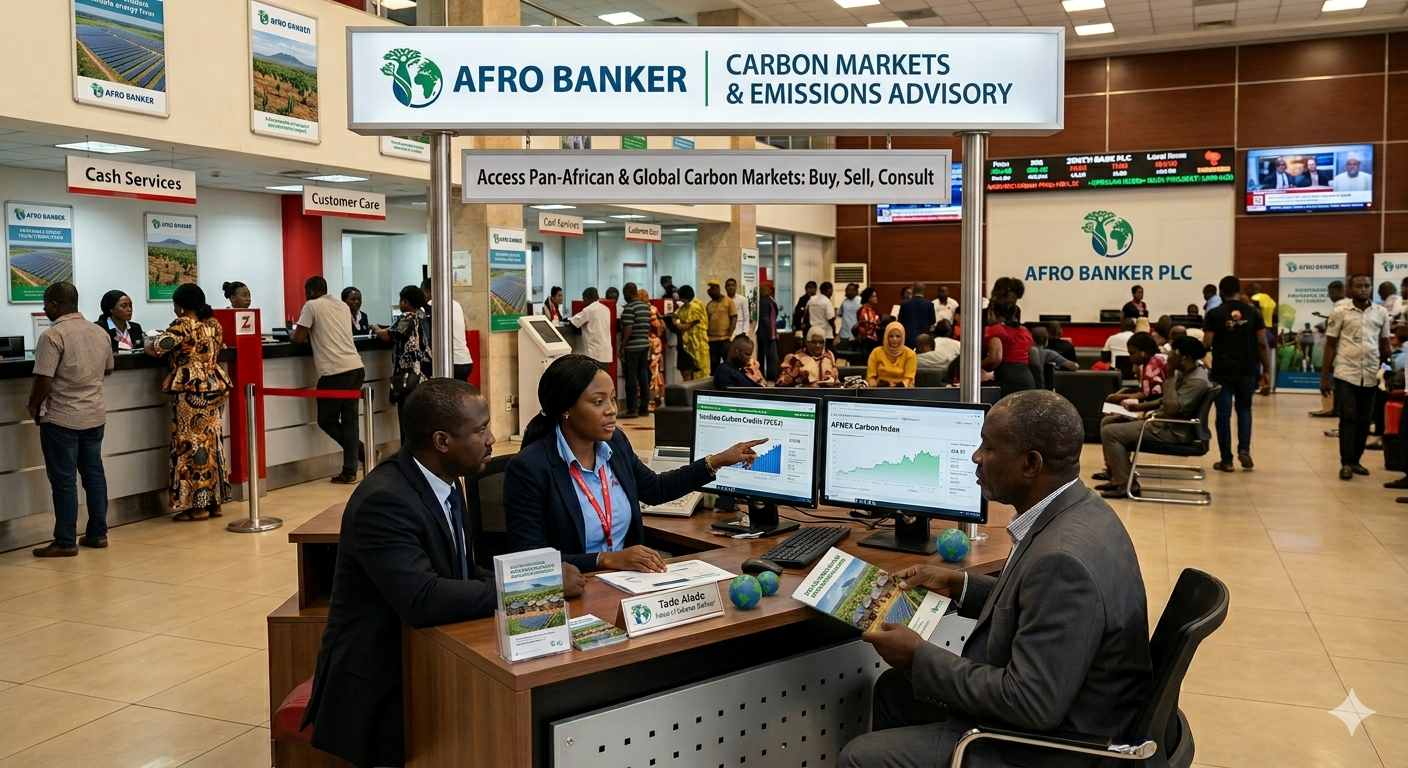
Across the global financial system, a quiet transformation is underway. This is a Silent Opportunity Banks Are Missing. Carbon markets once considered a niche climate policy tool are rapidly evolving into a multi‑billion-dollar financial ecosystem, attracting governments, corporations, and investors alike. Yet, despite their rising importance, many banks and financial institutions, especially across Africa, remain largely unaware, unprepared, or under-engaged.
This gap in awareness is not just a knowledge issue, it is a missed economic opportunity. From funding renewable energy to trading carbon credits, carbon markets are creating new revenue streams, new asset classes, and new financial instruments. For banks, this represents a shift similar to the early days of fintech or digital banking. Those who move early gain advantage. Those who delay risk falling behind. So why is awareness still low? And more importantly, how can banks catch up?
Understanding Carbon Markets
Before diving deeper, let’s simplify the concept. A carbon market is a system where entities can buy and sell carbon credits, each representing the reduction or removal of carbon emissions. These credits are generated through activities such as renewable energy projects, reforestation and afforestation, methane capture and energy efficiency improvements.
For financial institutions, the key takeaway is this: Carbon markets turn environmental impact into tradable financial assets.
Why Carbon Market Awareness Is Still Low In Banks
Despite global momentum, several structural and operational factors explain why banks, especially in emerging markets are lagging and the are:
1. Traditional Banking Focus Still Dominates
Most banks are still heavily focused on loans and credit facilities, deposits and liquidity management and foreign exchange and treasury operations. Climate finance, including carbon markets, is often seen as “non-core” or experimental. In reality, carbon finance is becoming a core financial segment, just like insurance or investment banking.
2. Knowledge Gap and Technical Complexity
Carbon markets are not straightforward. They involve measurement, Reporting, and Verification (MRV) systems, emission baselines and methodologies and international frameworks like Article 6 of the Paris Agreement. For many banks, this creates a barrier where “If we don’t fully understand it, we won’t engage.” This knowledge gap leads to low awareness at both executive and operational levels.
3. Lack of Internal Expertise and Talent
Many financial institutions do not yet have climate risk analysts, carbon trading specialists and sustainability finance teams. Without internal capacity, carbon markets remain an abstract concept rather than a business opportunity.
4. Regulatory Uncertainty in Emerging Markets
In regions like Africa, including Nigeria, carbon market frameworks are still evolving. Banks often wait for Clear regulatory rules, defined compliance obligations and government incentives. This leads to a “wait-and-see” approach, slowing adoption.
5. Perception That Carbon Markets Are Only for Governments & Corporates
A common misconception is that banks thinks that “Carbon markets are for governments or environmental organizations.” But this is incorrect because banks can play critical roles such as financing carbon projects, facilitating carbon credit trading, acting as intermediaries and developing financial products tied to carbon assets.
Why This Must Change (The Financial Opportunity)
Low awareness is not just a knowledge gap, it is a strategic risk.
1. Carbon Markets Are Becoming a Major Financial Asset Class
Carbon credits are increasingly being treated like commodities, financial derivatives and investment instruments. Banks that ignore this space risk missing the creation of a new financial ecosystem.
2. New Revenue Streams for Banks
Carbon markets unlock multiple income opportunities like:
- Trading fees from carbon credit transactions
- Advisory services for corporate clients
- Project financing for green initiatives
- Carbon-linked investment products
This is especially important for African banks seeking to diversify beyond traditional revenue sources.
3. Growing Demand from Corporate Clients
Companies are under pressure to achieve net-zero targets, ESG compliance sustainability reporting. These companies need banks to help source carbon credits, structure carbon finance deals and provide funding for emission reduction projects. Banks that are unaware cannot serve this growing demand.
4. Global Shift Toward Sustainable Finance
Sustainable finance is no longer optional, it is becoming standard. Key trends include green bonds, ESG investing, climate risk disclosure, carbon pricing. Carbon markets sit at the center of this shift.
5. Africa’s Strategic Advantage
Africa holds massive carbon potential like the forests and biodiversity (carbon sinks), renewable energy resources and agricultural carbon projects. For Nigerian and African banks, this means that carbon markets are not just global, they are local opportunities waiting to be unlocked.
How Financial Institutions Can Catch Up

The good news? Banks can move quickly if they adopt the right strategy.
1. Build Internal Awareness First
Awareness must start within the institution like executive education programs on carbon finance, internal workshops and training and integration into strategy discussions. If leadership understands it, action will follow.
2. Create Dedicated Climate Finance Units
Banks should establish teams focused on carbon markets, sustainable finance and ESG strategy. This creates ownership and accountability, turning awareness into execution.
3. Partner with Carbon Market Experts
Banks don’t need to start from scratch, they can collaborate with carbon registries, climate fintechs and international development organizations. This helps them to reduce learning curve, build credibility fast and access global networks.
4. Develop Carbon-Linked Financial Products
Innovative banks can begin offering in carbon-backed loans, green financing products, carbon investment portfolios and offset-linked banking services. This positions them as forward-thinking institutions.
5. Engage Regulators and Policymakers
Banks should not wait for regulation, they should help shape it. Active engagement ensures better policy design, early compliance readiness and competitive advantage.
6. Leverage Digital Platforms and Fintech
Technology will play a major role in carbon markets by creating a carbon trading platforms, ensuring blockchain verification systems and the provision of climate data analytics. Banks that integrate digital solutions will scale faster.
The Nigerian Banking Opportunity
Nigeria is entering the carbon market space with strong intent. This creates a unique advantage for early movers. Banks in Nigeria can finance local carbon projects (agriculture, energy, forestry), facilitate international carbon credit transactions, support SMEs in carbon initiatives and position Nigeria as a regional carbon finance hub.
As for my readers, this is a defining moment because the same way digital banking reshaped the industry, carbon finance could define the next decade.
Read more on “Why Fintechs Are Beating Traditional Banks”
The Risk of Inaction
Banks that ignore carbon markets face real risks of loss of relevance in sustainable finance, reduced competitiveness, missed investment opportunities and failure to meet global ESG expectations
In a rapidly evolving financial world, staying unaware is no longer neutral, it is a strategic disadvantage.
My Final Thoughts
Carbon markets are no longer a future concept, they are a present financial reality. The awareness gap in banks is understandable, but it is not sustainable. As global finance continues to shift toward sustainability, carbon markets will become deeply integrated into investment strategies, risk management, lending practices financial innovation.
For banks and financial institutions, especially in Africa, the question is no longer “Should we pay attention to carbon markets?” but rather “How fast can we understand, adapt, and lead?”
Therefore Banks should kindly take note on these key points:
1. Carbon markets convert emissions reduction into tradable financial assets
2. Awareness in banks is low due to knowledge gaps, regulation, and traditional focus
3. Opportunities include new revenue streams, product innovation, and market leadership
4. African banks are uniquely positioned to benefit from local carbon resources
5. The future belongs to financial institutions that act early and adapt quickly.
Leave a Reply