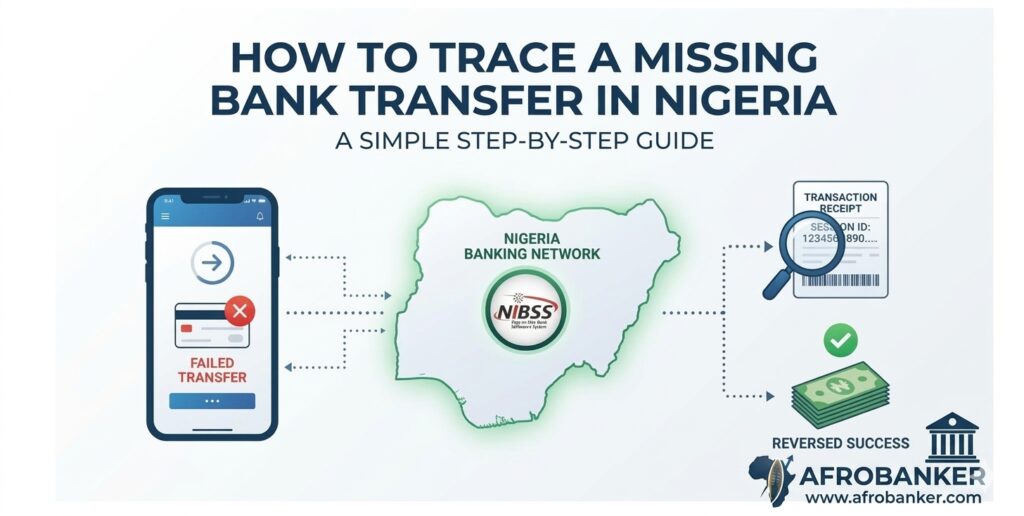
To trace a missing bank transfer in Nigeria, first obtain your transaction receipt, transaction ID, session ID, and account details. Confirm whether your account was debited, contact your bank immediately, and request a transfer trace. If the recipient has not received the funds, the bank can investigate the transaction through the payment switch and receiving institution. Most missing transfers are either successfully delivered, reversed automatically, or resolved through a formal dispute process.
Electronic banking has made moving money incredibly convenient, but it can be highly stressful when a transaction goes wrong. Whether you are dealing with a delayed payment, a mysterious account discrepancy, or a suspected scam, knowing how the banking infrastructure functions allow you to protect your funds.
Nothing creates panic faster than discovering that money has left your account, yet the recipient insists they have not received it. Whether you are sending money to a family member, paying school fees, completing a business transaction, funding a wallet, or settling an urgent bill, a missing bank transfer in Nigeria can leave you frustrated and worried.
As someone who has worked in banking operations and customer service over a decade, I have witnessed countless cases where customers rushed into banking halls believing their money had disappeared forever. In reality, most missing transactions can be traced, investigated, and resolved when the proper procedure is followed.
The challenge is that many people do not know how to trace a transfer, what information banks need, how long investigations take, or whether a transaction ID can actually be tracked.
This guide explains everything you need to know about tracing a missing bank transfer in Nigeria, understanding where your money may have gone, and what steps can help you recover it.
What Is a Missing Bank Transfer?
A missing bank transfer occurs when money leaves the sender’s account but does not appear in the recipient’s account within the expected timeframe.
This situation can happen on:
- Mobile banking apps
- Internet banking platforms
- USSD transfers
- POS transactions
- Fintech applications
- Interbank transfers
- International remittance platforms
The transfer may be delayed, held up in processing queues, affected by network issues, or awaiting reconciliation between financial institutions. Importantly, a missing transfer does not always mean the money is lost.
In most cases, the funds are either:
- Successfully delivered later
- Pending in the banking system
- Automatically reversed
- Under investigation
A Real Banking Scenario
A customer once entered a banking hall visibly distressed after transferring ₦350,000 to a supplier. The sender received a debit alert immediately, but the recipient received nothing. The customer checked the transaction history repeatedly but could not understand what happened.
The transaction had encountered a switching delay between institutions. The funds remained in transit for several hours before eventually posting successfully.
Had the customer panicked and sent another ₦350,000, they could have ended up paying twice. Situations like this occur everyday across Nigerian banks and fintech platforms. The key is knowing how to trace the transaction properly before assuming the money has vanished.
Step-by-Step Process to Trace a Missing Bank Transfer in Nigeria
Here is the exact step-by-step process to trace a missing bank transfer in Nigeria, along with the contact channels for major banks and the official escalation path to the Central Bank of Nigeria (CBN).
The Step-by-Step Tracing Process
When an electronic funds transfer (EFT) fails or hangs in transit between Nigerian banks, the Nigeria Inter-Bank Settlement System (NIBSS) guidelines mandate distinct timelines. Follow these phases to track down the money:
Step 1: Gather the Transaction Evidence
-
-
-
- Open your bank app or internet banking portal.
- Take screenshots of the successful debit alert and download the PDF Transaction Receipt.
- Note the Session ID / Transaction ID (a long string of numbers unique to that NIBSS transfer). This is the only footprint banks use to trace the money.
-
-
Step 2: Lodge an Official Complaint with the Originating Bank
-
-
-
- Call customer care or log into your banking app to fill out a Dispense Error / Transfer Dispute Form.
- Always demand a Complaint Tracking / Reference Number. Do not leave or hang up until you are issued one.
-
-
Step 3: Track the Resolution Window
-
-
-
- Under CBN regulations, standard instant funds transfer disputes should be resolved within 2 to 3 working days (72 hours).
- If the transfer was an inter-bank transaction (e.g., GTBank to Zenith), your bank will issue a “Recall Request” to the receiving bank using the Session ID.
- If the money left your bank but did not hit the destination account, it is likely held in the receiving bank’s clearing/suspense account and must be reversed or applied manually.
-
-
Customer Care Contact Channels for Major Nigerian Banks
Always reach out via verified official channels. Avoid sharing your PIN, passwords, or full BVN on social media platforms.
| Bank | Customer Care Email | Official Phone Line |
| Access Bank | contactcenter@accessbankplc.com | +234 1-2712005 |
| GTBank | complaints@gtbank.com | +234 1-4480000 |
| Zenith Bank | zenithdirect@zenithbank.com | +234 1-2787000 |
| UBA | cfc@ubagroup.com | +234 1-2808822 |
| First Bank | firstcontact@firstbanknigeria.com | +234 1-9052326 |
| Fidelity Bank | trueserve@fidelitybank.ng | +234 02014485252 |
| Stanbic IBTC | customercarenigeria@stanbicibtc.com | +234 1-4222222 |
How to Send a Complaint to CBN if the Bank is Non-Responsive
If your bank fails to resolve the issue within 2 weeks (14 days), or fails to acknowledge your initial complaint within 3 days, you have the legal right to escalate the matter to the apex regulator.
Where to File the Complaint
You must route your complaint to the Consumer Protection Department (CPD) of the CBN.
- Email: Send your petition directly to cpd@cbn.gov.ng.
- Physical Letter: Address a physical letter to the Director, Consumer Protection Department, Central Bank of Nigeria, Central Business District, Abuja. You can drop this off at the CBN Head Office or any CBN branch office nationwide.
What Your Complaint Letter Must Include
To make your petition effective and legally binding, your email or letter must explicitly contain:
-
- Your Personal Details: Full name, phone number, physical address, and contact email.
- Account Information: Name of the financial institution, your account number, and the recipient’s account details (Do NOT include your PIN or mobile app password).
- Transaction Details: Date of the incident, exact amount in Naira (₦), and transaction channel used (e.g., Mobile App, USSD, POS).
- Evidence of Prior Lodgment: Attach your bank’s Complaint Reference/Tracking Number along with screenshots of emails showing you gave the bank at least 2 weeks to fix the issue.
- Supporting Documents: Attach the PDF transaction receipt or bank statement showing the debit.
The CBN review process is entirely free. Once the CPD takes up the case, they hold the power to mandate reversals and levy financial penalties against the non-responsive bank.
Why Did My Bank Transfer Go Missing?
Several factors can contribute to a missing bank transfer in Nigeria.
Network and Switching Delays
Banks rely on payment infrastructure to route funds between institutions. When there is network congestion or system downtime, transactions may be delayed before reaching the destination account. This is one of the most common causes of delayed credits.
Core Banking System Issues
Sometimes a bank experiences technical upgrades, maintenance, or temporary service disruptions. In such cases, transactions may appear stuck even though the transfer process has already begun.
Wrong Account Details
A single incorrect digit can send money to the wrong destination or cause a transaction to remain unresolved. Always verify account number, bank name, beneficiary name before authorizing a transfer.
Reconciliation Delays
Financial institutions regularly reconcile transactions. If discrepancies arise, a transfer may remain pending until reconciliation is completed.
Recipient Bank Problems
Occasionally, the receiving bank experiences technical difficulties. The sender’s bank may have processed the transfer successfully while the recipient institution has not yet posted the credit.
How Do I Trace a Bank Transfer?
One of the most frequently asked questions is “how do I trace a bank transfer?”. To trace a bank transfer, you must formally request the originating financial institution to trace the path of the funds. The bank acts as a digital investigator, auditing the Electronic Funds Transfer (EFT) file logs to see exactly when the money departed their network and where it was routed.
For domestic transfers, the bank initiates an internal or network-wide check. For international transfers, banks use specific messaging networks like SWIFT to track down the exact node where the payment is stalled
To trace a transfer successfully, gather the following:
- Transaction ID
- Session ID
- Transfer amount
- Transfer date
- Sender’s account number
- Recipient’s account number
- Bank names involved
These details serve as the digital fingerprint of the transaction. Once available, contact your bank and request a transfer trace or transaction investigation. The more information you provide, the faster the investigation can proceed.
What if a Transaction Is Successful but Not Received?
If your bank app states the transaction was “Successful” but the recipient insists their account balance is unchanged, the money is typically stuck in a suspense or clearing account at the receiving institution. This situation confuses many customers. Your app may show “successful” while the recipient insists no credit has been received.
This can happen due to:
- Delayed posting
- Receiving-bank issues
- Notification delays
- Temporary account restrictions
In such cases, a trace investigation becomes necessary. Banks can verify whether the receiving institution acknowledged and processed the transaction.
Can a Transaction Number Be Traced?
Yes, absolutely. A transaction number is the absolute definitive tool for tracing a payment. Think of a transaction ID (often called a Reference Number, Session ID, or Trace ID) as a unique postal tracking number for your money.
When you provide this specific alphanumeric string to a bank agent, they bypass generic account searches and look up the exact digital envelope that carried the funds. This ID tracks the money across the sending bank, the central clearing switchboard, and the destination bank’s incoming vault.
Transaction numbers are designed specifically for tracking and verification. Each electronic transfer generates a unique identifier that allows banking institutions to monitor movement through payment channels.
A transaction number can help determine whether the transfer:
- Was successful
- Is still pending
- Failed completely
- Was reversed
- Reached the receiving bank
This is why customers should never delete transaction receipts after making payments.
Can I Track a Transaction with a Transaction ID?
In most situations, yes. A transaction ID is one of the most valuable pieces of information when investigating a missing bank transfer in Nigeria.
While customers cannot usually track the transaction themselves in real time, the bank can use the ID to review logs and determine the transaction status. The transaction ID often accelerates investigations significantly.
How to Track a Money Transfer Transaction
Follow these practical steps:
Keep Your Receipt
Always save:
- Transfer confirmation
- SMS alerts
- Screenshots
- Email receipts
Verify Recipient Information
Confirm:
- Correct bank
- Correct account number
- Correct beneficiary name
Monitor Both Accounts
Sometimes the recipient receives funds before notifications are updated. Ask the beneficiary to check transaction history instead of relying solely on alerts.
Contact Both Banks
Where necessary, both institutions can investigate the transaction. This becomes particularly useful if the transfer appears completed on one side but missing on the other.
What Happens if Money Is Transferred but Not Received?
A “Successful” status on your end simply means the money left your bank account smoothly and was accepted by the central clearing network. If the destination bank experiences a network delay, or if there is a minor mismatch in the recipient’s name or account tier limits, the funds will sit in a temporary holding buffer rather than posting to the customer’s balance. The sender must provide the transaction receipt to the recipient, who can then take the transaction ID to their own bank to manually claim and release the trapped funds.
Usually, one of three outcomes occurs:
- The Funds Arrive Later: The transfer experiences delays but eventually posts successfully.
- The Transfer Is Reversed: The money automatically returns to the sender’s account after a failed transfer.
- Investigation Is Initiated: The bank examines transaction records and determines where the funds are located.
Most unresolved transfers eventually fall into one of these categories.
How to Locate a Transaction
Locating an elusive transaction involves cross-referencing your financial logs across different channels. First, log into your mobile application and check both your “Pending Transactions” and your “Completed History.” If it is not visible there, download a full PDF Account Statement for the month, as statements often record raw data inputs that mobile interfaces skip. Finally, check your email inbox or SMS history for automated transaction alerts sent at the exact moment the exchange took place.
Start by checking:
- Bank statement
- Mobile app history
- Internet banking records
- Email confirmations
- SMS notifications
Look for date, amount, reference number, and beneficiary details. These records help identify the exact transaction and support any formal complaint.
Why Did a Transaction Disappear from My Bank Account?
Perhaps the most alarming situation is when a transaction appears to vanish completely. When a transaction completely vanishes from your statement history without a trace, it is usually due to one of three technical occurrences:
- Authorization Holds: Many transactions appear initially as “pending.” If a merchant fails to finalize or settle the transaction within a designated window, the temporary hold drops off, and the funds temporarily reappear in your balance.
- System Glitches & Processing Rollbacks: Banks regularly run batch processing cycles overnight. If a system failure or communication drop occurs mid-transit, the ledger might automatically roll back the transaction to its original state, making it look like it never happened.
- Fraud Adjustments: If your bank’s internal fraud detection algorithms flag a transaction as highly suspicious right after it occurs, they may pull the item from your visible feed while an investigation takes place.
Other possible reasons include:
System Updates: A temporary system refresh may affect transaction visibility.
Reversal Processing: The transaction could be undergoing automatic reversal.
Technical Glitches: App synchronization issues occasionally hide transactions temporarily.
Statement Refresh Delays: Backend records may update before customer-facing channels reflect changes.
If you cannot find a transaction, contact your bank immediately for clarification.
Why Am I Missing Money from My Bank Account?
Unexplained drops in your account balance usually stem from unrecorded backend deductions rather than outright theft. Common culprits include:
- Accumulated Maintenance Fees: Monthly card maintenance, account maintenance fees, or SMS alert charges billed in a single lump sum.
- Delayed Offline Debits: Transactions made days prior (like transit fares or automated subscriptions) that were finally processed by the merchant.
- Hidden Reversals: A previous credit or refund that was mistakenly applied to your account and subsequently clawed back by the bank’s audit team.
If funds seem to have disappeared, possibilities include:
- Failed transfers awaiting reversal
- Duplicate debits
- Unauthorized transactions
- Recurring payments
- Pending card transactions
- Banking errors
Prompt reporting increases the chances of quick resolution. Always review your transaction history carefully before assuming fraud has occurred.
Can a Bank Track the Location of a Transaction?
Many customers imagine banks tracking money like a GPS signal. The reality is slightly different.
Yes, banks track multiple layers of metadata for every transaction to combat fraud. When you perform an action, the bank records the physical ATM location or Point of Sale (POS) merchant address.
For digital banking, they track your IP address, device fingerprints, and geographic location tags. While a customer care representative might only see a merchant name on their standard screen, the bank’s internal cybersecurity compliance teams can pinpoint the digital and physical grid coordinates where a transaction was authenticated.
Banks cannot see a physical location for funds in the way people track vehicles. However, they can track the transaction’s path through payment systems.
They can determine:
- Processing stage
- Receiving institution
- Transaction status
- Settlement stage
- Reversal progress
This digital trail helps investigators determine exactly what happened.
How to Trace a Bank Payment
Tracking a payment requires pulling the digital receipt from your mobile app or online banking platform. Every digital payment leaves a financial paper trail.
The process includes:
- Collect transaction evidence.
- Identify the core transaction details: date, exact timestamp, amount, and the recipient’s institution details.
- Obtain reference numbers.
- Confirm beneficiary details.
- Contact customer support.
- Request transaction tracing.
- Follow up with reference numbers.
- Escalate unresolved cases.
Contact the customer service department of the sending provider and supply these criteria. They will check the transaction status against their system ledger to see if the money is “In Progress,” “Delivered,” or “Reversed”. The earlier a payment trace is initiated, the easier it is to investigate.
What Is the Longest a Bank Transfer Should Take?
Most Nigerian transfers are completed within minutes. However, processing delays can extend timelines.
The maximum duration depends entirely on the pathway the money travels:
- Domestic Instant Transfers: These should resolve in real-time or up to a maximum of 24 hours if caught in a system glitch.
- ACH / Standard Local Transfers: Typically take 1 to 3 business days to settle through standard clearinghouse cycles.
- International Wire Transfers: Generally require 3 to 5 business days. This timeline can extend up to 10 business days if the money must pass through multiple global intermediary or correspondent banks before reaching its final destination.
Other factors affecting timing include:
- Weekends
- Public holidays
- Network disruptions
- System maintenance
- Compliance reviews
- Interbank reconciliation issues
While many transfers complete almost instantly, unresolved cases sometimes require several business days of investigation. If your transfer remains unresolved beyond the expected timeframe, open a formal complaint with the bank.
Will Banks Refund Stolen Money?
A bank will typically refund stolen money only if you prove you exercised due diligence and met their strict reporting windows. If your card was physically stolen, or your digital account was hacked due to a data breach beyond your control, consumer protection laws generally protect you, provided you report the unauthorized activity immediately.
However, if you voluntarily gave out your One-Time Password (OTP), shared your secret PIN, or fell victim to a social engineering scam where you willingly initiated the transfer, banks usually deny the refund. They view this as a breach of your customer security agreement rather than a failure of their system infrastructure.
This question often arises when customers suspect unauthorized transactions. This depends on the circumstances. Banks carefully investigate:
- Fraud claims
- Account compromise
- Unauthorized access
- Customer negligence
- Scam-related transactions
If investigations prove the customer was a victim of unauthorized activity, refunds may be possible depending on findings and applicable regulations.
However, not every disputed transaction automatically qualifies for reimbursement. This is why immediate reporting is crucial.
How to Trace a Bank Transaction
The process is similar regardless of the bank involved.
Step 1: Check Transaction Status
Review your mobile app, internet banking profile, or transaction receipt. Look for statuses such as:
- Successful
- Pending
- Processing
- Failed
- Reversed
Step 2: Obtain the Transaction Reference
Most transfers generate transaction reference number, session ID, NIP reference and transaction ID. This number becomes critical during investigations.
Step 3: Contact Customer Support
Report the missing transaction immediately. Provide all available details, including screenshots and receipts if necessary.
Step 4: Request Escalation
If the issue remains unresolved after initial contact, request formal escalation to the bank’s dispute or electronic banking unit like the Consumer Protection Department (CPD) of the CBN.
What Information Should You Provide When Reporting a Missing Transfer?
When reporting a missing bank transfer in Nigeria, have the following ready:
- Full name
- Account number
- Transaction amount
- Date and time
- Transaction ID
- Session ID
- Beneficiary details
- Screenshot of the transaction
- Receipt or debit alert
Providing complete information can significantly reduce investigation time.
How to Avoid Missing Bank Transfers in Nigeria
Although some delays are unavoidable, certain precautions help reduce risk.
Double-Check Account Details
Always verify beneficiary information before sending funds.
Save All Receipts
Never delete transfer confirmations immediately.
Use Stable Internet Connections
Interrupted sessions can contribute to transaction problems.
Monitor Bank Notifications
Prompt awareness helps you react quickly when issues arise.
Report Problems Early
Do not wait several days before notifying the bank.
Early reporting increases the likelihood of efficient resolution.
Frequently Asked Questions (FAQs)
Q1: What is a NIBSS Session ID, and where can I find it?
A: A NIBSS Session ID is a unique 22-digit or 30-digit numerical string generated for every electronic transaction in Nigeria. It serves as the digital fingerprint of your transfer. You can find it printed directly on your PDF transaction receipt, under the label “Session ID,” “Ref Id,” or “Transaction Reference.”
Q2: My bank app says the transfer was “Successful,” but the receiver hasn’t gotten it. Where is the money?
A: If it is successful on your end but unreceived, the money is usually trapped in the receiving bank’s suspense account. This happens when the destination bank experiences a temporary network glitch or downtime at the exact moment the money arrives. The receiver needs to take your transaction receipt to their bank to log a manual deposit.
Q3: How long does a bank transfer reversal take in Nigeria?
A: According to Central Bank of Nigeria (CBN) regulations, failed instant inter-bank transfers should ideally reverse automatically within 10 minutes to 24 hours. If it requires manual reconciliation, the official resolution window is 2 to 3 working days (72 hours).
Q4: Can I trace a missing transfer if I did it via USSD code?
A: Yes. Even though you do not get a downloadable PDF receipt via USSD, the transaction leaves a paper trail. You can retrieve the Reference Number by checking your debit SMS alert, generating an account statement via your banking app, or calling your bank’s customer care line to request the transaction logs for that specific time.
Q5: What should I do if my bank refuses to refund a failed transfer after 3 working days?
A: You should immediately request a formal Complaint Log Number from your bank. If the issue remains unresolved after 14 days (2 weeks), you have the legal right to escalate the matter by sending a petition to the CBN Consumer Protection Department via cpd@cbn.gov.ng to enforce a reversal.
Q6: Can a Nigerian bank track the location or person behind a fraudulent transfer?
A: Yes. Every bank account in Nigeria is linked to a Bank Verification Number (BVN) and a National Identification Number (NIN). If funds are traced to a scammer’s account, the originating bank can collaborate with the receiving institution to place a temporary restriction (“Post No Debit” or PND) on the fraudulent account while legal or security agencies step in.
Q7: Why do transfers from commercial banks to fintech apps like OPay or PalmPay delay so often?
A: Fintech apps rely heavily on instant API webhooks rather than the traditional batch-clearing systems used by older commercial banks. If there is a slight network lag or an API timeout between the commercial bank and the fintech’s servers at the second you hit send, the money leaves the bank but fails to automatically trigger the credit alert on the fintech app.
Q8: How do I find a Session ID on OPay or PalmPay to track a missing transaction?
A: Open the app, go to your Transaction History, and click on the specific transaction. Instead of a long form, tap “Share Receipt” or “Download Receipt.” The generated image or PDF will clearly display a 22-digit or 30-digit sequence labeled as the NIBSS Session ID or Transaction Reference.
Q9: Are fintech apps covered by the same CBN 14-day dispute escalation rule as traditional banks?
A: Yes. All licensed fintech companies operating in Nigeria as Microfinance Banks (MFBs) or Payment Service Banks (PSBs) are fully regulated by the Central Bank of Nigeria (CBN). If OPay, PalmPay, Moniepoint, or any other fintech ignores a failed transaction dispute for over 14 days, you can escalate them directly to the CBN Consumer Protection Department (cpd@cbn.gov.ng).
Q10: What is the fastest way to get a response from a fintech customer care representative?
A: Unlike traditional banks where physical queues are common, fintechs are built for digital resolution. Using the in-app live chat support feature or logging a formal ticket directly inside the transaction history interface yields a much faster resolution track than calling their telephone hotlines.
Final Thoughts
Don’t Let Your Hard-Earned Money Float in Digital Limbo!
A missing bank transfer can send anyone into a panic but remember digital money always leaves a footprint. Armed with your NIBSS Session ID, an official complaint log number, and the knowledge of your rights under the CBN consumer protection laws, you hold all the cards needed to pull your funds back into your balance. Don’t let a customer care agent brush you off with a generic “please wait 24 hours” response track it down actively!
The most important thing is to remain calm, gather all transaction details, and report the issue promptly. Transaction IDs, session IDs, receipts, and account information provide the evidence banks need to investigate effectively.
Whether the transaction is delayed, pending, awaiting reconciliation, or due for reversal, understanding how to trace a missing bank transfer in Nigeria puts you in a stronger position to recover your money and resolve the issue quickly.
Have you ever had a transfer completely vanish between a traditional bank and a fintech app? How long did it take to get your money back? Drop your experiences and questions in the comments section below, let’s talk about it!
Related Guide: Are you specifically dealing with a transaction issue on a fintech app? Read our comprehensive breakdown on how to resolve a Moniepoint Outward Transfer Successful but Beneficiary Not Credited error step-by-step.