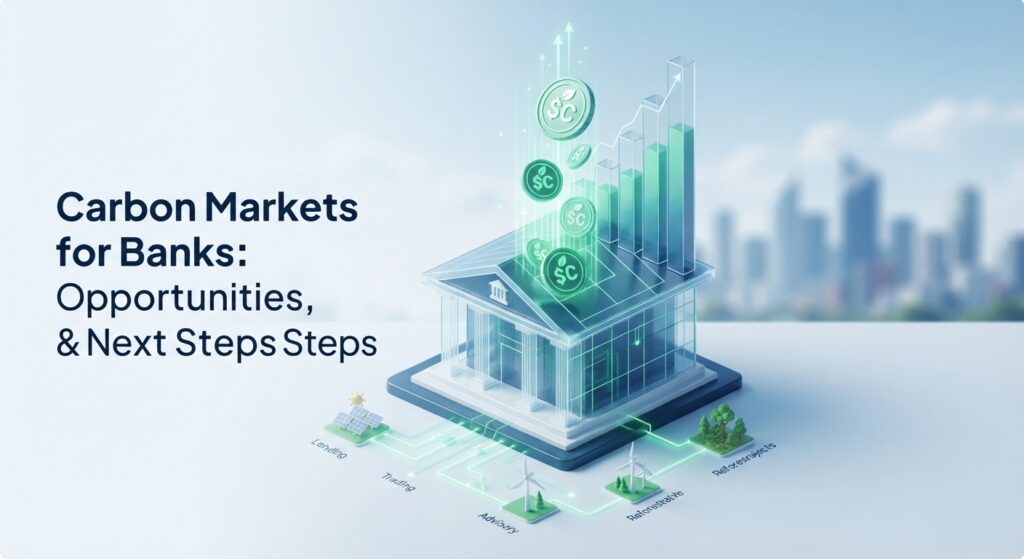
Carbon markets for banks present financial institutions with significant capital opportunities through green project lending, carbon credit trading, and sustainability advisory services. However, banks must navigate severe risks, including market price volatility, evolving cross-border regulations, and reputational greenwashing. Navigating these dynamics successfully requires building internal ESG frameworks and rigorous asset due diligence.
Carbon markets turn carbon dioxide (CO₂) emissions into tradeable commodities split into compliance and voluntary systems. For banks, these markets represent a major evolution into Carbon Markets 2.0 an era defined by high-integrity standards.
Across the global financial system, a quiet transformation is underway. This is a Silent Opportunity Banks Are Missing. Carbon markets once considered a niche climate policy tool are rapidly evolving into a multi‑billion-dollar financial ecosystem, attracting governments, corporations, and investors alike. Yet, despite their rising importance, many banks and financial institutions, especially across Africa, remain largely unaware, unprepared, or under-engaged.
This gap in awareness is not just a knowledge issue, it is a missed economic opportunity. From funding renewable energy to trading carbon credits, carbon markets are creating new revenue streams, new asset classes, and new financial instruments. For banks, this represents a shift similar to the early days of fintech or digital banking. Those who move early gain advantage. Those who delay risk falling behind. So why is awareness still low? And more importantly, how can banks catch up?
The Dawn of Carbon Banking/Understanding Carbon Markets
Climate change is no longer just an environmental debate; it is a profound macroeconomic transition. As global industries face tightening emissions targets, carbon has evolved into a formalized asset class. At the center of this transformation lies the banking sector. Financial institutions are uniquely positioned to bridge the gap between environmental necessity and capital deployment. The era of carbon banking has arrived, turning environmental compliance into a core driver of institutional liquidity and strategic growth.
Before diving deeper, let’s simplify the concept. A carbon market is a system where entities can buy and sell carbon credits, each representing the reduction or removal of carbon emissions. These credits are generated through activities such as renewable energy projects, reforestation and afforestation, methane capture and energy efficiency improvements.
For financial institutions, the key takeaway is this: Carbon markets turn environmental impact into tradable financial assets.
Why Carbon Markets For Banks Awareness Is Still Low In Banks
Despite global momentum, several structural and operational factors explain why banks, especially in emerging markets are lagging and the are:
1. Traditional Banking Focus Still Dominates
Most banks are still heavily focused on loans and credit facilities, deposits and liquidity management and foreign exchange and treasury operations. Climate finance, including carbon markets, is often seen as “non-core” or experimental. In reality, carbon finance is becoming a core financial segment, just like insurance or investment banking.
2. Knowledge Gap and Technical Complexity
Carbon markets are not straightforward. They involve measurement, Reporting, and Verification (MRV) systems, emission baselines and methodologies and international frameworks like Article 6 of the Paris Agreement. For many banks, this creates a barrier where “If we don’t fully understand it, we won’t engage.” This knowledge gap leads to low awareness at both executive and operational levels.
3. Lack of Internal Expertise and Talent
Many financial institutions do not yet have climate risk analysts, carbon trading specialists and sustainability finance teams. Without internal capacity, carbon markets remain an abstract concept rather than a business opportunity.
4. Regulatory Uncertainty in Emerging Markets
In regions like Africa, including Nigeria, carbon market frameworks are still evolving. Banks often wait for Clear regulatory rules, defined compliance obligations and government incentives. This leads to a “wait-and-see” approach, slowing adoption.
5. Perception That Carbon Markets Are Only for Governments & Corporates
A common misconception is that banks thinks that “Carbon markets are for governments or environmental organizations.” But this is incorrect because banks can play critical roles such as financing carbon projects, facilitating carbon credit trading, acting as intermediaries and developing financial products tied to carbon assets.
Why This Must Change (The Financial Opportunity)
Low awareness is not just a knowledge gap, it is a strategic risk.
1. Carbon Markets Are Becoming a Major Financial Asset Class
Carbon credits are increasingly being treated like commodities, financial derivatives and investment instruments. Banks that ignore this space risk missing the creation of a new financial ecosystem.
2. New Revenue Streams for Banks
Carbon markets unlock multiple income opportunities like:
- Trading fees from carbon credit transactions
- Advisory services for corporate clients
- Project financing for green initiatives
- Carbon-linked investment products
This is especially important for African banks seeking to diversify beyond traditional revenue sources.
3. Growing Demand from Corporate Clients
Companies are under pressure to achieve net-zero targets, ESG compliance sustainability reporting. These companies need banks to help source carbon credits, structure carbon finance deals and provide funding for emission reduction projects. Banks that are unaware cannot serve this growing demand.
4. Global Shift Toward Sustainable Finance
Sustainable finance is no longer optional, it is becoming standard. Key trends include green bonds, ESG investing, climate risk disclosure, carbon pricing. Carbon markets sit at the center of this shift.
5. Africa’s Strategic Advantage
Africa holds massive carbon potential like the forests and biodiversity (carbon sinks), renewable energy resources and agricultural carbon projects. For Nigerian and African banks, this means that carbon markets are not just global, they are local opportunities waiting to be unlocked.
How Financial Institutions Can Catch Up

The good news? Banks can move quickly if they adopt the right strategy.
1. Build Internal Awareness First
Awareness must start within the institution like executive education programs on carbon finance, internal workshops and training and integration into strategy discussions. If leadership understands it, action will follow.
2. Create Dedicated Climate Finance Units
Banks should establish teams focused on carbon markets, sustainable finance and ESG strategy. This creates ownership and accountability, turning awareness into execution.
3. Partner with Carbon Market Experts
Banks don’t need to start from scratch, they can collaborate with carbon registries, climate fintechs and international development organizations. This helps them to reduce learning curve, build credibility fast and access global networks.
4. Develop Carbon-Linked Financial Products
Innovative banks can begin offering in carbon-backed loans, green financing products, carbon investment portfolios and offset-linked banking services. This positions them as forward-thinking institutions.
5. Engage Regulators and Policymakers
Banks should not wait for regulation, they should help shape it. Active engagement ensures better policy design, early compliance readiness and competitive advantage.
6. Leverage Digital Platforms and Fintech
Technology will play a major role in carbon markets by creating a carbon trading platforms, ensuring blockchain verification systems and the provision of climate data analytics. Banks that integrate digital solutions will scale faster.
Understanding Carbon Markets (The Basics)
To effectively deploy capital, financial institutions must understand the structural division governing carbon trading.
Compliance Markets vs. Voluntary Carbon Markets (VCMs)
Carbon markets operate across two distinct ecosystems:
- Compliance Markets: Driven by mandatory national or regional regulations (such as Cap-and-Trade systems or Emissions Trading Schemes). Governments set legal caps on emissions; entities exceeding their limits must purchase allowances.
- Voluntary Carbon Markets (VCMs): Driven by corporate sustainability pledges and corporate social responsibility (CSR) initiatives. Corporations, individuals, or institutions buy carbon credits voluntarily to offset their operational footprints.
The African Landscape: Why This Matters for Regional Growth
For African banks, carbon markets represent a vital mechanism for unlocking direct foreign investment. Africa holds an immense supply of natural carbon sinks including the Congo Basin, expansive mangrove ecosystems, and vast reforestation potential. Initiatives like the African Carbon Markets Initiative (ACMI) aim to dramatically scale the continent’s credit production. Local financial institutions that master carbon economics can position themselves as primary gatekeepers for international climate finance pouring into regional projects.
The Big Opportunities for African Banks
Carbon trading opens up multi-layered revenue streams across traditional and specialized banking operations.
Financing Green: Lending for Local Carbon Removal Projects
Banks can generate robust lending pipelines by financing project developers. Providing project finance, mobilization capital, or structured loans to local initiatives such as sustainable agriculture, renewable energy generation, or reforestation, allows banks to secure long-term interest income while generating high-integrity carbon assets.
Revenue Generation: Trading, Structuring, and Market-Making
As the carbon market matures, corporate clients require liquidity. Banks can establish dedicated carbon trading desks to act as market makers. By purchasing credits in bulk, structuring portfolio derivatives, or facilitating spot-market trading, financial institutions can generate substantial fee and commission income while offering liquidity to corporate buyers and project sellers alike.
Strategic Advisory: Guiding Corporate Clients Through Net-Zero Transitions
Corporate clients across Africa face mounting pressure from international supply chains to report and reduce emissions. Banks can capitalize on this by expanding their corporate advisory arms. Offering strategic guidance on carbon asset acquisition, climate risk assessments, and portfolio decarbonization turns the bank from a simple lender into an indispensable, long-term strategic partner.
Navigating the Risks & Realities
While the financial incentives are significant, the lack of market standardization introduces critical institutional risks.
Greenwashing & Integrity: Avoiding Bad Credit Traps
The voluntary carbon market has historically suffered from transparency issues. Financing or selling low-quality, non-verifiable carbon credits exposes a financial institution to severe reputational damage and greenwashing allegations. Banks must protect their brand equity by verifying that project outcomes are real, measurable, permanent, and additional.
Regulatory Shifting: Managing Uncertain Cross-Border Compliance Rules
The legal framework governing carbon trading remains fluid. Under Article 6 of the Paris Agreement, international trading rules are constantly being renegotiated by governments. Shifting national export policies on carbon credits, changing tax implications, and evolving compliance mandates create a complex legal landscape that compliance departments must aggressively monitor.
Market Volatility: Handling Fluctuations in Carbon Pricing
Carbon credit prices are highly sensitive to corporate macroeconomic health, geopolitical policy shifts, and public perception. Unlike traditional commodities, a sudden shift in corporate demand or a regulatory adjustment can cause sharp price drops. Banks holding carbon assets on their balance sheets must implement strict market risk metrics to manage collateral volatility.
Actionable Next Steps for Financial Institutions
Transitioning into carbon banking requires a deliberate, phased approach to build operational capability without over-exposing institutional capital.
Phase 1: Building Internal ESG Expertise & Dedicated Teams
Banks should begin by establishing a dedicated Environmental, Social, and Governance (ESG) or Climate Finance unit. Up-skilling existing risk management, compliance, and asset management teams on carbon accounting frameworks ensures the institution can evaluate carbon assets accurately before deploying capital.
Phase 2: Establishing Due Diligence Frameworks for Vetting Credits
Risk teams must develop a specialized due diligence framework for carbon assets. This involves partnering with globally recognized independent registries (such as Verra, Gold Standard, or regional registries) and deploying technology like satellite monitoring to verify project performance on the ground.
Phase 3: Launching a Pilot Project (From Offsets to Green Loans)
Rather than executing large-scale structural changes immediately, banks should launch small, controlled pilot programs. This could include offering tokenized carbon offset options to retail wealth clients, or providing a green loan to an existing corporate client with interest rates tied explicitly to verifiable carbon reduction targets.
What is the role of commercial banks in the carbon market?
Commercial banks act as financial intermediaries in the carbon market by providing project financing, market liquidity, risk management derivatives, and corporate advisory services.
While project developers create carbon credits and corporations buy them to meet sustainability goals, banks bridge the gap between these two groups. Specifically, commercial banks support the ecosystem through four primary channels:
- Capital Deployment: Providing upfront debt financing, mobilization capital, or structured loans to carbon offset developers (e.g., solar farms, reforestation projects).
- Market-Making: Establishing trading desks to buy carbon credits in bulk and sell them to corporate clients, providing crucial market liquidity.
- Risk Mitigation: Structuring hedging instruments, futures, and options to protect buyers and sellers from volatile carbon price fluctuations.
- Corporate Advisory: Guiding enterprise clients through compliance requirements, emissions calculations, and strategic carbon asset acquisition.
Why are banks investing in carbon credits?
Banks are investing in carbon credits to capture new high-growth revenue streams, fulfill internal net-zero commitments, and protect their corporate lending portfolios from climate-related regulatory risks.
Institutional investment in carbon assets is driven by strategic financial necessity rather than simple philanthropy. Financial institutions are entering the asset class for three major reasons:
- Alternative Income Generation: Trading fees, structuring commissions, and interest margins from green lending represent a massive, multi-billion-dollar global growth market.
- Portfolio Decarbonization: As global regulators penalize institutions with high “financed emissions,” banks invest in carbon assets to offset the carbon footprint of their existing loan books.
- Client Retention: Major corporate banking clients are demanding carbon products. If a bank cannot facilitate carbon credit procurement, clients will move to competitors who can.
How do financial institutions value carbon assets?
Financial institutions value carbon assets based on market structural demand, project integrity metrics (additionality, permanence, and verifiability), and the underlying methodology used to generate the credit.
Unlike traditional commodities, two carbon credits representing the exact same metric ton of \(CO_{2}\) can have vastly different financial values. Banks determine pricing using three main criteria:
- Compliance vs. Voluntary Value: Credits traded under mandatory government cap-and-trade schemes (like the EU ETS) command significantly higher prices than voluntary corporate credits due to strict legal enforcement.
- Project Quality and Vintage: Credits from recent years (younger vintage) that prove strict “additionality” meaning the carbon reduction would never have happened without the project funding command premium pricing.
- Co-Benefits: Carbon removal projects that also provide socio-economic benefits to local communities, improve biodiversity, or protect regional water tables hold a higher market value.
What are the main challenges for banks entering carbon trading?
The main challenges for banks entering carbon trading are structural market fragmentation, severe reputational risks from greenwashing, and shifting cross-border regulatory frameworks.
Because carbon banking is a frontier market, compliance and risk departments face steep operational hurdles:
- Data Transparency and Integrity Traps: A lack of centralized, standardized global tracking makes it difficult to verify if a carbon project is delivering real environmental impact, exposing banks to severe greenwashing accusations.
- Volatile Regulatory Environments: Evolving global tax legalities, national carbon export bans, and ongoing negotiations surrounding Article 6 of the Paris Agreement create immense compliance uncertainty.
- Liquidity and Pricing Risks: The voluntary carbon market remains highly fragmented with low standardized standardization. This lack of transparent, real-time pricing makes it difficult for banks to manage balance sheet risk effectively.
The Nigerian Banking Opportunity
Nigeria is entering the carbon market space with strong intent. This creates a unique advantage for early movers. Banks in Nigeria can finance local carbon projects (agriculture, energy, forestry), facilitate international carbon credit transactions, support SMEs in carbon initiatives and position Nigeria as a regional carbon finance hub.
As for my readers, this is a defining moment because the same way digital banking reshaped the industry, carbon finance could define the next decade.
Read more on “Why Fintechs Are Beating Traditional Banks”
The Risk of Inaction
Banks that ignore carbon markets face real risks of loss of relevance in sustainable finance, reduced competitiveness, missed investment opportunities and failure to meet global ESG expectations
In a rapidly evolving financial world, staying unaware is no longer neutral, it is a strategic disadvantage.
Frequently Asked Questions (FAQs)
What are the two main types of carbon markets?
The two main types of carbon markets are compliance (mandatory) markets and voluntary carbon markets (VCMs). Compliance markets are regulated by national or international legal regimes (such as the European Union Emissions Trading System) that legally mandate emissions caps for specific industries. Voluntary carbon markets allow corporations, NGOs, and individuals to purchase carbon credits of their own accord to offset their operational footprints or fulfill corporate net-zero pledges.
What is the purpose of carbon markets?
The primary purpose of carbon markets is to put a monetary price on greenhouse gas emissions to financially incentivize industries to reduce their carbon footprints. By turning carbon dioxide reduction into a tradable financial asset, carbon markets make pollution an operational expense and carbon reduction a revenue stream. This mechanism effectively channels global private capital directly into sustainable projects like reforestation and renewable energy.
Where is the carbon market located?
The carbon market does not exist in a single physical location; it operates globally across decentralized digital registries, regional compliance exchanges, and over-the-counter (OTC) trading desks. Compliance carbon trading takes place on formal financial exchanges like the Intercontinental Exchange (ICE) or China’s National Carbon Emissions Trading Market. Voluntary carbon credits are issued and tracked electronically on international digital registries such as Verra and the Gold Standard.
Which country has the world’s largest carbon trading market?
China has the world’s largest carbon emissions trading market, covering approximately 8.3 billion metric tons of carbon dioxide emissions. Formally launched for online operation, China’s national carbon market regulates thousands of power generation and manufacturing enterprises. It serves as the cornerstone of the country’s domestic policy infrastructure to peak carbon emissions and achieve complete carbon neutrality.
Who is the biggest buyer of carbon credits?
Globally, the oil and gas giant Shell is the largest historical buyer of retired voluntary carbon credits, while Microsoft is the world’s largest corporate buyer of engineered carbon dioxide removal (CDR) contracts. Market transaction metrics indicate that heavy-emitting sectors like energy, aviation, and manufacturing dominate the bulk volume of traditional nature-based credits, whereas major technology firms drive the purchasing of premium, high-durability engineered carbon removal credits.
How much does 1 carbon credit sell for?
A single carbon credit—representing one metric ton of carbon dioxide equivalent sells for anywhere from less than $1 to over $1,000, depending heavily on project quality and technology type. Legacy avoidance or renewable energy credits often trade on the open market at low rates between $1 and $5. Conversely, high-integrity nature-based reforestation credits command $15 to $45, while advanced engineered solutions like Direct Air Capture (DAC) routinely trade between $400 and $1,000 per ton.
How much does 1 kg of carbon cost?
On the retail and industrial market, industrial-grade elemental carbon (such as carbon black) costs approximately $1.50 to $3.50 per kilogram, whereas the implied financial value of a kilogram of captured carbon dioxide on environmental markets ranges from $0.01 to $1.00. Environmental asset values are calculated per metric ton (1,000 kg). Breaking down environmental pricing to a smaller metric means a standard voluntary credit priced at $20 per ton values carbon dioxide at exactly $0.02 per kilogram.
Where is Carbon bank located in Nigeria?
Carbon bank operates as a 100% digital bank with no physical retail branches, but its corporate headquarters is located at Plot 642C Akin Adesola Street, Victoria Island, Lagos, Nigeria. Because its operational model is mobile-first, Nigerian customers manage their bank accounts, process transactions, and access customer service entirely through the official Carbon mobile application.
Who owns Carbon bank?
Carbon bank is owned by Carbon Microfinance Bank Limited, an independent financial technology company founded by Nigerian tech entrepreneurs and brothers, Chijioke Dozie and Ngozi Dozie. Originally launched in 2012 under the corporate identity “One Credit” and later known widely as the digital lending app “Paylater,” the institution rebranded to Carbon to expand its consumer credit model into a full-service digital retail bank.
Who is the CEO of Carbon?
The Co-founder and Chief Executive Officer (CEO) of Carbon is Chijioke Dozie. He oversees the company’s regional financial services expansion alongside his brother, Ngozi Dozie, who serves as the co-founder and managing director. Before launching the digital financial ecosystem, the executive team built extensive career foundations in international private equity and corporate investment banking.
Is the Carbon loan approved by CBN?
Yes, loans and credit facilities issued by Carbon are fully approved, licensed, and regulated by the Central Bank of Nigeria (CBN). Operating officially under the corporate entity Carbon Microfinance Bank Limited (RC 1642222), the platform adheres strictly to the apex bank’s retail lending regulations, and all customer cash deposits are securely insured by the Nigeria Deposit Insurance Corporation (NDIC).
Can I borrow money from Carbon?
Yes, qualified individuals and small business owners can instantly borrow money from Carbon without providing physical collateral or third-party guarantors. Personal digital loans accessible through the Carbon mobile app range dynamically from ₦25,000 to ₦1,000,000, featuring customizable repayment periods spanning from 61 days up to 12 months based on user creditworthiness.
How do I open a Carbon account?
To open a Carbon bank account, download the official Carbon app from the Google Play Store or Apple App Store and complete the secure digital onboarding process. Applicants must register using a valid phone number, link their Bank Verification Number (BVN) for legal identity verification, upload a clean selfie photo, and provide a valid government-issued identification document to fulfill standard regulatory KYC (Know Your Customer) requirements.
What 9 banks are sanctioned by CBN?
The 9 Deposit Money Banks (DMBs) sanctioned by the CBN with a cumulative fine of ₦1.35 billion for violating cash distribution guidelines are First Bank, Zenith Bank, United Bank for Africa (UBA), Sterling Bank, Fidelity Bank, Keystone Bank, Union Bank, Globus Bank, and Providus Bank. The apex bank imposed a mandatory penalty of ₦150 million on each institution following regulatory spot checks that confirmed their failure to process and dispense physical naira notes through automated teller machines (ATMs).
Conclusion: Leading the Green Financial Revolution
Carbon markets are reshaping the parameters of modern institutional finance. For forward-thinking financial institutions, carbon banking is a powerful mechanism to drive profitability, protect corporate client bases, and fund sustainable regional development. By taking measured, strategic steps today, banks can transition from passive observers into active leaders of the global green economic revolution.
Carbon markets are no longer a future concept, they are a present financial reality. The awareness gap in banks is understandable, but it is not sustainable. As global finance continues to shift toward sustainability, carbon markets will become deeply integrated into investment strategies, risk management, lending practices financial innovation.
For banks and financial institutions, especially in Africa, the question is no longer “Should we pay attention to carbon markets?” but rather “How fast can we understand, adapt, and lead?”
Therefore Banks should kindly take note on these key points:
1. Carbon markets convert emissions reduction into tradable financial assets
2. Awareness in banks is low due to knowledge gaps, regulation, and traditional focus
3. Opportunities include new revenue streams, product innovation, and market leadership
4. African banks are uniquely positioned to benefit from local carbon resources
5. The future belongs to financial institutions that act early and adapt quickly.